The Real Benefits of Tai Chi Walking: What Science Says About Balance and Longevity
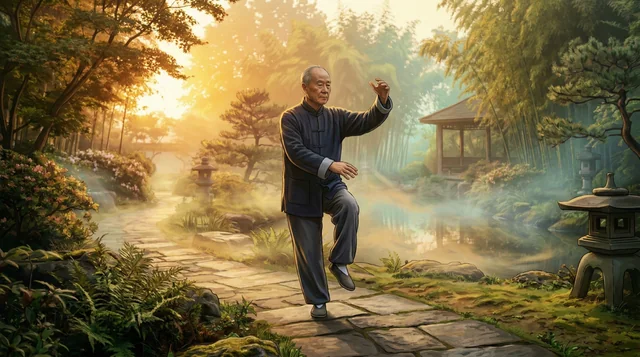
If you’ve been on social media lately, you’ve probably seen viral videos of AI-generated musclebound seniors crediting their physiques to “Tai Chi walking.” The clips have driven a massive surge of interest in this ancient practice — but with wildly unrealistic expectations.
The truth? Tai Chi walking won’t give you bulging muscles. But the real, science-backed benefits are arguably more valuable: better balance, fewer falls, reduced stress, and improved body awareness that can genuinely change how you move through daily life.
Here’s what researchers and Tai Chi instructors say you should actually expect — and how to get started.
What Is Tai Chi Walking?
Tai Chi is a traditional Chinese martial art built on complex, flowing poses called “forms” that integrate movement, breath, and mindfulness. Tai Chi walking (or Tai Chi gait) is the very first thing new students learn — it’s the most fundamental movement in the entire practice.
“It’s the most fundamental movement for Tai Chi practice,” says Feng Yang, an associate professor of biomechanics at Georgia State University who both practices and studies Tai Chi.
The difference from normal walking is dramatic. When you walk normally, you push off from one step to the next using momentum. Tai Chi walking removes the pushing entirely, slowing everything down until you have complete control of each movement. Some practitioners describe it as a “catlike walk” — slow, silent, and deliberate.
The Science-Backed Benefits
1. Dramatically Better Balance
Preventing falls requires two things: recognizing when you’re off balance and having the strength to correct course. Tai Chi addresses both by improving your proprioception — your body’s sense of where it is in space — and strengthening your leg and core muscles through controlled, weight-shifting movements.
Research shows Tai Chi can even reduce the fear of falling in older adults, an anxiety that often becomes self-fulfilling. When people are afraid of falling, they limit their movements and become weaker, which ironically increases their fall risk.
2. Reduced Fall Risk
Falls are the leading cause of injury death among adults 65 and older. Multiple studies have demonstrated that regular Tai Chi practice significantly reduces both the rate and severity of falls. While most research has examined full Tai Chi practice, a small study by Dr. Yang found that Tai Chi walking alone challenges balance more than normal walking, forcing the body to constantly stabilize itself.
3. Stress Reduction and Mental Calm
Beyond the physical benefits, Tai Chi walking functions as moving meditation. The intense focus required to control each micro-movement creates a mindfulness state that reduces anxiety and promotes mental calm. As instructor Leda Elliott puts it: “The practice is only as good as the attention you bring to it.”
4. Accessible to Nearly Everyone
Unlike some Tai Chi poses that can aggravate knee pain, Tai Chi walking generally doesn’t require much knee bending. Li Li, a kinesiology professor at Georgia Southern University, notes it’s far easier to learn than the complete practice — including for older adults with dementia or other cognitive impairments.
How to Start Tai Chi Walking
The basic Tai Chi gait is simple enough to learn from online videos, according to Dr. Yang. Here’s the step-by-step technique:
- Soften your knees and shift all your weight onto your right leg
- Pick up your left leg and place it gently in front of you, heel first
- Slowly pour all your weight into the left leg
- Lift the right heel, then the entire right leg
- Step forward without relying on any momentum
- Keep your body upright and steady — imagine balancing a teacup on your head
Start with just 2–4 steps to familiarize yourself with the movement. Keep your attention focused on every part and breathe naturally. From there, you can try stepping backward, adding weight shifts, turns, and arm motions.
Practical Tips
- Start with 2–3 minutes — that’s enough to feel the effects
- Go barefoot or wear soft-soled shoes to connect with the ground and feel weight shifts
- Practice anywhere — outside, down a hallway, or around your living room
- Focus on control, not speed — slower is harder and more beneficial
- Consider taking in-person classes if you want to learn full Tai Chi forms
What Tai Chi Walking Won’t Do
Despite what viral social media videos claim, Tai Chi walking will not:
- Build bulging muscles (it’s a balance and mindfulness practice, not strength training)
- Help you “slim down” with just 7 minutes a day of gentle exercise
- Replace your existing workout routine for cardiovascular or strength goals
Those AI-generated videos of muscular seniors are marketing fiction. The real benefits — improved balance, fall prevention, stress relief, and body awareness — are far more meaningful for long-term health.
The Bottom Line
Tai Chi walking is a genuinely beneficial practice that’s easy to learn, safe for nearly everyone, and requires no equipment or gym membership. The viral hype may be overblown, but the underlying science is solid: this slow, controlled walking technique can improve your balance, reduce your fall risk, and bring a dose of mindfulness into your daily routine.
Start with a few steps, focus on control, and see how it feels. The practice is only as good as the attention you bring to it.