Swarm Aero Raises $35M to Build Large Swarming Military Drones
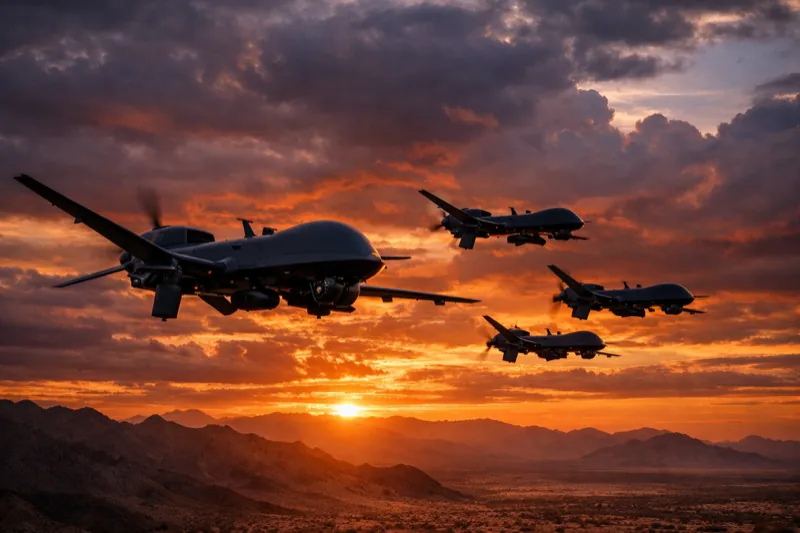
Swarm Aero Wants to Build the Drones Between Switchblade and B-2
Swarm Aero, a defense startup focused on large swarming drone systems, has raised $35 million in a Series A round. The company, led by CEO Danny Goodman, is building drones that occupy a deliberately underserved niche in the military drone market: too big and capable to be expendable like a Switchblade, but far cheaper and more numerous than exquisite platforms like the B-2 or F-35.
This follows a $22 million seed round in 2023, bringing total funding to $57 million. The company plans to use the new capital to double its headcount and accelerate production of its swarming drone systems.
What Makes Swarm Aero Different
The defense drone market has largely split into two categories: small, cheap, expendable drones (like the Switchblade loitering munition or commercial DJI drones adapted for military use) and large, expensive, reusable platforms (like the MQ-9 Reaper or RQ-4 Global Hawk). Swarm Aero is targeting the gap between them.
Their drones are designed to be:
- Large enough to carry meaningful payloads — missiles, electronic warfare equipment, cargo, or ISR (intelligence, surveillance, reconnaissance) sensors
- Cheap enough to deploy in large numbers — a swarm of 50+ drones rather than a single high-value asset
- Smart enough to coordinate autonomously — the "swarm" in Swarm Aero refers to AI-driven coordination where dozens of drones operate as a single tactical unit
- Reusable — unlike expendable munitions, these drones return to base after missions
Why Swarming Matters
The military logic is straightforward: a single F-35 costs roughly $80 million. A swarm of 50 large drones, even at $200,000 each, costs $10 million total. The swarm can cover more area, present more targets to enemy air defenses, and lose individual units without losing the mission. If an adversary shoots down 10 drones from a 50-drone swarm, the remaining 40 continue operating. Lose one F-35, and you have lost $80 million and possibly a pilot.
This is the quantity-over-quality argument that has been reshaping military thinking since Ukraine demonstrated how cheap commercial drones could neutralize equipment worth hundreds of times more. Swarm Aero is taking that lesson and building purpose-designed military systems around it.
The Applications
Swarm Aero's drones are designed for multiple mission types:
- Strike: Carrying missiles or munitions to saturate enemy air defenses
- Electronic warfare: Disrupting enemy communications and radar across a wide area
- Cargo delivery: Resupplying forward positions in contested environments
- ISR: Persistent surveillance over large areas with redundant coverage
The versatility is part of the pitch — the same drone platform can be configured for different missions, reducing the logistics burden compared to maintaining separate aircraft types for each role.
The Bottom Line
Swarm Aero's $35M raise is a bet on the idea that the future of military aviation is not fewer, better planes — it is more, cheaper, smarter drones working together. Ukraine has provided the proof of concept. The question now is whether purpose-built swarming systems can deliver on the promise before the next major conflict demands them. At $57M total funding and a doubling workforce, Swarm Aero is moving fast to find out.