Starcloud Raises $170M to Build Data Centers in Space, Hits $1.1B Valuation
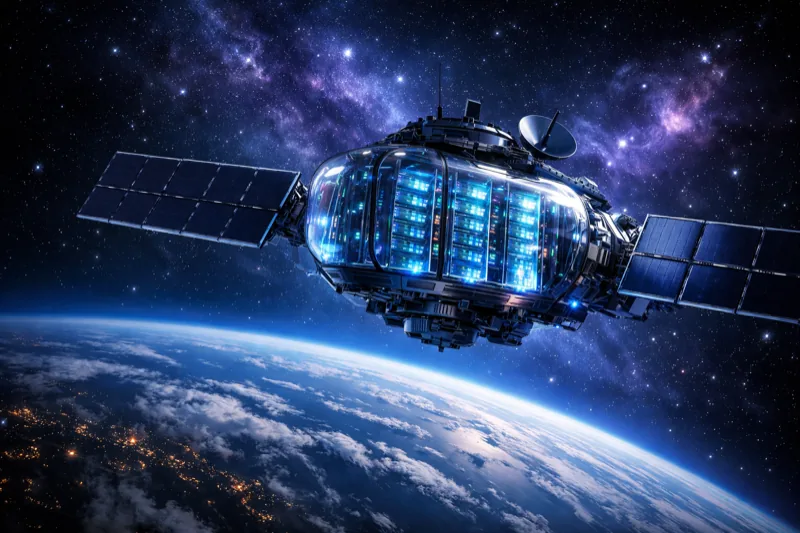
The idea of putting data centers in orbit sounds like science fiction. But Starcloud just raised $170 million to do exactly that — and they’re already the fastest Y Combinator startup to reach unicorn status, hitting a $1.1 billion valuation just 17 months after demo day.
What Starcloud Is Building
The Series A, led by Benchmark and EQT Ventures, brings Starcloud’s total funding to $200 million. The company launched its first satellite carrying an Nvidia H100 GPU in November 2025 — reportedly the first terrestrial GPU deployed in orbit. It was used to train an AI model in space, a first for the industry.
Next up: Starcloud 2, launching later this year with multiple GPUs including an Nvidia Blackwell chip, an AWS server blade, and — interestingly — a bitcoin mining computer. The company will also have the largest deployable radiator ever flown on a private satellite.
The Starship Bet
The bigger play is Starcloud 3: a 200-kilowatt, three-ton spacecraft designed to launch from SpaceX’s Starship using the same “PEZ dispenser” deployment system as Starlink satellites. CEO Philip Johnston says this will be the first orbital data center that’s cost-competitive with terrestrial facilities at around $0.05 per kWh.
The catch? Starship isn’t flying commercially yet. Johnston expects access to open in 2028-2029. Until then, smaller versions will launch on Falcon 9.
The Scale Problem
Here’s the reality check: SpaceX’s entire Starlink network of 10,000 satellites produces roughly 200 megawatts of energy. Meanwhile, data centers with more than 25 gigawatts of power are currently under construction in the US alone. The gap between orbital compute and terrestrial compute is enormous.
And there are just dozens of advanced GPUs in orbit, compared to the nearly 4 million Nvidia sold to terrestrial hyperscalers in 2025 alone.
The Competition
Starcloud isn’t alone. Aetherflux (reportedly raising at $2B valuation), Google’s Project Suncatcher, and Aethero are all developing space data center businesses. And the elephant in the room is SpaceX itself, which has applied to build and operate a million satellites for distributed compute.
The Bottom Line
Space data centers are no longer theoretical — there’s real hardware in orbit running real AI models. But the economics depend entirely on next-generation rockets that don’t exist yet. Starcloud is betting that by the time Starship flies commercially, they’ll have years of hard-won operational knowledge that nobody else has. Whether that head start is worth $1.1 billion is the billion-dollar question.