SpaceX Is Warning Investors Its Orbital AI Data Centers Are Unproven — That Should Tell You Something
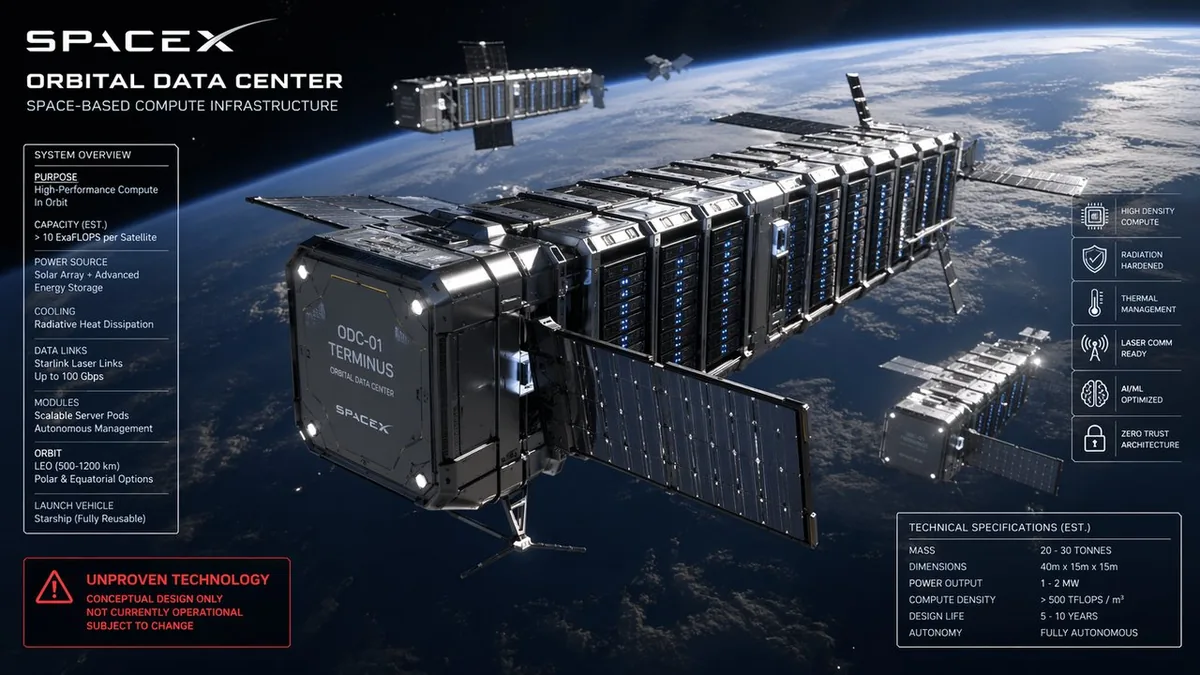
SpaceX has warned investors that orbital AI data centers — a concept generating serious hype in venture capital circles — remain unproven technology with no clear commercial path. Coming from the company that built the orbital infrastructure, this warning deserves more attention than it's getting.
What SpaceX Actually Said
In investor communications, SpaceX flagged that running AI compute in orbit faces major unsolved problems: power generation in space is expensive per watt, heat dissipation without convective cooling requires costly engineering, and launch economics haven't improved enough to make orbital compute competitive with ground-based data centers.
This is notable because SpaceX has the most credible position to make orbital compute work. If they're skeptical, everyone else pitching orbital AI infrastructure should lower their voice several decibels.
The Ground-Level Reality
The AI compute race has driven enormous investment in terrestrial data centers — and even those are struggling badly. 40% of US data centers due in 2026 are already facing significant delays. Some investors have floated orbital infrastructure as an alternative path. SpaceX's own warning suggests that's venture capital storytelling, not engineering reality.
Meanwhile SpaceX keeps making ambitious non-space bets — like its reported option to acquire AI coding tool Cursor for $60 billion.
My Take
Orbital data centers are a great pitch deck concept that doesn't survive contact with physics. You need massive solar arrays to power compute, and you generate massive heat with zero convective cooling available. SpaceX telling investors this is unproven isn't pessimism — it's accurate. The companies solving the actual AI infrastructure problem are building on the ground.
Frequently Asked Questions
What are orbital AI data centers?
The concept of placing computing hardware in satellites to process AI workloads in orbit, reducing latency for satellite-based applications.
Why would orbital compute theoretically be useful?
For Earth observation AI or satellite communications, local orbital processing avoids sending raw data to ground stations — reducing latency and bandwidth costs.
What are the main technical challenges?
Power generation costs per watt, heat dissipation without convective cooling, high launch costs, and the impossibility of on-orbit maintenance.