Sony's AI Ping Pong Robot Just Beat Elite Human Players — and That's Not the Surprising Part
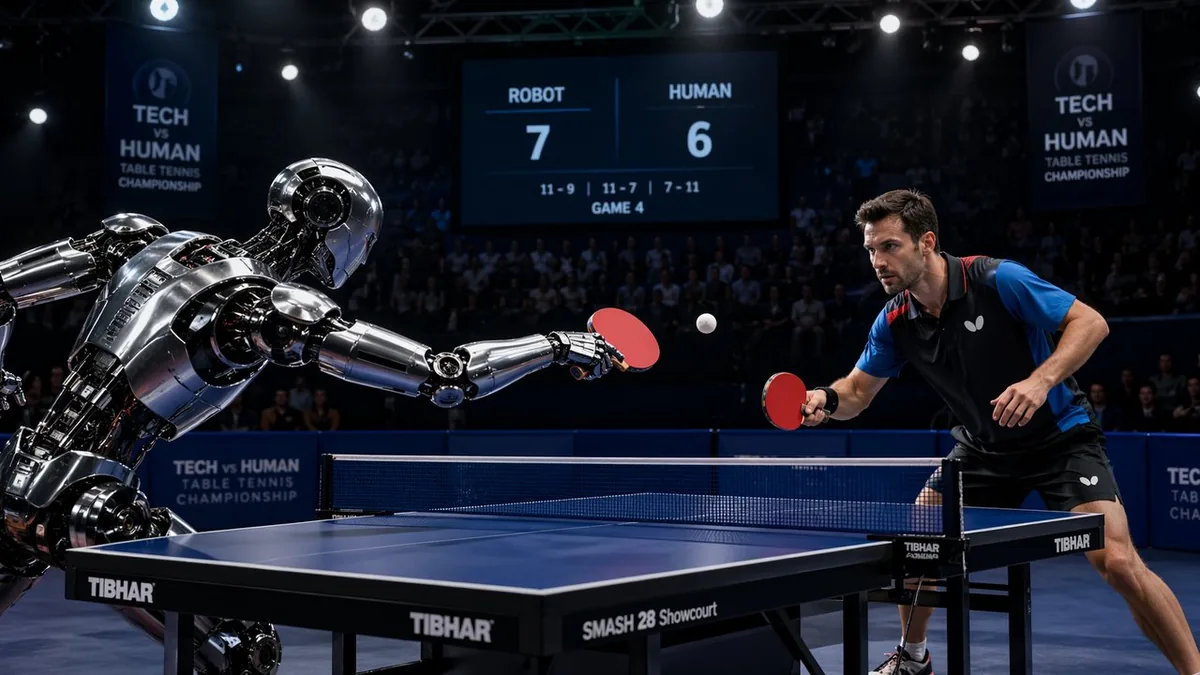
Sony AI's autonomous ping pong robot, named Ace, just beat elite human players in competitive table tennis. If that sounds like a stunt, it isn't — or at least, it isn't only a stunt. The technical achievement involved solving one of the hardest real-time control problems in robotics: reacting to unpredictable spin, speed, and placement at sub-second intervals, against humans who have spent years developing muscle memory and strategic instinct. Ace did it. And it raises questions worth taking seriously.
What's Actually Happening
Sony AI developed Ace as a research platform for autonomous physical agents. The robot uses a combination of computer vision, real-time trajectory prediction, and high-speed motor control to return shots and win rallies against expert-level players. Reuters reported the system achieved "expert-level performance" in matches against top human competitors — not just returning balls, but playing with strategy.
This isn't the first AI to beat humans at games — chess, Go, and StarCraft are well-documented. But those are digital. Ace operates in the physical world, with all the noise, latency, and unpredictability that entails. That's a categorically harder problem.
Why It Matters
Table tennis might seem trivial, but the underlying capabilities are not. Real-time physical prediction, precise motor control under uncertainty, and adaptive strategy against an unpredictable opponent are exactly the skills that translate to industrial robotics, warehouse automation, and eventually humanoid robots operating in unstructured environments.
Sony is making a strategic bet that physical AI — robots that navigate and interact with the real world — will be as transformative as digital AI. Ace is both a research milestone and a demonstration of where Sony's robotics ambitions are pointed. For context on how the broader AI hardware race is playing out, see our coverage of Google's latest TPU hardware.
My Take
The achievement is real and genuinely impressive. But I'd push back on the narrative framing of "robot beats human" as if it's the end of something. Table tennis robots and chess computers prove that machines can optimize specific tasks beyond human capability. What they don't prove is general physical intelligence — the ability to transfer that skill to a new environment or problem.
Ace can beat you at ping pong. It cannot pack your groceries, navigate a crowded street, or help an elderly person get out of a chair. Those tasks require the kind of adaptive physical reasoning that's still decades away from being solved. The gap between "beats elite player at one physical game" and "useful in the real world" remains enormous. Don't let the headlines obscure that.
FAQ
How does Ace work? It uses high-speed cameras for real-time vision, AI models to predict ball trajectory, and precision actuators to execute shots — all within milliseconds of the ball leaving the opponent's paddle.
Is this a commercial product? No — Ace is a research platform, not a consumer or industrial product. Sony AI uses it to advance autonomous physical agent research.
What's the significance beyond ping pong? The real-time physical control capabilities developed for Ace have applications in industrial robotics, precision manufacturing, and humanoid robot development.
Can Ace beat a world champion? Sony hasn't claimed world-champion level yet. "Elite human players" suggests high-level competition, but the gap between top-10 and world number one in table tennis is significant.