SoftBank and DOE Partner to Build 10 GW AI Data Center on Former Nuclear Site in Ohio
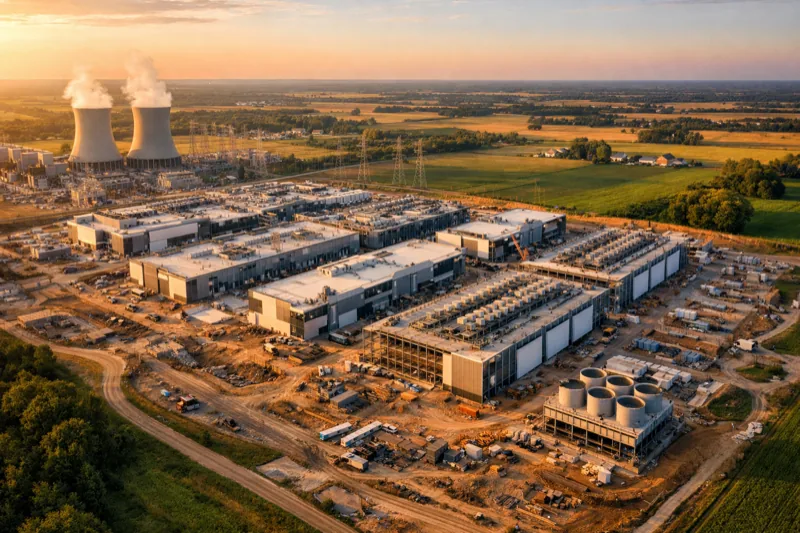
The U.S. Department of Energy has unveiled one of the most ambitious AI infrastructure projects to date: a 10-gigawatt data center built on the site of a decommissioned uranium enrichment plant in Piketon, Ohio, in partnership with SoftBank Group and its affiliate SB Energy.
From Nuclear to Neural Networks
The Portsmouth Gaseous Diffusion Plant, now rebranded as the "PORTS Technology Campus," will host the massive data center alongside up to 10 gigawatts of new power generation. The bulk of that power — 9.2 gigawatts — will come from natural gas generation, raising immediate questions about the environmental impact of powering AI with fossil fuels.
The project includes $33.3 billion in Japanese funding tied to the natural gas generation component, part of the U.S.-Japan Strategic Trade and Investment Agreement. SoftBank, through SB Energy, is partnering with AEP Ohio to build the power generation and transmission infrastructure, including a $4.2 billion investment in grid upgrades.
Scale and Ambition
To put 10 gigawatts in perspective, that is enough electricity to power roughly 7.5 million homes. The project connects to SoftBank's broader Stargate initiative — a collaboration with OpenAI and Oracle aimed at building massive U.S. data center capacity with a potential $500 billion in total investment.
Energy Secretary Chris Wright, Commerce Secretary Howard Lutnick, and Interior Secretary Doug Burgum visited Piketon for the announcement, with Wright stating the project would "add power generation, create jobs, and ensure the United States wins the AI race."
Local Opposition Growing
Not everyone is celebrating. Rural Ohio residents have filed a petition to put a constitutional ban on mega data centers on the statewide ballot. Ohio already ranks fifth in the nation for data centers with about 200 sites, and locals are increasingly concerned about the environmental, financial, and societal costs of AI infrastructure.
The Bottom Line
There is something deeply ironic about building the future of AI on the ruins of Cold War nuclear infrastructure — and powering it with 9.2 gigawatts of natural gas. SoftBank and the DOE are betting big that AI dominance matters more than climate commitments. Whether Ohio residents agree is another question entirely.