Global Smartphone Shipments to Hit Record Low in 2026 as AI Memory Demand Drives Prices Up
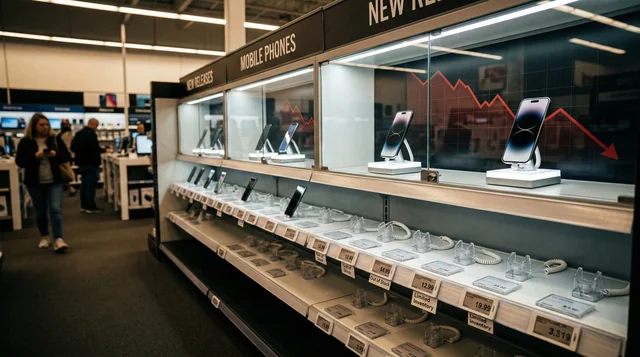
AI Is Making Your Next Phone More Expensive
The global smartphone market is heading for its worst year in over a decade, and the culprit isn’t weak consumer demand — it’s artificial intelligence. According to a new IDC report, worldwide smartphone shipments will decline 12.9 percent year-on-year in 2026 to just 1.1 billion units, the lowest annual volume in more than ten years.
The root cause: AI’s surging demand for memory chips has created a global shortage that’s rippling through the entire electronics supply chain. Phone makers can’t get enough DRAM and NAND flash at reasonable prices, and the squeeze is hitting hardest where margins are thinnest.
The $100 Smartphone Is Effectively Dead
The most striking number in IDC’s forecast isn’t the shipment decline — it’s the price increase. Average selling prices are expected to jump 14 percent to a record $523 this year, even as shipments crater. IDC’s Nabila Popal calls this a “structural reset” rather than a temporary blip, noting that the sub-$100 smartphone segment is becoming “permanently uneconomical.”
That’s a seismic shift for billions of people in developing markets who depend on affordable smartphones for internet access, banking, and communication. The Middle East and Africa face the steepest drop at 20.6 percent, while Asia Pacific (excluding Japan and China) is expected to decline 13.1 percent.
Winners and Losers: Apple and Samsung Pull Ahead
Not everyone loses equally in a supply crunch. IDC notes that Apple and Samsung are “better positioned to navigate this crisis” thanks to their scale, supplier relationships, and higher-margin product lines. When components get expensive, companies selling $1,000 phones absorb the cost more easily than those selling $150 phones.
The forecast predicts industry consolidation, with smaller budget-focused Android brands either exiting the market or seeing sharp shipment declines. Francisco Jeronimo, IDC’s VP for Worldwide Client Devices, put it bluntly: vendors at the low end “will have no choice but to pass the costs on to end users.”
When Does It Get Better?
IDC expects memory prices to stabilize by mid-2027, but here’s the catch — they won’t return to previous levels. The market should see a modest 2 percent recovery in 2027, followed by a stronger 5.2 percent rebound in 2028. But the structural damage to the budget segment may be permanent.
The irony is hard to miss: the AI revolution that’s supposed to make technology more accessible is actually making the most basic piece of technology — a smartphone — harder and more expensive to obtain for the people who need it most.