Skyryse Funding Signals a Safer Future for Automated Flight
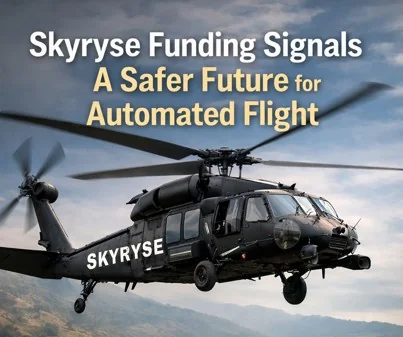
Skyryse Funding Signals a Safer Future for Automated Flight
Aviation startup Skyryse has secured more than $300 million in fresh funding. On the surface, it’s another big-ticket venture round. Look closer, and it signals something far more important: the aviation industry is inching toward a future where flying is dramatically safer, simpler, and less dependent on pilot perfection.
This matters not just to investors or pilots, but to anyone who relies on helicopters for emergency care, defense, or transport. Automation in the sky is no longer theoretical—it’s being certified, funded, and deployed right now.
Key Facts: What Happened and Why It’s Notable
Skyryse is an El Segundo, California–based aviation automation startup founded in 2016. The company recently raised over $300 million in a Series C round led by Autopilot Ventures, pushing its valuation to approximately $1.15 billion and officially making it a unicorn.
The new capital brings Skyryse’s total equity funding to more than $605 million. It will primarily support two efforts: completing Federal Aviation Administration (FAA) certification and expanding deployment of its operating system, SkyOS, across more aircraft—including U.S. military Black Hawk helicopters.
Skyryse already works with emergency medical services, law enforcement agencies, private operators, and defense partners. Its system is designed to make flying easier and safer without removing the pilot from the cockpit.
Why Skyryse Funding Matters Beyond the Headlines
The real story behind Skyryse funding isn’t the valuation—it’s the shift in how aviation thinks about risk.
Helicopters are among the most difficult and dangerous aircraft to operate. They demand constant attention, precise coordination, and fast decision-making under pressure. Skyryse attacks this problem at its root by automating the most complex and error-prone tasks, such as hovering, emergency landings, and engine-out scenarios.
This reflects a larger trend: aviation automation startup innovation is moving away from full autonomy and toward pilot augmentation. Instead of replacing humans, systems like SkyOS act as safety multipliers, reducing cognitive load and preventing catastrophic mistakes.
For regulators, this approach is easier to approve. For operators, it’s easier to trust. And for pilots, it’s a tool—not a threat.
How SkyOS Changes Helicopter Flight Automation
Skyryse’s SkyOS flight system replaces dozens of traditional mechanical controls—gauges, switches, and levers—with a streamlined digital interface powered by multiple flight computers.
Key capabilities include:
-
Automated takeoff and landing
-
Fully automated hover
-
Engine-out emergency landings
-
Touchscreen-based flight inputs
Importantly, SkyOS is not fully autonomous. A pilot remains in control at all times, but the system handles the most dangerous edge cases where human reaction time and stress often lead to accidents.
According to the company, the system can be operated with “a literal swipe of the finger,” a simplicity that has already attracted partners like United Rotorcraft, Air Methods, and Mitsubishi Corporation.
FAA Certification: The Quiet but Critical Milestone
One of the least flashy but most important parts of the Skyryse story is FAA certification.
Last year, the FAA granted final design approval for SkyOS flight control computers. What remains is formal flight testing and verification—the final hurdle before full certification.
Why does this matter? Because FAA approval doesn’t just validate Skyryse’s technology; it sets a precedent. Once certified, similar helicopter flight automation systems will face a clearer regulatory path, accelerating innovation across the industry.
This is how change happens in aviation: slowly, carefully, and then all at once.
What Comes Next for Skyryse and the Industry
Looking ahead, Skyryse funding positions the company to expand well beyond helicopters. The underlying idea—software-defined flight controls that enhance safety—can be applied to many aircraft types.
Likely next steps include:
-
Full FAA certification of SkyOS
-
Wider adoption across emergency and military fleets
-
Gradual expansion into commercial and private aviation
For operators, the practical takeaway is clear: automation that improves safety without eliminating pilots is becoming the industry standard. For investors, it’s a signal that regulated, hardware-heavy sectors like aviation are finally ripe for software-driven disruption.
Conclusion: Automation as the New Safety Baseline
Skyryse funding isn’t just a win for one startup—it’s a milestone for aviation itself. By focusing on simplicity, pilot support, and safety-first automation, Skyryse is helping redefine what “modern aircraft” really means.
As certification progresses and adoption grows, systems like SkyOS may soon become as expected in cockpits as autopilot is today. The future of flight isn’t pilotless—it’s smarter, safer, and increasingly software-powered.
FAQ SECTION
Q: What does Skyryse actually automate?
A: Skyryse automates the most complex and dangerous parts of flying, including hovering, takeoff, landing, and emergency engine-out landings. Pilots remain in control, but the system reduces workload and risk during high-stress situations.
Q: Is SkyOS a fully autonomous flight system?
A: No. SkyOS is not fully autonomous. A pilot is always required. The system is designed to assist and enhance pilot performance, not replace human decision-making.
Q: Why is FAA certification such a big deal for Skyryse?
A: FAA certification validates the safety and reliability of Skyryse’s technology. It also clears the way for broader commercial adoption and sets regulatory precedent for future aviation automation systems.
Q: Who is using Skyryse technology today?
A: Skyryse works with emergency medical services, law enforcement, private operators, and the U.S. military. It has also integrated SkyOS into Black Hawk helicopters.