Saturn's Rings Disappear in Rare Edge-On Alignment: What You Need to Know
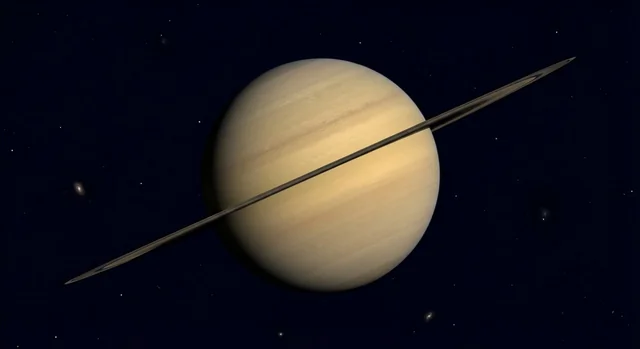
One of the most stunning sights in our solar system—Saturn's magnificent rings—is playing a cosmic disappearing act. On November 23, 2025, skywatchers around the world witnessed a rare astronomical event called a ring-plane crossing, where Saturn's iconic rings seemingly vanish from view. But don't worry—this is just an optical illusion, and the rings will be back.
What's Happening to Saturn's Rings?
Saturn's rings aren't actually disappearing. Instead, we're experiencing a rare moment when Earth's viewing angle aligns perfectly with the edge of Saturn's ring system. This phenomenon, known as a ring-plane crossing, happens when we see the rings edge-on rather than from above or below.
The event reached its peak on November 23, 2025, at 7 p.m. Eastern time, when the rings appeared at their narrowest. During this alignment, the rings reflect very little sunlight toward Earth, making them nearly invisible even through powerful telescopes.
Why Do Saturn's Rings Seem to Vanish?
Saturn's rings are one of nature's most deceptive illusions. While they stretch an impressive 280,000 kilometers (170,000 miles) across—wide enough to fit nearly two Earths side by side—they're incredibly thin. In most places, the rings are only about 10 meters (30 feet) thick. That's roughly the height of a three-story building.
To put this in perspective, if Saturn's rings were the size of a football field, they'd be thinner than a sheet of paper. When viewed edge-on, this razor-thin profile reflects so little light that the rings essentially disappear from our view.
The Science Behind Ring-Plane Crossings
Ring-plane crossings occur because of Saturn's tilted axis. Like Earth, Saturn is tilted on its axis—by 26.7 degrees to be exact. As Saturn orbits the Sun, which takes 29.4 Earth years, this tilt causes the rings to appear at different angles from our perspective on Earth.
Sometimes we see the rings from above, sometimes from below, and twice during Saturn's orbit around the Sun, we see them exactly edge-on. These edge-on views happen during Saturn's equinox, when the Sun shines directly over the planet's equator and, consequently, directly over the rings.
Because Earth and Saturn are both moving in their respective orbits, ring-plane crossings from Earth's perspective happen roughly every 13 to 15 years—about twice per Saturnian year.
A Brief History of Saturn's Disappearing Rings
This isn't the first time Saturn's rings have pulled their vanishing act. The phenomenon has been observed since the invention of the telescope. In fact, Galileo Galilei, who first observed Saturn in 1610, was puzzled when the "handles" he saw on either side of the planet (actually the rings) disappeared in 1612 during a ring-plane crossing.
More recently, ring-plane crossings occurred in 1995-1996 and 2009. The 1995-1996 event was particularly significant for astronomers, who used the opportunity to discover several new moons of Saturn. Between 1655 and 1980, 13 of Saturn's moons were discovered during ring-plane crossings, when the rings' absence made it easier to spot faint objects near the planet.
The 2025 Events: Two Chances to Witness History
The 2025 ring-plane crossing actually consisted of two events. The first occurred on March 23, 2025, but unfortunately, Saturn was too close to the Sun at that time, making it impossible to observe from Earth. The November 23 event provided a much better viewing opportunity for amateur astronomers and space enthusiasts.
However, viewers needed patience and the right equipment. Even at its best, the edge-on rings are extremely challenging to see, requiring a good telescope and clear, dark skies.
When Will We See Saturn's Rings Again?
The good news is that Saturn's rings are already starting to "reappear" from our perspective. As Earth and Saturn continue their orbital dance, our viewing angle will gradually change, and the rings will become increasingly visible over the coming months and years.
The absolute best viewing will come in 2032, when Saturn's rings will be tilted at their maximum angle as seen from Earth, providing spectacular views for anyone with a telescope. Mark your calendars—it'll be worth the wait!
The next ring-plane crossing won't occur until 2038, and that event promises to be even better positioned for observation than the November 2025 occurrence.
Why Ring-Plane Crossings Matter to Science
Beyond their visual spectacle, ring-plane crossings offer valuable scientific opportunities. When the bright rings disappear from view, astronomers can more easily detect faint objects near Saturn, including small moons and moon fragments that would otherwise be lost in the glare of the rings.
These events also allow scientists to measure the exact thickness of the rings more accurately and study how ring particles behave during the transition. NASA's Hubble Space Telescope and other observatories take advantage of these rare alignments to gather data that helps us better understand the composition and dynamics of Saturn's ring system.
Frequently Asked Questions
Are Saturn's rings really disappearing?
No, Saturn's rings are not actually disappearing. This is an optical illusion that occurs when Earth's viewing angle aligns with the edge of Saturn's extremely thin rings. The rings are still there; we just can't see them well from our perspective.
How often do Saturn's rings disappear?
Ring-plane crossings happen approximately every 13 to 15 years from Earth's perspective. This occurs twice during Saturn's 29.4-year orbit around the Sun, during the planet's equinoxes.
How thin are Saturn's rings?
Saturn's rings are remarkably thin—only about 10 meters (30 feet) thick in most places. Despite stretching 280,000 kilometers (170,000 miles) across, they're proportionally thinner than a sheet of paper.
Can I see Saturn's rings disappear with my own eyes?
No, you need a telescope to see Saturn's rings. Even during normal viewing conditions, the rings are only visible through telescopes. During a ring-plane crossing, they become even more challenging to observe and require a good-quality telescope and excellent viewing conditions.
When will Saturn's rings look their best?
Saturn's rings will be at their maximum tilt as seen from Earth in 2032, providing the best views for the next several years. This will be an excellent time for amateur astronomers to observe and photograph the ringed planet.
What are Saturn's rings made of?
Saturn's rings are made primarily of water ice particles, ranging in size from tiny grains to house-sized chunks. The rings also contain some rocky material and dust. The ice reflects sunlight brilliantly, which is why the rings appear so bright when tilted toward Earth.
When is the next ring-plane crossing?
The next ring-plane crossing will occur in 2038. Unlike the November 2025 event, the 2038 crossing is expected to be very well positioned for observation from Earth, providing excellent viewing opportunities.
Did Galileo discover Saturn's rings?
Galileo Galilei was the first to observe Saturn's rings in 1610, but he didn't recognize them as rings. He thought they were two separate objects or "handles" on either side of Saturn. When the rings disappeared during the 1612 ring-plane crossing, Galileo was completely puzzled by their vanishing act.