Samsung Z TriFold Explained: Why This 3-Panel Foldable Changes Everything
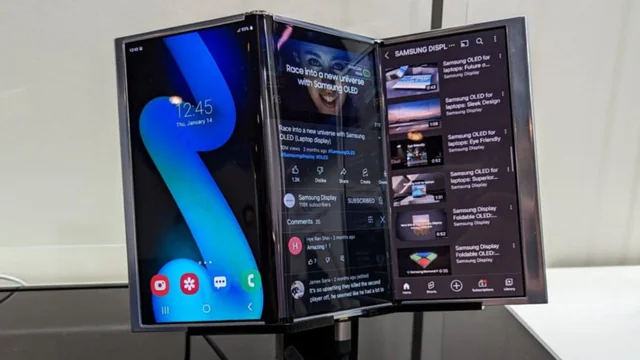
Samsung’s New Z TriFold: A Bold Step Toward the “All-in-One” Future of Mobile Computing
Foldables have evolved quickly, but Samsung’s newly announced Z TriFold represents the most significant shift in the category since the original Galaxy Fold. Rather than simply upgrading a hinge or refining durability, Samsung is betting on a transformative idea: your phone, tablet, and mini-laptop should be one device—no compromises.
Launching first in South Korea on December 12, with a U.S. release slated for early 2026, the Z TriFold may be one of the first consumer devices that genuinely redefines how we think about “mobile.”
Below, we break down what’s new, why it matters, and whether this device hints at the next era of portable tech.
What Samsung Actually Announced (The Short Version)
Samsung unveiled the Z TriFold, a foldable with two hinges and three display panels. Once fully opened, it morphs into a 10-inch tablet-sized screen with a smooth 120Hz adaptive refresh rate. Fold it again, and you get a familiar 6.5-inch smartphone front display.
Key specs include:
-
10-inch inner screen, 2160×1584 resolution, 1–120Hz adaptive refresh
-
6.5-inch outer display, 1080p with 21:9 ratio
-
Triple rear cameras: 200MP main + 12MP ultrawide + 10MP telephoto
-
Dual 10MP selfie cameras (inner + cover)
-
Snapdragon 8 Elite for Galaxy, 16GB RAM
-
5,600mAh battery split across the three panels
-
IP48 water resistance
-
Price in Korea: KRW 3,590,400 (~$2,500 for 512GB)
The most surprising omission?
No S Pen support, despite the massive screen real estate.
Why the Z TriFold Actually Matters (The Bigger Picture)
Samsung isn’t just launching another foldable—they’re testing an entirely new category:
“Ultra-portable hybrid devices.”
Here’s why this is a big deal.
1. Samsung Is Pushing Toward a Post-Laptop Future
The ability to run three apps side-by-side or use Samsung DeX without an external monitor turns the Z TriFold into something more ambitious than a tablet or phone.
For many users—especially creators, travelers, remote workers—this could replace:
-
Tablets
-
Ultralight laptops
-
Secondary travel devices
This is the first foldable that genuinely feels like it could serve as a primary productivity hub, not a novelty screen that happens to bend.
2. The Engineering Leap Is Bigger Than the Marketing
Two hinges mean double the failure points, yet Samsung claims:
- 200,000 folding cycles—equivalent to 100 folds a day for 5 years.
That’s a necessary benchmark if foldables want to transition from “cool tech” to “daily-driver.”
The mix of ceramic-reinforced polymer backing, titanium hinge housing, and three-battery layout shows Samsung isn’t treating this as an experiment—it’s treating it as a flagship.
3. The Thick-but-Functional Debate Begins
At 12.9mm folded, the TriFold is thick—significantly more than a standard smartphone.
But here’s the context most headlines skip:
-
Huawei’s Mate XT is almost the same thickness.
-
You’re essentially carrying a tablet + phone + laptop-lite in one device.
-
Most users willingly tolerate thickness if it replaces multiple gadgets.
Consumers will quickly decide whether that trade-off is worth the convenience.
4. The Missing S Pen Says a Lot About Samsung’s Priorities
S Pen support was once a bragging point for the Fold series. Dropping it on the TriFold suggests:
-
The digitizer layer may compromise durability
-
Optimizing the hinges took priority
-
Samsung wants to perfect the form factor before layering more tech on top
Expect S Pen compatibility to return, but not until Samsung solidifies this design.
Our Take: Is the Z TriFold the Future—or Just a Fancy Prototype?
The TriFold isn’t just a device—it’s a thesis statement.
Samsung believes:
-
Screens will get bigger
-
Devices will get more modular
-
Productivity will merge with mobility
-
And the smartphone will eventually become a workstation
Early adopters and power users will adore it.
Mainstream consumers? Not yet.
But the direction is clear:
We’re inching closer to the day when your phone unfolds into your only computer.
And the Z TriFold is the strongest hint yet of that future.
Conclusion
Samsung’s Z TriFold may look like a niche ultra-premium gadget today, but history shows that once Samsung experiments publicly, the industry follows. From multi-window multitasking to edge displays to the original Fold—these ideas start high-end and eventually shape the mainstream.
This device isn’t just another announcement—it’s the next blueprint.