Samsung Galaxy S26 Prices Set to Rise as AI Chip Demand Devours Memory Supply
Why Your Next Samsung Phone Will Cost More
If you were hoping the Samsung Galaxy S26 series would hold the line on pricing, prepare for disappointment. Multiple industry reports now confirm that Samsung's next flagship lineup will see notable price increases across all models, and the culprit isn't what you might expect — it's artificial intelligence.
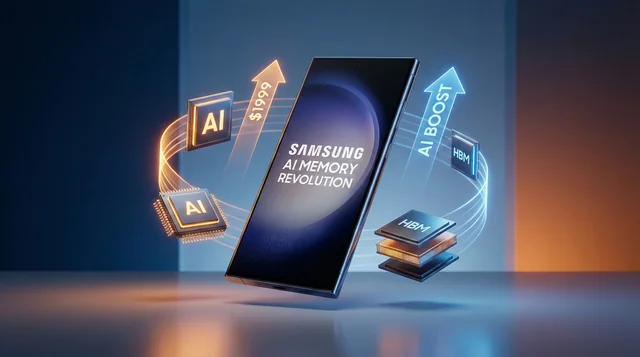
The surging demand for High Bandwidth Memory (HBM) chips from AI companies like NVIDIA, Google, and Microsoft has created an unprecedented squeeze on the global memory market. Samsung, the world's largest memory chip manufacturer, is now caught in an ironic bind: its own semiconductor division is so busy supplying AI data centers that it can't secure cheap memory for its own smartphones.
The AI Memory Chip Connection
Here's how the economics work. HBM chips — the specialized memory used in AI training GPUs — are manufactured on the same production lines as the LPDDR5X memory that goes into smartphones. As AI companies place massive orders for HBM (which commands 3-5x higher margins than standard mobile memory), Samsung's foundries are prioritizing those lucrative contracts.
The result? Less production capacity for smartphone-grade memory, which drives up costs. Industry analysts estimate that LPDDR5X pricing has risen 15-20% year-over-year, and those costs are being passed directly to consumers.
What to Expect from Galaxy S26 Pricing
According to reports from 9to5Google and Korean industry sources, here's what the Galaxy S26 lineup pricing could look like:
- Galaxy S26: Expected to start at $849-$899 (up from $799)
- Galaxy S26+: Likely $1,049-$1,099 (up from $999)
- Galaxy S26 Ultra: Could reach $1,349-$1,399 (up from $1,299)
That's roughly a $50-$100 increase across the board, with the Ultra model potentially crossing the $1,400 threshold for higher storage configurations.
It's Not Just Memory — Other Factors at Play
While AI-driven memory costs are the primary driver, several other factors are contributing to the price hike:
- Snapdragon 8 Elite Gen 2 pricing: Qualcomm's next-generation chipset is expected to cost more due to advanced 3nm manufacturing
- Display technology: Samsung is reportedly upgrading to brighter, more efficient LTPO panels with improved outdoor visibility
- On-device AI features: Galaxy AI is expanding significantly, requiring more RAM (potentially 16GB base) and storage
- Tariffs and trade policies: Ongoing US-China trade tensions continue to add uncertainty to component supply chains
The Bigger Picture: AI Is Making Everything More Expensive
Samsung's Galaxy S26 pricing situation illustrates a broader trend that's rippling across the consumer electronics industry. The AI boom isn't just changing how we use technology — it's fundamentally reshaping the economics of hardware manufacturing.
When NVIDIA orders millions of HBM chips for its H200 and B200 GPUs, that capacity has to come from somewhere. Samsung, SK Hynix, and Micron are all redirecting their most advanced fabrication capacity toward AI memory, leaving less room for consumer devices.
This isn't limited to Samsung phones either. Apple, Google, and other smartphone makers are facing similar memory cost pressures. The difference is that Samsung, as both a memory manufacturer and a phone maker, feels the tension most acutely.
The Bottom Line
The Samsung Galaxy S26 price increase is a direct consequence of the AI revolution eating into global memory chip supply. Your next premium smartphone is more expensive not because of what it can do for you, but because of what AI data centers need to function. It's a stark reminder that the AI boom has real-world costs that extend far beyond Silicon Valley — all the way to your wallet.
For consumers, the message is clear: if you're planning to upgrade, budget accordingly. The days of flagship Android phones staying under $800 may be behind us for good.