Rivian Software Strategy: Why 2026 Could Be the Turn
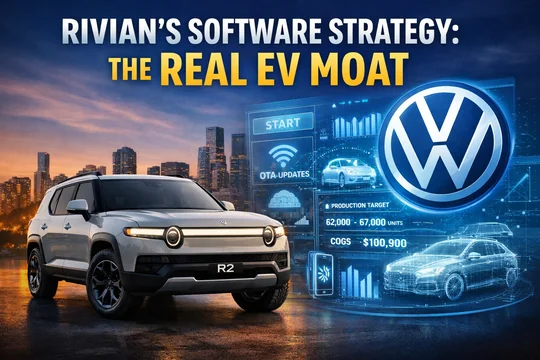
Rivian’s Software Strategy: The Real EV Moat
Rivian’s latest earnings revealed something that’s easy to miss if you only look at vehicle deliveries: Rivian’s biggest advantage in 2025 wasn’t hardware—it was software.
And that matters, because Rivian is heading into its most important year yet.
The company is preparing to launch the lower-cost R2 SUV, and this is the moment where Rivian either proves it can scale profitably… or stays stuck in the expensive niche-EV corner.
Let’s break down what the numbers actually say, what the Volkswagen partnership really means, and why the R2 might be the make-or-break product for Rivian’s future.
Key Facts From Rivian’s Earnings (The Short Version)
Here are the essential takeaways from the report:
-
Rivian delivered 42,247 vehicles in 2025 across its R1 lineup and its electric delivery vans.
-
Rivian says its automotive cost of goods sold (COGS) per vehicle dropped to $100,900 in 2025, down from $110,400 in 2024.
-
The company expects to deliver 62,000 to 67,000 vehicles in 2026, which could be a major year-over-year jump.
-
Rivian’s software and its joint venture with Volkswagen Group was positioned as a major financial lifeline, with another $2 billion expected in 2026.
-
Rivian’s stock jumped sharply after earnings, driven by optimism about demand and production ramp.
Why Rivian’s Software Strategy Matters More Than Ever
Here’s the uncomfortable truth: EV manufacturing is brutally expensive, especially for smaller automakers.
Rivian’s COGS per unit is still extremely high. Even after improvements, a cost around $100,900 per vehicle suggests Rivian is still fighting the math on every sale.
So why did investors get excited?
Because Rivian’s software strategy hints at something bigger than selling trucks.
Software is becoming the real profit engine in EVs
In the early EV era, companies competed on range and battery specs. Now, the competition is shifting toward:
-
vehicle operating systems
-
driver assistance platforms
-
connected services
-
over-the-air updates
-
fleet and diagnostics software
That’s exactly where Rivian’s Volkswagen partnership becomes so important.
The Volkswagen Deal Isn’t Just Funding—It’s Validation
The Rivian Volkswagen joint venture isn’t just “extra money.”
It’s a major signal that a legacy automaker sees Rivian as valuable beyond its vehicles.
Volkswagen doesn’t need Rivian’s trucks. What it wants is what Rivian has been quietly building: a modern EV software stack that can compete with Tesla-style architecture.
That’s why TechCrunch framed it as Rivian’s “savior.”
And honestly? That word isn’t too dramatic.
A cash infusion tied to software gives Rivian breathing room while it prepares for the R2 ramp—without needing to rely entirely on selling premium-priced vehicles at low margins.
The R2 SUV Is Rivian’s Biggest Test Yet
Rivian has positioned the R2 SUV as its “more affordable” model, and the company has floated a base price range of $45,000 to $50,000.
But the real question isn’t what Rivian wants to charge.
It’s whether Rivian can produce the R2 at a cost that makes sense.
This is the difference between hype and a real turnaround
If Rivian can build the R2 efficiently, it opens the door to:
-
higher volume
-
better supplier pricing
-
lower per-unit manufacturing costs
-
a stronger path to profitability
If it can’t, the R2 risks becoming another great EV that loses money with every delivery.
One detail from the TechCrunch report sums up the stakes perfectly: Rivian’s COGS is dropping, meaning it’s “losing less on each vehicle it sells.” That’s progress—but not the finish line.
The Bigger Trend: Mobility Is Splitting Into Two Races
The article also points to a broader shift happening across transportation:
Race #1: EV profitability and scaling
Rivian is in this race, alongside Tesla, BYD, and legacy automakers trying to modernize.
Race #2: Autonomous vehicles and platform power
Uber is aggressively partnering with AV companies. Lyft is being criticized for moving slower—even while sitting on billions in cash.
This matters because the future mobility winners may not be the companies with the best vehicles.
They may be the companies that own:
-
the customer relationship
-
the ride-hailing platform
-
the AV deployment network
-
the software stack
That’s also why sensor consolidation (lidar + camera tech) is accelerating. Companies like Ouster are buying up smaller players because “physical AI” is bringing new investment into perception systems.
In other words: transportation is turning into a software + systems game.
Practical Predictions: What Happens Next for Rivian
Here’s what to watch in the next 6–12 months:
-
R2 pricing will creep upward
Rivian may advertise $45K–$50K, but early trims will likely land higher. Launch editions almost always do. -
Volkswagen funding becomes a long-term runway
If Rivian proves its software can scale into VW platforms, it becomes more than a one-time cash boost. It becomes a recurring business line. -
COGS will decide Rivian’s fate, not demand
Rivian seems confident demand exists. The bigger risk is whether Rivian can build enough units profitably. -
Rivian becomes a hybrid company
Not “just” an automaker. Not “just” a software company. Something in between—like Tesla, but with a different market position.
Conclusion: Rivian’s Software Strategy Is the Real Story
Rivian’s future doesn’t hinge only on how many vehicles it can deliver.
It hinges on whether the company can turn its engineering advantage into a real business advantage—and that’s why the Rivian software strategy is the most important signal from earnings.
The R2 will be Rivian’s volume test. The Volkswagen partnership is Rivian’s survival cushion. And software is the lever that could make both of those things work.
2026 won’t just be a growth year for Rivian. It could be the year Rivian proves it deserves to exist long-term.
FAQ SECTION
Q: What is Rivian’s software strategy?
A: Rivian’s software strategy focuses on building a modern vehicle operating system, connected services, and an architecture that supports fast updates and future autonomy features. This is increasingly valuable because software can generate recurring revenue and improve vehicle performance long after purchase.
Q: Why is Rivian working with Volkswagen?
A: Rivian and Volkswagen formed a technology joint venture because Volkswagen wants access to Rivian’s EV software and electrical architecture. For Rivian, the partnership provides major funding and validation, helping it finance the R2 launch and improve long-term stability.
Q: How much will the Rivian R2 SUV cost?
A: Rivian has suggested a base price between $45,000 and $50,000 for the R2 SUV. However, early launch versions will likely cost more because they typically include premium trims, dual motors, and all-wheel drive.
Q: Will the Rivian R2 be cheaper to build than the R1?
A: Rivian expects the R2 to be cheaper to produce than the R1T and R1S because it’s designed for higher volume and cost efficiency. The real proof will come once production ramps and Rivian reports cost-per-unit improvements.