Rivian CEO Launches Mind Robotics, Raises $500M for Factory AI Robots
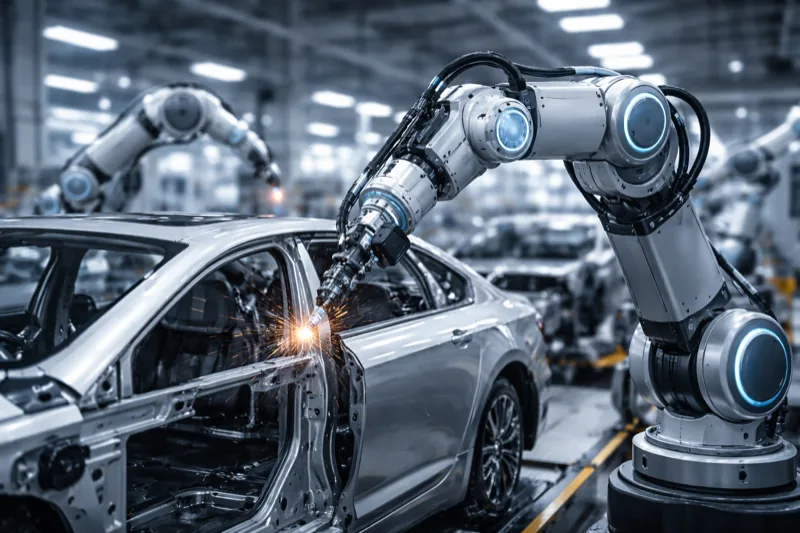
RJ Scaringe, the founder and CEO of Rivian, has a new venture. Mind Robotics, a company he spun out of Rivian in November 2025, just closed a $500 million Series A co-led by Accel and Andreessen Horowitz (a16z). The Wall Street Journal reports the company is valued at $2 billion — making it one of the most richly valued robotics startups before it has even shipped a product outside Rivian’s own factory.
Not Another Humanoid Robot Company
Mind Robotics is explicitly not building humanoid robots. Scaringe has been blunt about this: “Doing cartwheels does not create value in manufacturing.” Instead, Mind is focused on industrial AI-powered robots designed for real factory work — the kind of repetitive, precise, and physically demanding tasks that existing automation still can’t handle well.
The company is training its robots on data from Rivian’s own EV factory in Normal, Illinois, where the machines are already being tested on the production line. The pitch is straightforward: current industrial robots can do repeatable tasks, but they lack the dexterity and adaptability needed for more complex assembly work. Mind wants to fill that gap.
The Money Trail
This $500 million Series A follows a $115 million seed round led by Eclipse in late 2025, bringing total funding to $615 million. At a $2 billion valuation, Mind Robotics is already in rarefied air for a company that’s barely six months old. The investor list reads like a who’s who of Silicon Valley: Accel, a16z, and Eclipse are all betting big on Scaringe’s vision.
But here’s the question investors should be asking: is the valuation based on what Mind Robotics has built, or on who’s building it? Scaringe has credibility from Rivian, but Rivian itself has struggled with production targets and profitability. A $2 billion valuation for a pre-revenue robotics spinout is a lot of faith.
The Rivian Connection
Mind Robotics isn’t just inspired by Rivian — it’s deeply connected. Rivian announced custom silicon in December 2025, and Scaringe has said it’s essentially “a robotics processor” that could be sold to Mind Robotics. So Rivian builds the chips, Mind builds the robots, and both companies benefit. It’s a neat arrangement, though it raises questions about how independent Mind Robotics really is.
This is also Scaringe’s second spinout from Rivian. The first was Also, an e-bike company valued at $1 billion. Running three companies simultaneously is ambitious, to put it mildly.
The Bigger Picture
Mind Robotics is entering a crowded field. Companies like Figure, Agility Robotics, and Apptronik are all chasing factory automation with varying approaches. The difference is that most competitors are building humanoid robots — general-purpose machines that can theoretically do anything. Mind is betting that purpose-built industrial robots, trained on real factory data, will be more practical and deployable sooner.
Scaringe says Mind plans to have a “large number” of robots deployed by the end of 2026. That’s an aggressive timeline, but if the robots are already working in Rivian’s factory, it’s not impossible.
The Bottom Line
A car company CEO spinning out a $2 billion robotics startup while also running an e-bike company is either visionary multitasking or a recipe for distraction. The $615 million in funding says investors are betting on the former. But the real test isn’t raising money — it’s whether Mind Robotics can deliver working factory robots to customers who aren’t named Rivian. Until then, this is an expensive bet on one man’s ability to juggle three companies at once.