Pinterest Is Drowning in AI Slop While Its Own AI Mods Ban Real Artists
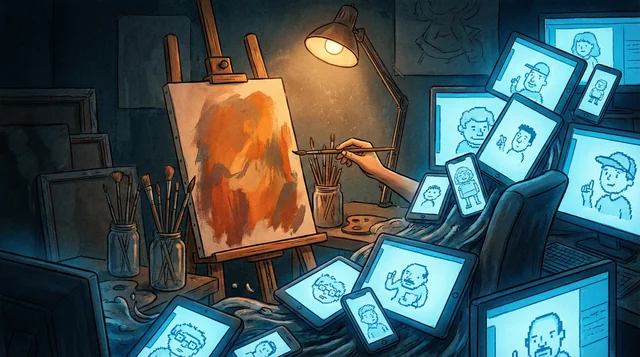
The Platform Artists Built Is Now Working Against Them
Pinterest was once the internet's quiet corner for creatives — a place to collect reference images, share hand-drawn illustrations, and find inspiration for everything from home renovations to wedding cakes. That era appears to be ending. Artists and longtime users say the platform has become nearly unusable, overrun by AI-generated images while the company's own AI moderation system actively punishes the human creators who made the site worth visiting in the first place.
AI Moderators Are Banning Real Artists
The first problem is Pinterest's automated moderation. Artists report that the platform's AI moderators are pulling down legitimate posts and banning accounts with little recourse. Tiana Oreglia, an artist who uses Pinterest to store reference material for her work, told 404 Media that she's stuck in an endless cycle of appeals. Female figures — even fully clothed ones — get flagged as adult content. A stock photo of a man holding a gun on a telephone was flagged for "self-harm."
Each appeal takes time. Each reversal is temporary. And the worst-case scenario? A full account ban. Pinterest says it uses "a combination of AI and human review," but the ratio clearly skews toward AI, and the AI is getting it wrong at scale.
Hand-Drawn Art Is Being Labeled as AI-Generated
Perhaps the most insulting glitch: Pinterest's AI is slapping "AI modified" labels on human-made artwork — including pieces that predate generative AI entirely. Artist Min Zakuga reports that artwork from 10 to 13 years ago is being flagged as AI-generated. The process to remove the label is painfully slow and may still get rejected.
For artists who actively market their work as "100% hand-drawn" and "no AI," this creates a credibility nightmare. When a Pinterest pin is simultaneously labeled "Hand Drawn" and "AI modified," it undermines the artist's brand positioning on other platforms like Etsy. And the cycle repeats — appeal, wait 24-48 hours, get it fixed, then watch the next pin get tagged again.
Meanwhile, Actual AI Slop Floods Every Feed
While real artists fight to keep their work visible and correctly labeled, AI-generated images are flooding Pinterest feeds with almost no resistance. Users report that 95 out of every 100 pins they scroll past are AI-generated content or stolen art. The platform that was supposed to be a curated visual discovery tool has become, in one user's words, "infested and made obsolete."
Some users have managed to train the algorithm to reduce AI content in their feeds, but it takes significant effort — manually flagging AI images one by one until the recommendation engine adjusts. That's unpaid labor to fix a problem the platform created.
Pinterest Laid Off 15% of Staff to "Double Down on AI"
The timing couldn't be more tone-deaf. Earlier this month, Pinterest cut 15 percent of its workforce as part of what CEO Bill Ready described as a push to prioritize "AI-focused roles, teams, and ways of working." The company is investing heavily in the technology that's degrading the user experience while cutting the humans who could fix these problems.
Pinterest also launched Pinterest Canvas, a proprietary text-to-image AI tool that uses public pins as training data. Artists who built the platform with their original work are now watching that work get used to train an AI that will produce the slop competing against them in search results.
Artists Are Pulling Their Work — But It May Be Too Late
Some artists, like Eva Toorenent, have removed all their original art from Pinterest after learning about the AI training. But they have no control over other users who previously uploaded or repinned their work. "I have already caught a few of my images still on Pinterest that I did not upload myself," Toorenent told 404 Media. The art is already in the training pipeline.
The Bigger Pattern: Platforms Consuming Their Own Creators
Pinterest isn't the first platform to turn against its creative community. The pattern is becoming depressingly familiar across the tech industry: let creators build your platform for free, use their content to train AI, flood the platform with AI-generated alternatives, and automate moderation to cut costs — all while the original creators get flagged, mislabeled, and pushed out.
The question isn't whether Pinterest will fix its AI moderation. It's whether there will be any real artists left on the platform by the time it does.