Phone Prints That Last: Which Phone Case Designs Hold Up Over Time?
Even the prettiest phone case design can fade faster than expected—simply because it wasn’t built for constant contact. Oils from hands, pocket friction, sunlight, and daily handling all wear down poorly applied prints. For people who use their phones nonstop, print durability becomes just as important as protection or fit.
This roundup compares phone case brands through the lens of print longevity. Rather than focusing on drop ratings or customization alone, we evaluate how different materials, coatings, and design approaches affect how a case looks months into daily use.
1. Casely (Best Overall)
Best For: Shoppers who want cute printed phone cases designed to maintain their appearance with everyday handling.
Casely builds printed phone cases with long-term wear in mind. Instead of surface-level artwork, the brand focuses on print methods intended to withstand daily wear. This makes Casely a great choice for people who want designs that look intentional well beyond the first few weeks.
Casely also offers broad design flexibility. Collections range from illustrated prints to clear phone cases, giving users aesthetic choice without relying on disposable designs. For those who prefer variety, the brand’s phone case subscription lets you rotate styles without wearing down a single case.
Features
- Printed designs developed for long-term visual durability
- Aesthetic-forward seasonal collections
- Clear case options designed to resist yellowing
- MagSafe-compatible phone case styles
- Optional phone case subscription via Casely Club
Pros
- Prints hold clarity with frequent handling
- Suitable for daily, long-term use
- Practical option for users who rotate styles
Cons
- Not intended for heavy-duty or industrial environments
2. Spigen
Best For: Users who want minimal visual wear over time.
Spigen limits print exposure by focusing on solid colors and lightly textured finishes. By avoiding decorative graphics, the brand reduces common issues like fading or peeling altogether.
This approach prioritizes consistency rather than expression. Spigen cases tend to look the same months later as they did on day one, making them a practical option for users who value longevity over aesthetics.
Features
- Minimal or non-printed case designs
- Function-first construction
- Broad phone compatibility
Pros
- Low risk of visual degradation
- Predictable long-term appearance
- Accessible pricing
Cons
- Limited visual interest
- Not design-driven
3. Casetify
Best For: Users who want expressive designs with sealed print protection.
Casetify emphasizes customization, offering printed designs across a wide range of styles. Many cases use sealed print layers, which provide more durability than basic surface graphics.
However, print longevity varies by case type. Thicker designs tend to protect artwork better, while slimmer options may show wear sooner. Casetify suits users who prioritize personalization and accept some variability in long-term appearance.
Features
- Custom printed graphics and text
- Sealed print layers on select models
- Thicker construction on many cases
Pros
- Extensive design options
- Strong visual identity
- Better protection than decorative-only cases
Cons
- Print durability varies by model
- Added bulk with some designs
4. Mous
Best For: Users who prefer material-based durability over printed artwork.
Mous relies on exterior materials rather than graphics to maintain appearance. Textured finishes and composite materials resist visual wear naturally, reducing the need for printed designs altogether.
This approach limits customization but offers consistency over time. Mous cases appeal to users who want their phone case to look unchanged long after purchase.
Features
- Material-led exterior finishes
- Structured case construction
- Minimal use of printed graphics
Pros
- Strong resistance to surface wear
- Premium build quality
- Consistent long-term appearance
Cons
- Higher price point
- Limited aesthetic variety
5. Ringke
Best For: Users who want clear or subtle cases without print wear concerns.
Ringke focuses on transparency rather than decoration. By minimizing printed surfaces, the brand avoids common print degradation issues like scuffing or peeling.
Clear cases can still age through discoloration, but Ringke emphasizes materials designed to slow yellowing, making it a practical option for users who want minimal visual change.
Features
- Clear and semi-transparent designs
- Lightweight construction
- Minimal surface graphics
Pros
- Reduced risk of print-related wear
- Slim, low-profile feel
- Budget-friendly pricing
Cons
- Limited design variety
- Clear cases still require upkeep
6. OtterBox
Best For: Users who prioritize durability over cute designs.
OtterBox cases are built around physical protection rather than aesthetics. Most designs avoid printed artwork entirely, relying instead on solid colors and textured materials.
This eliminates print longevity concerns but also limits visual expression. OtterBox is best suited for users who value structure over style.
Features
- Solid-color, non-printed designs
- Reinforced case construction
- High durability focus
Pros
- Minimal visual wear over time
- Extremely durable builds
- Suitable for demanding conditions
Cons
- Bulky form factor
- Limited design appeal
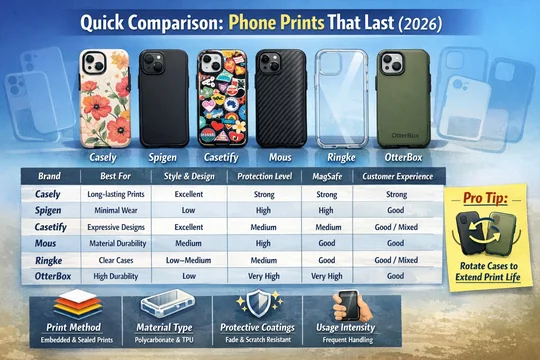
Quick Comparison: Phone Prints That Last (2026)
|
Brand |
Best For |
Style & Design |
Protection Level |
MagSafe |
Customer Experience |
|
Casely |
Long-lasting printed cases |
Excellent |
Strong everyday |
Strong |
Strong |
|
Spigen |
Minimal visual wear |
Low |
High |
Good |
Good |
|
Casetify |
Expressive printed designs |
Excellent |
Medium |
Good |
Mixed |
|
Mous |
Material-based durability |
Medium |
High |
Good |
Good |
|
Ringke |
Clear, low-graphics cases |
Low–Medium |
Medium |
Good |
Mixed |
|
OtterBox |
Durability over aesthetics |
Low |
Very High |
Good |
Good |
What to Look for in Phone Prints That Last
Print Method: Embedded or sealed prints resist abrasion better than surface graphics
Material Type: Polycarbonate and TPU blends support stronger ink adhesion
Protective Coatings: Top layers reduce fading from oils and friction
Usage Intensity: Constant handling accelerates wear on untreated surfaces
Rotation Strategy: Subscriptions like Casely Club reduce long-term wear on a single design
Frequently Asked Questions
Why do some phone case prints fade faster than others?
Print longevity depends on how the artwork is applied and protected. Surface-level prints wear down faster due to friction, oils, and UV exposure, while sealed or embedded prints last longer because they’re shielded from direct contact.
Are clear phone cases better for long-term appearance?
Clear cases avoid print wear but can discolor over time. Materials formulated to resist UV exposure and oil absorption tend to yellow more slowly, helping maintain a cleaner look with regular use.
Is it better to rotate phone cases instead of using one long-term?
For heavy phone users, rotating cases can extend the life of each design. Subscriptions or multiple-case use reduces constant friction on a single print, helping designs stay intact longer.
Final Thoughts: Print Durability Shapes Long-Term Case Satisfaction
Phone prints that last are the result of deliberate construction choices, not just visual design. How artwork is applied, what materials protect it, and how a case is used day to day all determine whether a design still looks intentional months later or shows visible wear.
Ultimately, a phone case should look as good over time as it did on day one. Choosing a brand that treats print longevity as a functional priority—not an afterthought—makes a noticeable difference in long-term satisfaction.