OpenAI Raises $110 Billion at $730 Billion Valuation Because When You're Burning Cash, Might as Well Burn More
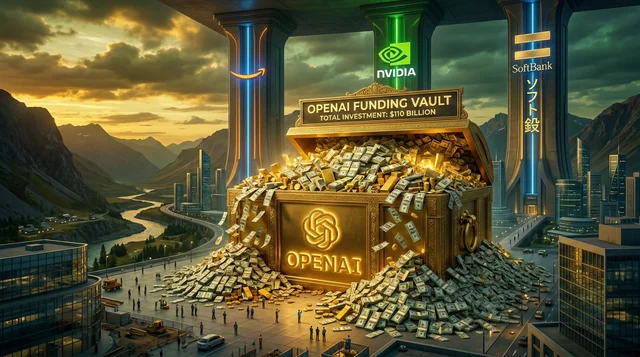
OpenAI just closed the largest private funding round in history: $110 billion at a $730 billion pre-money valuation. Amazon led with $50 billion, Nvidia contributed $30 billion, and SoftBank added another $30 billion. The numbers are so large they've essentially stopped meaning anything in conventional venture capital terms.
But behind the headline figure lies a more interesting story about what this money actually buys — and what it reveals about the shifting power dynamics in the AI industry.
The Amazon Factor
Amazon's $50 billion investment is the centerpiece. But this isn't charity or even traditional venture capital. It comes packaged with a strategic partnership that commits OpenAI to expanding its presence on AWS by $100 billion over eight years. Amazon is also building 2 gigawatts of Trainium chip capacity specifically for OpenAI workloads.
Translation: Amazon is paying $50 billion to lock in a customer who will spend $100 billion on Amazon's cloud platform. That's not an investment — it's a customer acquisition cost with extraordinary returns. Amazon gets a guaranteed revenue stream that dwarfs the upfront capital, plus it gets to validate its custom Trainium silicon against the most demanding AI workloads in the world.
Nvidia's Strategic Insurance
Nvidia's $30 billion contribution is equally strategic. As the dominant GPU supplier, Nvidia has watched Amazon, Google, and Microsoft all develop competing custom AI chips. By investing directly in OpenAI — which runs some of the most GPU-intensive workloads on the planet — Nvidia ensures it has a seat at the table regardless of how the custom chip landscape evolves.
It's also a signal to the market: if even OpenAI's biggest compute customers are investing at this valuation, Nvidia's chips must be worth every premium dollar they command.
SoftBank's Familiar Pattern
SoftBank's $30 billion is the most traditional venture play of the three, and also the riskiest. Masayoshi Son has been here before — making enormous bets on companies he believes will define the next technology era. His track record is decidedly mixed, with spectacular wins (Alibaba) and equally spectacular losses (WeWork). OpenAI represents his conviction that generative AI is the defining platform shift, and he's willing to bet $30 billion on being right.
The Numbers That Actually Matter
ChatGPT now has over 900 million weekly active users and more than 50 million paid consumer subscribers. These aren't research lab metrics — they're consumer internet scale. For context, that puts ChatGPT's weekly active user base in the same league as Instagram and approaching YouTube territory.
OpenAI expects to raise an additional $10 billion by the end of March 2026, which would push the company's valuation to approximately $850 billion. That's not far from the market capitalization of companies like Berkshire Hathaway or TSMC.
What This Really Means
The $110 billion round isn't really about OpenAI needing money. It's about three of the largest technology companies in the world deciding that being financially intertwined with the leading AI lab is worth more than the capital they're deploying. Each investor gets something specific: Amazon gets a customer, Nvidia gets validation, and SoftBank gets a bet on the future.
The question that should concern everyone — investors, users, and competitors alike — is what happens when the company that's supposed to be building transformative AI technology becomes primarily a vehicle for strategic partnerships between its own investors. When your biggest shareholders are also your biggest customers and suppliers, the conflicts of interest don't just multiply — they become the business model.
At $730 billion, OpenAI is being valued not on what it has built, but on what everyone hopes it will become. That's a lot of hope for a company that still hasn't figured out how to make its core product consistently profitable.