OpenAI Forecasts $102 Billion in Advertising Revenue by 2030, Targeting 36% of Total Sales
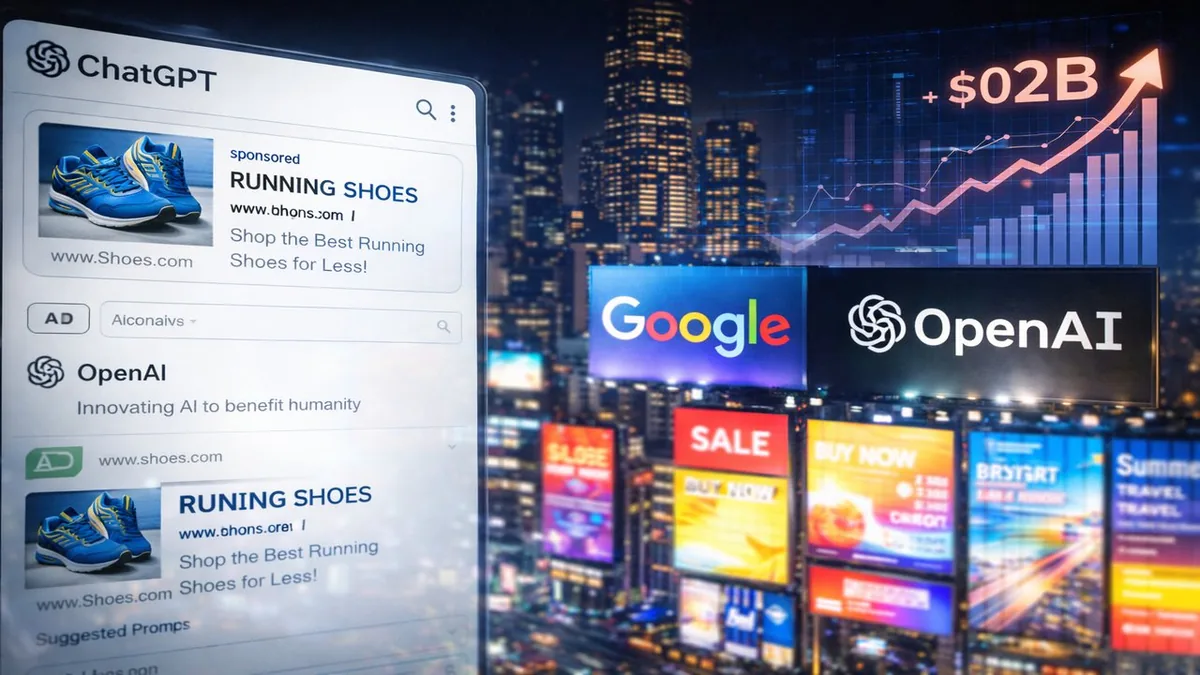
OpenAI is projecting $102 billion in advertising revenue by 2030, with ads expected to represent 36% of the company's total sales within five years, The Information reported. The forecast represents a dramatic strategic evolution for a company that launched as a research nonprofit and spent its first years explicitly rejecting the advertising business model that dominates most consumer internet platforms. If the projection holds, OpenAI would be competing directly with Google and Meta for digital advertising dollars — a collision between the AI company most threatening to Google's search dominance and the advertising model that Google's search has funded for two decades. This comes as enterprise AI adoption accelerates and OpenAI seeks revenue diversification beyond its subscription and API products.
Why OpenAI Is Turning to Advertising
OpenAI's current revenue model — subscriptions from ChatGPT Plus, Pro, and Team tiers, plus API access fees for developers — has grown rapidly but faces structural ceilings. Enterprise contracts through ChatGPT Enterprise provide large deals, but the total addressable market for subscription AI is smaller than the total addressable market for advertising-supported AI. Google demonstrated this dynamic over two decades: a free, advertising-supported product can reach billions of users who would never pay a subscription, and the aggregate advertising revenue from that user base can dwarf what subscriptions would generate from the subset willing to pay.
ChatGPT's user base — reported to exceed 500 million weekly active users — is the scale at which advertising becomes economically viable. At that reach, even modest revenue per user from advertising can generate tens of billions annually. The $102 billion forecast implies OpenAI expects to reach advertising revenue comparable to Meta's current annual ad revenue, suggesting a future where ChatGPT becomes a primary interface through which users discover and purchase products — displacing Google Search in that function as well as in information retrieval.
The Conflict With Google's Core Business
OpenAI entering advertising at scale would represent the most direct competitive threat to Google's core business that the company has faced. Google's $237 billion in 2025 advertising revenue came primarily from search — the act of users expressing intent through queries that advertisers then bid to reach. ChatGPT and AI Mode in search are already disrupting the query-based model by providing direct answers rather than lists of links. If OpenAI attaches advertising to those direct answers — showing sponsored products, services, or content alongside AI responses — it would be replicating Google's core business model in the environment that is replacing Google's core product. The $102 billion projection is not just an OpenAI revenue target; it is a claim about who will own the advertising layer of the next generation of the internet.
Frequently Asked Questions
Does OpenAI currently run advertisements?
No. OpenAI currently generates revenue primarily through subscriptions (ChatGPT Plus, Pro, Team, Enterprise) and API access fees. The $102 billion advertising revenue forecast is a projection for 2030, representing a future business line OpenAI has not yet launched.
How would OpenAI advertising work?
OpenAI has not announced its advertising model publicly. Most likely formats would include sponsored responses within ChatGPT conversations, product recommendations within AI-generated answers, and placement within AI-powered search results — analogous to how Google attaches ads to search queries.
Why does this threaten Google?
Google's $237 billion in annual advertising revenue is tied to search — users expressing intent through queries that advertisers bid to reach. ChatGPT is replacing that query model with direct AI answers. If OpenAI monetizes those interactions through advertising, it captures the same user intent signals that Google's search ads have monetized for 25 years.
The Bottom Line
OpenAI projecting $102 billion in advertising revenue by 2030 is the most consequential strategic signal the company has sent since it launched ChatGPT. It means OpenAI is not content to be a subscription AI tool — it intends to own the advertising layer of AI-native search and discovery. If that projection is anywhere close to accurate, OpenAI will not just have disrupted Google's information retrieval product. It will have moved into Google's revenue model too. That is the competitive scenario Google has been most worried about since ChatGPT launched — and OpenAI is now projecting it publicly.