Nvidia's $20B Groq Deal Births New Inference Chip — OpenAI Signs On as First Customer
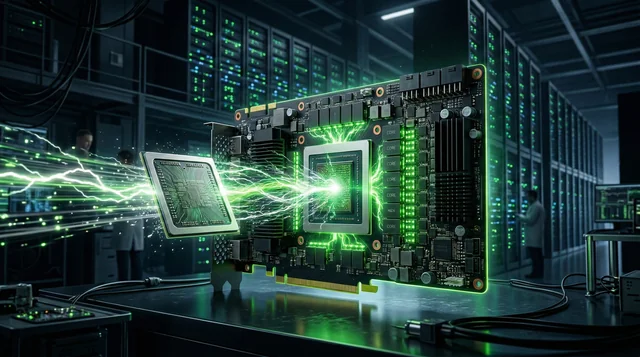
Nvidia is about to reshape the AI chip landscape — again. At its GTC developer conference in San Jose this March, the company plans to unveil a new processor specifically designed for AI inference, incorporating technology from its $20 billion acquisition of chip startup Groq.
And the first major customer? OpenAI.
The $20 Billion Bet on Inference
While Nvidia's GPUs have dominated AI model training, the industry is rapidly shifting toward inference — the process of actually running trained AI models at scale. Every ChatGPT conversation, every AI-generated image, every autonomous driving decision requires inference computing. And it's becoming the bigger market.
That's why Nvidia paid $20 billion for Groq, structuring the deal as a massive licensing agreement plus an "acqui-hire" of nearly 90% of Groq's engineering talent. Jonathan Ross, Groq's founder and the original architect of Google's TPU (Tensor Processing Unit), now leads Nvidia's new Real-Time Inference division.
SRAM vs HBM: The Speed Revolution
What makes Groq's technology so valuable? It's all about memory architecture. Traditional Nvidia GPUs use HBM (High Bandwidth Memory) — powerful but expensive and constrained by supply chains dominated by Samsung and SK Hynix.
Groq's Language Processing Units (LPUs) take a fundamentally different approach. They embed hundreds of megabytes of SRAM (Static Random Access Memory) directly into the chip silicon. This isn't cache — it's primary weight storage. The result? SRAM is up to 100 times faster than HBM for inference workloads, delivering nearly 10x the throughput while consuming approximately 90% less power.
Think of it this way: HBM is like fetching books from a library across town. SRAM is like having the book already open on your desk.
OpenAI Goes All In
OpenAI has committed to becoming the lead customer for Nvidia's new inference processor, reportedly planning a massive purchase of dedicated inference capacity. This is significant timing — Sam Altman's company had been "shopping around" for more efficient alternatives to pure GPU-based inference.
The deal makes strategic sense for OpenAI. As ChatGPT and its API serve hundreds of millions of users, inference costs dwarf training costs. A chip that delivers 10x throughput at 90% less power could dramatically reduce the cost of running AI at scale.
The Vera Rubin Architecture
The first tangible results of the Groq acquisition are expected in Nvidia's upcoming "Vera Rubin" architecture, scheduled for late 2026. Reports suggest these next-generation chips will feature dedicated "LPU strips" on the die — specialized inference cores alongside traditional GPU cores.
This hybrid approach could give Nvidia the best of both worlds: raw GPU power for training, plus Groq's specialized speed for inference. It also reduces Nvidia's dependency on the volatile HBM supply chain, since SRAM can be manufactured using more standard processes.
What This Means for AI
The shift from training to inference represents a fundamental inflection point in AI. Training a model is a one-time cost. Running that model for millions of users is an ongoing expense that only grows. By acquiring Groq's inference technology, Nvidia is positioning itself to dominate both sides of the AI computing equation.
For the broader AI industry, faster and cheaper inference means AI applications become more affordable, more responsive, and more accessible. The technology that powers your next ChatGPT conversation, AI search query, or autonomous vehicle decision could be running on Nvidia-Groq hybrid silicon by late 2026.
The AI chip war isn't just about who can train the biggest models anymore. It's about who can run them the fastest — and Nvidia just made a $20 billion bet that it'll be them.