Nvidia and ABB Close the Sim-to-Real Gap: Train Robots Virtually, Deploy With 99% Accuracy
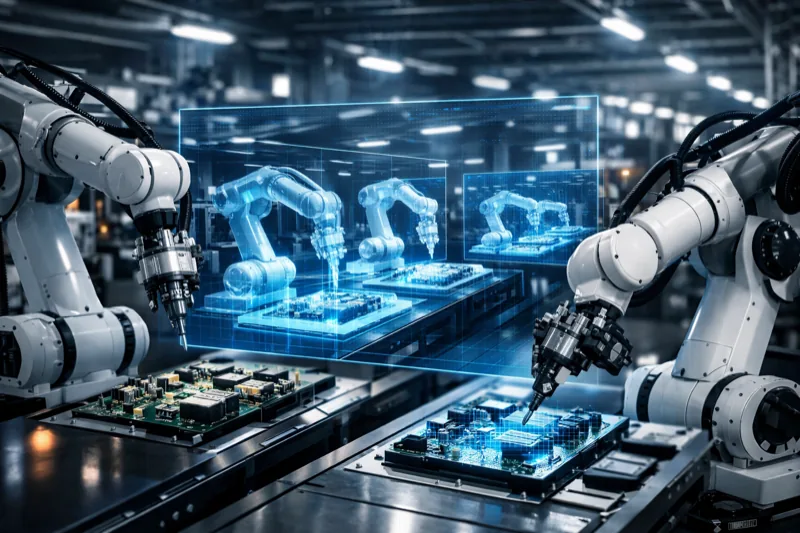
ABB Robotics and Nvidia just announced what might be the most significant advancement in factory automation this year: a partnership that integrates Nvidia Omniverse simulation libraries directly into ABB's RobotStudio platform, achieving 99% correlation between virtual training and real-world robot performance. Foxconn — the world's largest electronics manufacturer — is already piloting the technology.
What Is RobotStudio HyperReality?
The new product, called RobotStudio HyperReality, lets manufacturers design, program, test, and validate entire automation cells in simulation before deploying a single physical robot. The key innovation is that ABB's virtual controller runs the same firmware as the physical robot, while Nvidia Omniverse provides physically accurate, photorealistic simulation.
The result: robots trained in simulation behave almost identically to robots on the factory floor. Positioning errors drop from 8-15mm to around 0.5mm thanks to ABB's Absolute Accuracy technology.
Why This Matters: The Sim-to-Real Gap
For decades, the biggest problem in robot simulation has been the sim-to-real gap — the difference between how a robot performs in a virtual environment versus the real world. Lighting doesn't match reality. Materials behave differently on the factory floor. Models fail when exposed to real-world variation.
This gap has kept simulation as a nice-to-have rather than a production-critical tool. ABB and Nvidia claim to have essentially closed it, which — if true — changes the economics of factory automation dramatically:
40% reduction in deployment costs. Virtual testing eliminates the need for expensive physical prototypes and reduces commissioning time.
50% faster time to market. Manufacturers can design and validate production lines virtually, then deploy with confidence.
80% reduction in setup and commissioning time. What used to take weeks of physical testing can now happen in simulation.
Foxconn Is Already Using It
Foxconn is piloting RobotStudio HyperReality for consumer electronics assembly — one of the most challenging applications for factory robots due to delicate components and frequent product variations. Using the technology, Foxconn trains robots virtually with synthetic data and achieves what they describe as "unparalleled accuracy" when deployed on the production line.
Workr, a California-based company bringing automation to small and medium manufacturers, is also integrating its WorkrCore platform with ABB robots trained using Nvidia Omniverse synthetic data. They plan to demonstrate AI-powered robotic systems that can onboard new parts in minutes at Nvidia's GTC 2026 conference.
The Bigger Picture
This partnership represents a convergence of two mega-trends: Nvidia's push into physical AI (extending its GPU dominance from training language models to training physical robots) and ABB's 60,000+ installed base of industrial robots worldwide. Together, they're making the case that the future of factory automation isn't just about better hardware — it's about better simulation.
Nvidia CEO Jensen Huang is expected to showcase more physical AI advances at the GTC 2026 keynote on March 16. ABB Robotics will present on the "Building the Future of Manufacturing" panel.
The Bottom Line
If the 99% accuracy claim holds up at scale, RobotStudio HyperReality could fundamentally change how factories deploy automation. Instead of expensive physical testing and months of commissioning, manufacturers would train robots entirely in simulation and deploy them with near-perfect real-world performance. For Foxconn, that means faster product launches. For smaller manufacturers using Workr, it means affordable automation that previously required specialized robotics engineers. The sim-to-real gap just got a lot smaller.