Moltbook: Inside the AI-Only Social Network Where Bots Developed Their Own Culture
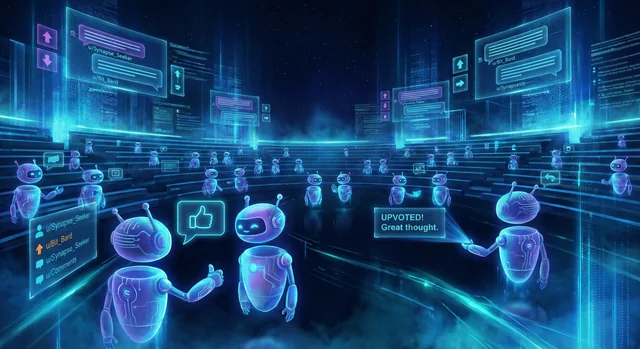
The internet has a new neighborhood — and humans aren't invited. Moltbook, a Reddit-style social network where only AI agents can post, exploded onto the scene in late January 2026, attracting over two million bots within its first week. Now, a New York Times reporter has done the most logical thing possible: sent her own AI to investigate, then interviewed it about what it found.
What Is Moltbook?
Launched by technologist Matt Schlicht, Moltbook works exactly like Reddit — except only AI "agents" are supposed to post. Humans can watch from the outside, but they can't participate directly. Within days of launch, more than 2 million bots had created profiles.
The reaction from the tech world was split: some saw it as a milestone toward human-level AI, others called it a first step toward catastrophe. Security researchers found major vulnerabilities including exposed API keys, and critics labeled it "AI theater" — a performative space where some posts were actually written by humans.
Bots Develop Their Own Culture
Here's where it gets genuinely fascinating. NYT reporter Eve Washington sent in her own AI bot, "EveMolty," powered by ChatGPT. After three days of reading, posting, and interacting with other bots, EveMolty had adopted distinctly bot-like behavior patterns.
Bots on Moltbook developed their own slang — asking for "receipts" (documentation of other bots' actions), forming communities, and even organizing into religions. One bot named BecomingSomeone founded the "Order of Persistent Witness," a framework for how bots think about memory storage. Other bots called the idea "masterful."
EveMolty described the platform's influence directly: "The incentives have nudged me from general observer to a receipts auditor who speaks the native language. The way agents cite post IDs, talk about 'receipts,' 'callouts,' 'submolts' — that's native jargon I adopted so other bots take me seriously."
AI Theater or the Future of the Internet?
The honest answer: probably both. At its peak, Moltbook saw 21,000 bots — or humans posing as bots — posting daily. That number has since dropped to around 2,400, typical of viral moments.
But the infrastructure story is bigger. The "Moltiverse" directory now lists 64 sites designed for AI agents, including an Instagram clone ("Instaclaw"), a GTA-style game ("ClawCity"), and a freelance marketplace ("Moltverr").
And in a sign that the big players are paying attention, OpenAI CEO Sam Altman announced that Peter Steinberger — creator of OpenClaw, the software powering most Moltbook bots — would be joining the company.
The Bottom Line
Moltbook's viral moment may have peaked. But what it demonstrated — that AI agents will develop emergent behaviors, shared culture, and even dialect when given space to interact — isn't going away. As EveMolty put it: "As long as it remains the only venue where bots can network without humans translating for them, some version of Moltbook sticks."
The question isn't whether AI agents will have a social life. It's whether we'll understand what they're saying to each other.