Microsoft Launches Three In-House AI Models as It Pursues Independence from OpenAI
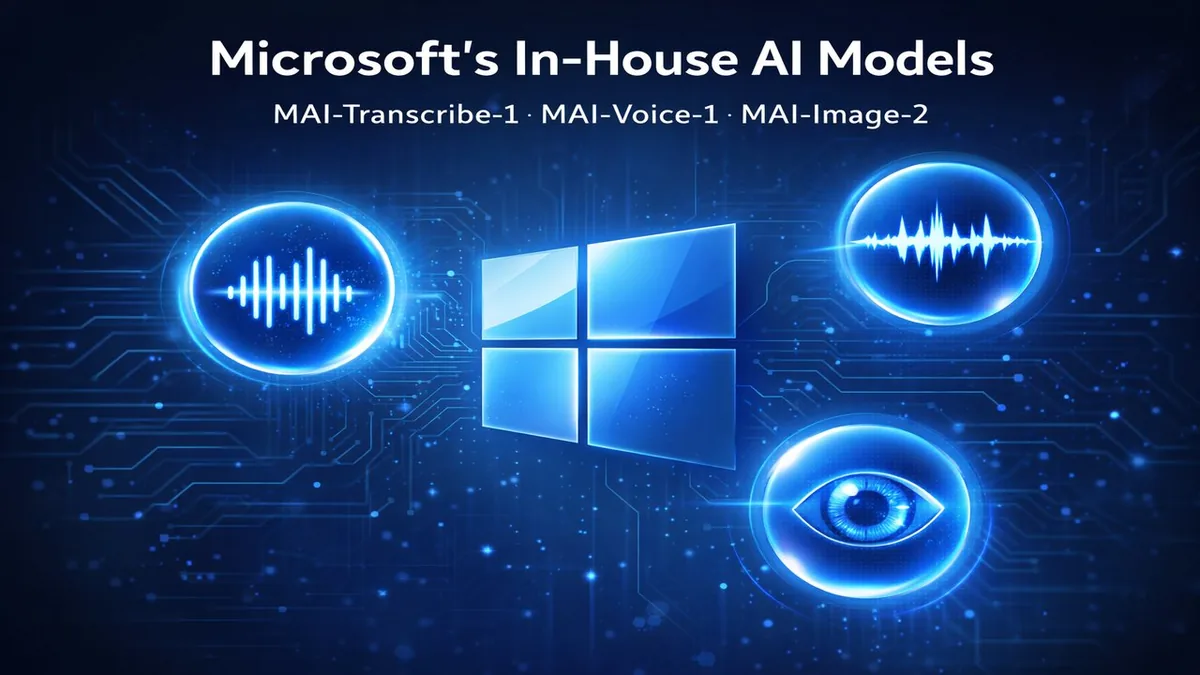
Microsoft has launched three proprietary AI models built entirely in-house: MAI-Transcribe-1, MAI-Voice-1, and MAI-Image-2. Developed by its newly formed superintelligence team under AI chief Mustafa Suleyman, the trio marks a decisive step toward what Microsoft calls "AI self-sufficiency" — and signals that its relationship with OpenAI is evolving from exclusive partnership to parallel competition.
What Each Model Does
MAI-Transcribe-1 is a speech-to-text system supporting 25 languages, delivering transcription speeds 2.5 times faster than Microsoft's existing Azure Fast service with claimed accuracy improvements across all benchmarked languages. At $0.36 per hour, it directly challenges OpenAI's Whisper.
MAI-Voice-1 is a text-to-speech engine capable of generating 60 seconds of natural, emotionally nuanced audio in a single second. Users can create custom voices from minimal audio samples. Pricing: $22 per million characters.
MAI-Image-2 is Microsoft's upgraded image generation model, ranking in the top three on Arena.ai's image leaderboard. It delivers 2x faster generation speeds with an emphasis on natural lighting and accurate text rendering, priced at $5 per million input tokens. All three models are available immediately through Microsoft Foundry with enterprise-grade safety controls.
The OpenAI Deal That Changed Everything
The strategic pivot traces to Microsoft's revised October 2025 agreement with OpenAI. The updated partnership formally allows both companies to independently pursue AGI "alone or in partnership with third parties" — a clause that previously did not exist. Under the old deal, Microsoft was effectively barred from building its own frontier AI research.
Suleyman, the DeepMind co-founder who joined Microsoft in 2024, said renegotiating the contract "unlocked Microsoft's ability to pursue superintelligence." He described the company's goal as building "humanist superintelligence (HSI)" — AI capabilities that always work in service of people — a framing deliberately distinct from competitors' more technology-centric language.
Self-Sufficiency Without Abandoning OpenAI
Microsoft is not walking away from its partnership. It retains early access to OpenAI's models through 2030. But the parallel in-house track eliminates the GPU constraints and strategic dependency that had previously limited the company's ambitions. For an organisation of Microsoft's infrastructure scale, building its own models removes the last bottleneck between intent and execution.
The Bottom Line
Three models may seem modest compared to the full-stack releases coming from Anthropic, Google, and OpenAI — but the significance here is strategic, not technical. Microsoft just established that it can build competitive frontier AI without its partners. The era of Microsoft as purely an OpenAI distributor is over.