Meta Metaverse Shutdown: What It Means for VR’s Future
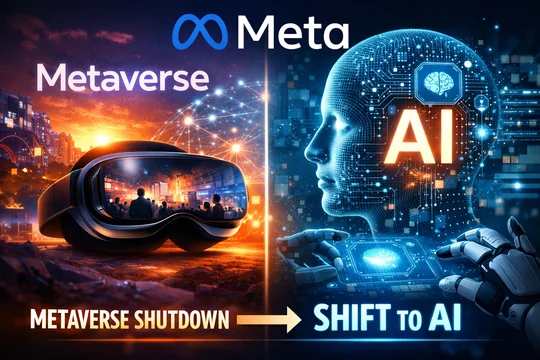
Meta Metaverse Shutdown Signals a Big Shift to AI
Meta has reportedly laid off around 1,500 employees in its Reality Labs division and shut down several VR game studios.
That might sound like “just another tech layoff story.” But it’s bigger than that.
This moment feels like the clearest sign yet that Meta’s metaverse dream is no longer the company’s main bet. Instead, Meta is doubling down on AI—and leaving VR to fight for relevance on its own.
If you’re a creator, developer, marketer, investor, or anyone watching tech trends, the Meta metaverse shutdown isn’t just a corporate pivot. It’s a warning about hype, timing, and what happens when a platform tries to force a future before people are ready.
Key Facts: What Happened (Quick Summary)
Here’s what we know so far, based on reporting from outlets like The Wall Street Journal, CNBC, and The Verge:
-
Meta reportedly cut roughly 1,500 jobs from Reality Labs (around 10% of the unit).
-
Several VR game studios were affected or shut down, including teams behind major titles.
-
Meta’s VR workplace product, Workrooms, is also reportedly being shut down.
-
Meta’s VR fitness app Supernatural is expected to move into “maintenance mode,” meaning no major new content.
-
Meta has spent an estimated $73 billion on Reality Labs over time, yet the division has not delivered consistent profits.
The result: VR isn’t “dead,” but Meta’s version of the metaverse as the next social universe is no longer the priority.
Why the Meta Metaverse Shutdown Matters (Beyond the Headlines)
The metaverse didn’t fail because virtual reality is useless.
It struggled because Meta tried to turn VR into a mass-market social platform before it became a mass-market habit.
1) The product wasn’t ready for the promise
Meta sold a future where millions of people would work, play, shop, and hang out inside Horizon Worlds.
But early experiences didn’t match the vision. When people hear “next-generation internet,” they expect something magical—not clunky avatars and awkward movement.
There’s a hard truth in tech: you don’t get infinite time to improve a first impression.
2) Meta treated VR like a platform tax opportunity
Meta didn’t just want VR adoption. It wanted VR control.
One of the biggest motivations was reducing dependence on Apple and Google’s app store rules. Meta wanted its own ecosystem where it could collect fees, shape distribution, and control monetization.
That strategy can work—but only after people actually show up.
Trying to monetize too aggressively before scale is like opening a toll booth on a road no one drives.
3) Safety issues became part of the metaverse story
VR isn’t like scrolling a feed. It feels personal.
So when harassment and virtual abuse made headlines, it didn’t just hurt Meta’s brand—it made the entire metaverse concept feel risky, especially for new users.
Meta introduced safety tools, but much of it came after problems were already public. And in emerging tech, trust is hard to rebuild once it’s lost.
4) AI became the “better future” with faster payoff
The biggest reason this shift happened now is simple: AI is delivering results today.
AI tools are easy to access, instantly useful, and don’t require expensive headsets. You can try them in seconds, not after spending hundreds of dollars and learning new controls.
For Meta, AI is a faster path to growth, attention, and revenue—while VR remains a slower, more expensive gamble.
Meta Reality Labs Layoffs: What This Signals for the Industry
The Meta Reality Labs layoffs aren’t just internal restructuring. They signal where big tech believes the next decade is headed.
Here are the most likely outcomes:
-
VR becomes niche again (for now)
VR will still matter in gaming, training, and simulation. But the dream of “everyone living in VR” is on pause. -
Mixed reality and smart glasses win the spotlight
AR glasses and lightweight wearable tech have a clearer everyday use case: photos, audio, directions, quick AI help. You don’t need to escape the world—you enhance it. -
Developers will follow stability, not hype
If you’re a developer, you build where the users are and where the platform won’t change direction every year.
This pivot may make studios more cautious about building inside ecosystems controlled by one company’s shifting priorities.
-
The future of virtual reality may look quieter—but smarter
The future of virtual reality might still be strong, but it will likely evolve as:
-
more practical (work training, education, design)
-
less “virtual world social network”
-
more connected to AI interfaces and assistants
Practical Takeaways: What You Should Do Next
Whether you’re building products or building a career, here’s how to respond to this shift:
-
Don’t build on a trend—build on a behavior
People didn’t wake up craving VR social life. But they are actively adopting AI tools daily. -
If you’re a creator, diversify your platforms
Relying on one ecosystem is risky. Build audiences that can move with you. -
If you’re in VR, focus on strong use cases
The best VR opportunities now are the ones that save time, reduce cost, or improve training—not vague “metaverse experiences.” -
If you’re in marketing, track where attention is moving
“Metaverse campaigns” used to sound futuristic. Now, AI-driven personalization and content workflows are the real competitive edge.
[INTERNAL LINK: AI marketing trends]
Conclusion: The Meta Metaverse Shutdown Is a Reset, Not the End
The Meta metaverse shutdown doesn’t mean virtual reality disappears. It means the story is changing.
VR will keep evolving—but it may take a slower, more focused path than Meta promised in 2021. Meanwhile, AI is becoming the main stage, pulling talent, budget, and attention with it.
The big lesson is simple: the future doesn’t belong to the loudest prediction—it belongs to the most useful product.
And right now, usefulness is spelled A-I.
| Feature | Metaverse Strategy (VR-First) | AI-First Strategy |
|---|---|---|
| Adoption barrier | High (headset + learning curve) | Low (apps + instant access) |
| Time to value | Slow | Fast |
| Main use case | Social worlds + VR gaming | Productivity + content + assistants |
| Cost to scale | Expensive hardware + studios | Software-driven expansion |
| User demand today | Mixed | Strong and growing |
Bottom Line: AI is winning because it’s easier to adopt and delivers value immediately, while VR still needs better hardware, clearer use cases, and stronger trust to scale.
Q: Is Meta shutting down the metaverse completely?
A: Not entirely, but Meta is clearly reducing its focus. The Meta metaverse shutdown signals that the company is pulling resources away from VR-first projects and putting more energy into AI. VR may continue, but it’s no longer the headline strategy.
Q: What are Meta Reality Labs layoffs about?
A: Meta Reality Labs layoffs appear tied to cutting costs and narrowing focus. Reality Labs has required massive investment over the years, and Meta seems to be trimming projects that aren’t growing fast enough, especially as AI becomes a higher priority.
Q: Does this mean the future of virtual reality is over?
A: No—VR still has strong use cases in gaming, training, and simulations. But the “everyone will live in the metaverse” idea is fading. The future of virtual reality is likely to be more practical and less focused on mass social platforms.
Q: Why is AI beating the metaverse right now?
A: AI is winning because it’s easier to access and immediately useful. You don’t need new hardware, and results are instant. Compared to VR’s cost and learning curve, AI fits naturally into daily life and work, which drives faster adoption.