Meta Launches Muse Spark: First Model from Meta Superintelligence Labs with Parallel AI Agents
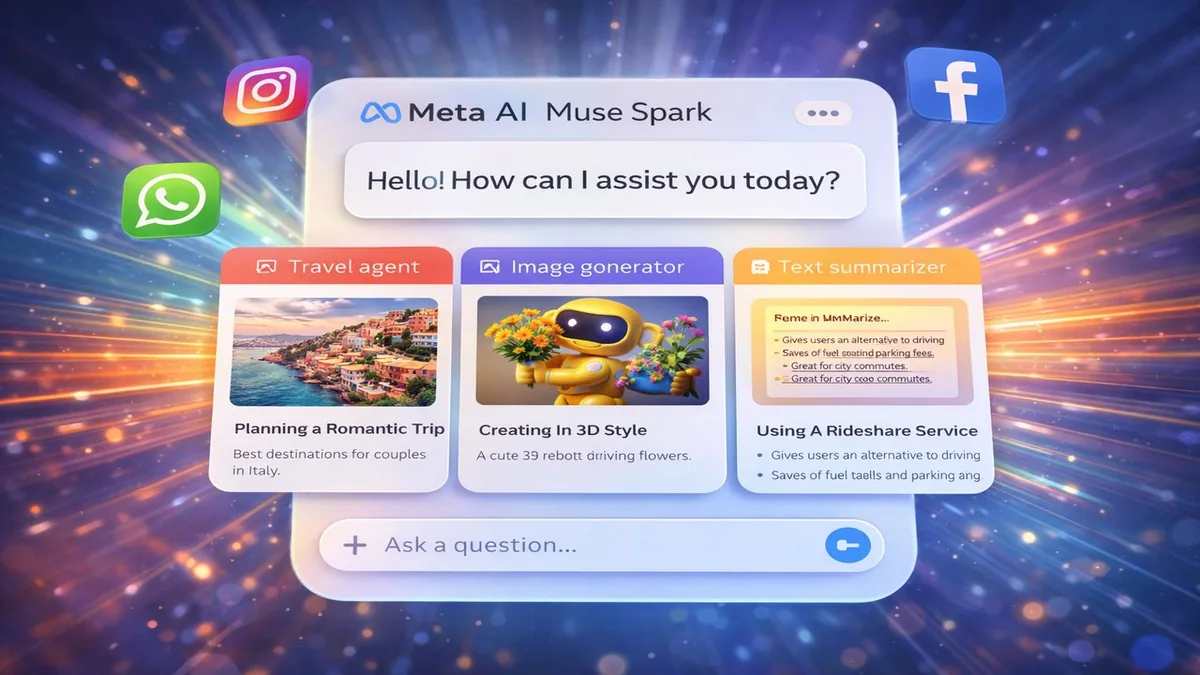
Meta has launched Muse Spark, the first large language model from its newly formed Meta Superintelligence Labs (MSL) division — and the company is describing it as the most powerful AI model it has ever built. Unlike prior Meta AI releases focused on open-source or developer-facing tooling, Muse Spark is a consumer product designed to power Meta AI across its 3.3 billion-user ecosystem of apps. It is available immediately in the US in the Meta AI app and on meta.ai, with rollout to WhatsApp, Instagram, Facebook, Messenger, and Meta AI glasses coming in the following weeks. The launch signals Meta's escalation from AI infrastructure provider to direct competitor in the consumer AI assistant race against OpenAI, Google, and Anthropic — where Anthropic's revenue alone has tripled to $30 billion in recent months.
What Muse Spark Can Do
Muse Spark is "small and fast by design, yet capable enough to reason through complex questions in science, math, and health." It ships with two interaction modes: Instant mode for quick answers and Thinking mode for complex multi-step reasoning. The model is multimodal — it can see and understand images, not just read text — enabling use cases like snapping a photo of food packaging and getting a protein content comparison against alternatives, or scanning a product and receiving a buying recommendation with competitor context.
The most distinctive capability is parallel subagent execution. Where other AI assistants process tasks sequentially, Muse Spark launches multiple agents simultaneously. A user planning a Florida trip receives three simultaneous outputs: a draft itinerary, a comparison of Orlando versus the Keys, and a list of kid-friendly activities — all running in parallel. According to Meta's announcement, Muse Spark can also generate custom websites and mini-games from a single prompt, and provides detailed health query responses developed with a physician advisory team.
Meta Superintelligence Labs: A Strategic Reframe
The launch of MSL as a standalone division — rebuilt over nine months from the ground up — is as significant as the model itself. Meta is signalling that AI is no longer a feature layer on top of social media; it is the primary strategic product. The division's name, Meta Superintelligence Labs, is a deliberate positioning statement — the company is openly competing for the "most capable AI" label that OpenAI and Anthropic have held.
The planned open-source release of future Muse Spark versions follows the Llama playbook that made Meta's open models a foundation for thousands of developers and enterprise deployments. This mirrors the broader trend of NVIDIA open-sourcing Isaac GR00T to accelerate ecosystem adoption — open-sourcing as a strategy to build a developer moat rather than a revenue model.
Why This Changes the Consumer AI Landscape
Muse Spark's distribution advantage is enormous. Meta's apps collectively reach over 3 billion people daily — an install base no standalone AI assistant can match. When Muse Spark rolls out to WhatsApp and Instagram, it will reach billions of users who have never downloaded a dedicated AI app. This passive distribution moat is why Meta's consumer AI play is fundamentally different from OpenAI's ChatGPT or Anthropic's Claude — those require users to seek out and install new products. Muse Spark arrives inside apps people already open dozens of times per day.
The health use case is also notable: detailed AI health responses, built with physician oversight, deployed to billions of users, have real-world implications for how people access health information globally.
Frequently Asked Questions
What is Meta Superintelligence Labs and how is it different from Meta AI?
Meta Superintelligence Labs (MSL) is Meta's new dedicated AI research and model development division, rebuilt over nine months to focus on building large language models. Meta AI is the consumer assistant product — Muse Spark is the underlying model that powers it. MSL is to Meta AI what OpenAI's research lab is to ChatGPT.
What can Muse Spark do that other AI models cannot?
Muse Spark's standout capability is parallel subagent execution — launching multiple AI agents simultaneously to handle complex, multi-part requests rather than processing steps sequentially. Combined with multimodal vision, custom website generation, and health query depth developed with physicians, it offers a distinctive capability set compared to competing consumer AI assistants.
When will Muse Spark be available on WhatsApp and Instagram?
Meta announced Muse Spark is available immediately in the US via the Meta AI app and meta.ai, with rollout to WhatsApp, Instagram, Facebook, Messenger, and Meta AI glasses coming in the weeks following the April 8, 2026 launch.
The Bottom Line
Meta's launch of Muse Spark through Meta Superintelligence Labs is the company's most serious bid yet to compete at the frontier of AI. The combination of a powerful multimodal model, parallel agentic architecture, and distribution across 3+ billion users gives Meta a path to consumer AI scale that neither OpenAI nor Anthropic can easily replicate. The race for the default AI assistant in people's daily lives just got significantly more competitive.