Mantle Tokenholders Approve 30,000 ETH Aave Credit Line — DeFi's De Facto FDIC Takes Shape
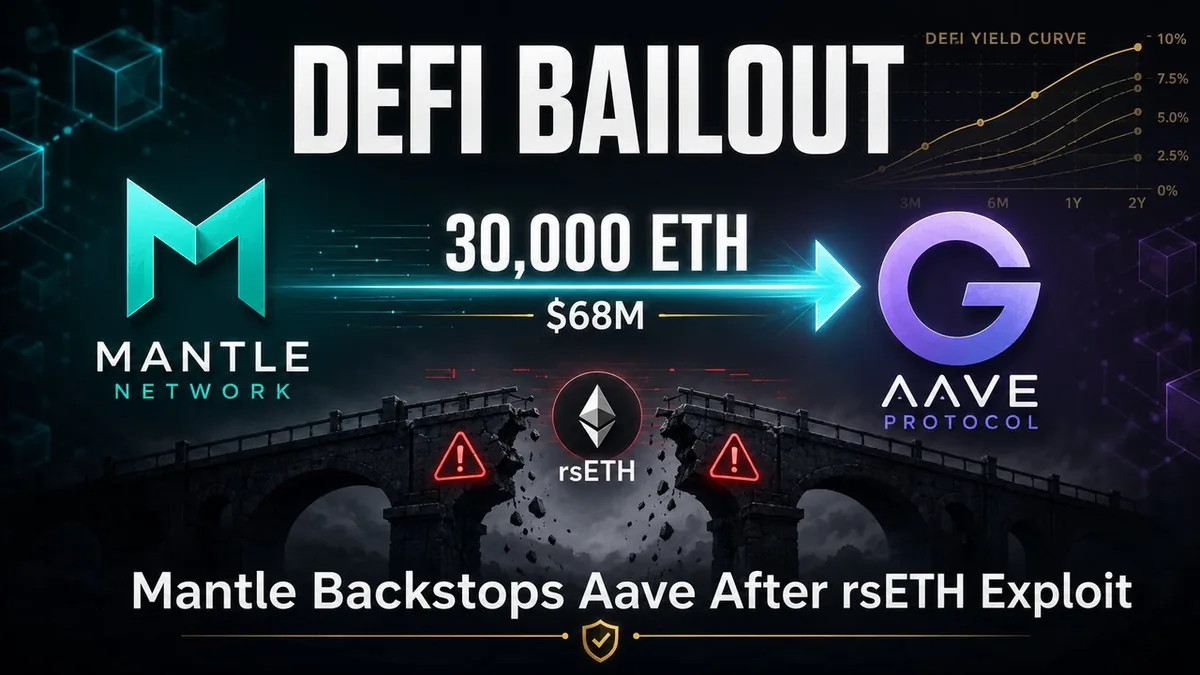
Mantle tokenholders approved MIP-34 last Friday in a seven-day Snapshot vote ending May 8, 2026. The proposal authorizes the Mantle Foundation to extend up to 30,000 ETH (approximately $68 million at current prices) as a credit facility to Aave to help manage the bad debt fallout from the April 18 rsETH exploit. The facility is conditional on Aave implementing its recovery plan and the parties finalizing terms. The vote passed; we now have a fourth major DeFi protocol explicitly responding to a single April incident.
SaveDelete has covered this story arc closely: the original Aave-Arbitrum-Kelp emergency motion, the post-Kelp oracle migration to Chainlink, and the 1inch Fusion resolver hack that followed in May. Mantle's credit facility is the fourth governance-level response, and it raises a sharper question than any of the prior three: when a major protocol's bad debt exceeds its insurance reserves, are emergency credit facilities from related-protocol treasuries the right pattern? It is starting to look like the answer is yes — by default, because nothing better exists.
What MIP-34 Actually Approved
From the Mantle Snapshot vote and Cointelegraph's coverage:
- Vote: MIP-34 (Mantle Improvement Proposal 34) approved via 7-day Snapshot vote ending Friday, May 8, 2026
- Credit amount: Up to 30,000 ETH (~$68 million at current prices)
- Purpose: Address bad debt impact on Aave V3 from the rsETH exploit
- Bad debt scope: Attacker deposited 89,567 unbacked rsETH and borrowed approximately $190 million in WETH, wstETH, and stablecoins — creating potential bad debt between $123.7 million and $230.1 million
- Market stress signal: WETH utilization in Aave V3 stayed above 99% for 12.7 days post-exploit, average utilization ~99.6% — the protocol effectively ran out of borrowable WETH liquidity
- Conditional: Facility subject to Aave implementing its recovery plan and parties finalizing terms (interest rate, duration, collateral not disclosed)
- Executor: Mantle Foundation negotiates and executes from Mantle Treasury
Why Mantle Is Stepping In (And Why It Matters)
The motivation is rational on multiple levels. Mantle's mETH product overlaps in user audience with rsETH; Mantle has significant Treasury reserves (publicly estimated in the $400-700M range); and a healthy Aave V3 is structurally good for Mantle's own DeFi ecosystem because Mantle assets are routinely deposited or borrowed against on Aave. Letting Aave's bad debt fester would degrade lending markets across the entire L2 ecosystem, which is bad for Mantle's products.
But the larger pattern is what should be worrying DeFi observers. Over the past 18 months, we have now seen at least four protocols extend emergency facilities or take governance action specifically because Aave's loan book had become impaired by a single counterparty exploit:
- Kelp DAO itself — exploited April 18, lost $293M in rsETH
- Aave V3 — held the bad debt on its loan book, opened recovery proposal
- Arbitrum — froze ~30K ETH related to the exploit
- Mantle — now extending 30K ETH credit line
Plus the broader oracle-migration wave (Solv, Tydro, Kelp itself moving to Chainlink) covered earlier this week. Five governance-level responses, four protocols' treasuries deployed in some form, from one exploit. That is not a feature; it is a systemic dependency that the DeFi community has not yet acknowledged structurally.
The 'DeFi FDIC' Pattern Is Emerging Without a Charter
Banks have the FDIC because individual depositors needed protection from idiosyncratic bank failure. The FDIC charges premium fees ex-ante, builds a reserve fund, and pays out when a member bank fails. The structural genius is the pre-funded, mutualized risk pool with explicit terms.
DeFi has been building something that LOOKS like an FDIC but operates without the structural foundation:
- Each emergency facility is negotiated ad hoc per incident
- Terms are not disclosed in advance, so depositors cannot price the protection
- Cross-protocol credit lines are conditional on bilateral negotiation, not pre-committed
- The risk pool is the lender's treasury, not a mutualized fund
- Voting is governance-token-weighted, not depositor-weighted
This is what an FDIC looked like in 1929 before the actual FDIC charter existed — well-meaning ad hoc bailouts that worked when stress was small and contagion was limited, and that failed catastrophically when stress was large. DeFi's emergency-credit pattern is now well into its “works for now” phase. The structural question is whether it gets formalized before the first major failure.
My Take
Mantle's vote is rational, and the credit-facility terms (once disclosed) will probably be acceptable for both sides. The interesting question is not whether MIP-34 is the right move for Mantle. It is whether the entire pattern — protocols bailing out other protocols' bad debt via governance-approved credit lines — is the right architecture for DeFi resilience.
I think it isn't. The right structure is a pre-funded, multi-protocol insurance pool with formal underwriting standards, contributions scaled to each protocol's risk profile, and explicit payout rules. Something closer to Lloyd's of London than to the current ad-hoc-bailout model. Several attempts have been made (Nexus Mutual, Cover Protocol pre-2022 collapse, Sherlock); none have achieved the scale or coverage that a real protocol-level FDIC would require. The reason: it requires protocols to pre-pay premiums in good times, and governance-token-holders don't want to vote yes on premium payments when the protocol seems healthy. So we keep getting Mantle-style ad hoc bailouts instead.
The other thing worth flagging: the rsETH-Kelp-Aave-Mantle chain demonstrates how concentrated DeFi infrastructure risk has become. Five major protocols affected by one bridge misconfiguration. The system is more brittle than the TVL numbers suggest, and the brittleness is being managed by hand each time. That works until it doesn't.
Frequently Asked Questions
What is MIP-34?
Mantle Improvement Proposal 34, approved via Snapshot governance vote on May 8, 2026. It authorizes the Mantle Foundation to extend up to 30,000 ETH (approximately $68 million) as a credit facility to Aave V3 to help manage the bad debt fallout from the April 18 rsETH exploit.
How is Mantle connected to the rsETH exploit?
Mantle is not directly affected by the rsETH exploit (which drained Kelp DAO via a LayerZero bridge configuration). But Aave V3 — which Mantle's mETH and broader ecosystem depend on for lending liquidity — has potential bad debt of $123-230 million from the attacker's leveraged borrowing against unbacked rsETH. Backstopping Aave protects the wider DeFi lending market that Mantle relies on.
What were the bad-debt figures?
The exploit attacker deposited 89,567 unbacked rsETH into Aave V3 and borrowed approximately $190 million across WETH, wstETH, and stablecoins. The resulting bad debt range is estimated $123.7 million to $230.1 million depending on how Aave handles liquidations.
What are the credit-facility terms?
Interest rate, duration, and collateral terms have not been publicly disclosed yet. The facility is conditional on Aave implementing its recovery plan and the parties finalizing bilateral terms. Expect a follow-up announcement within the next 2-4 weeks.
Is this similar to other DeFi bailouts?
Structurally, yes. Mantle's facility is the fourth governance-level response to the April 18 exploit (alongside Aave's recovery proposal, Arbitrum's frozen ETH motion, and Kelp DAO's own oracle migration). The DeFi industry is increasingly running emergency credit between protocols ad hoc, rather than via formal insurance structures.
The Bottom Line
Mantle's 30,000 ETH Aave credit facility is the right move for Mantle and a worrying sign for DeFi's structural resilience. The ad hoc emergency-bailout pattern has now been deployed four times in 30 days. It works when stress is contained; it fails when stress is systemic. The DeFi industry will eventually formalize a real insurance structure or it will get a structural failure cycle. Both outcomes are predictable; the timing is not.
Related Reading
- After Kelp DAO's $293M Blowup, DeFi Migrates Oracles to Chainlink
- 1inch Fusion Resolver TrustedVolumes Hit by $6.7M Exploit
- Aave Files Emergency Motion to Recover Frozen Kelp Exploit ETH