Kraken's Parent Payward Files for OCC National Trust Charter — The Banking Land Grab Begins
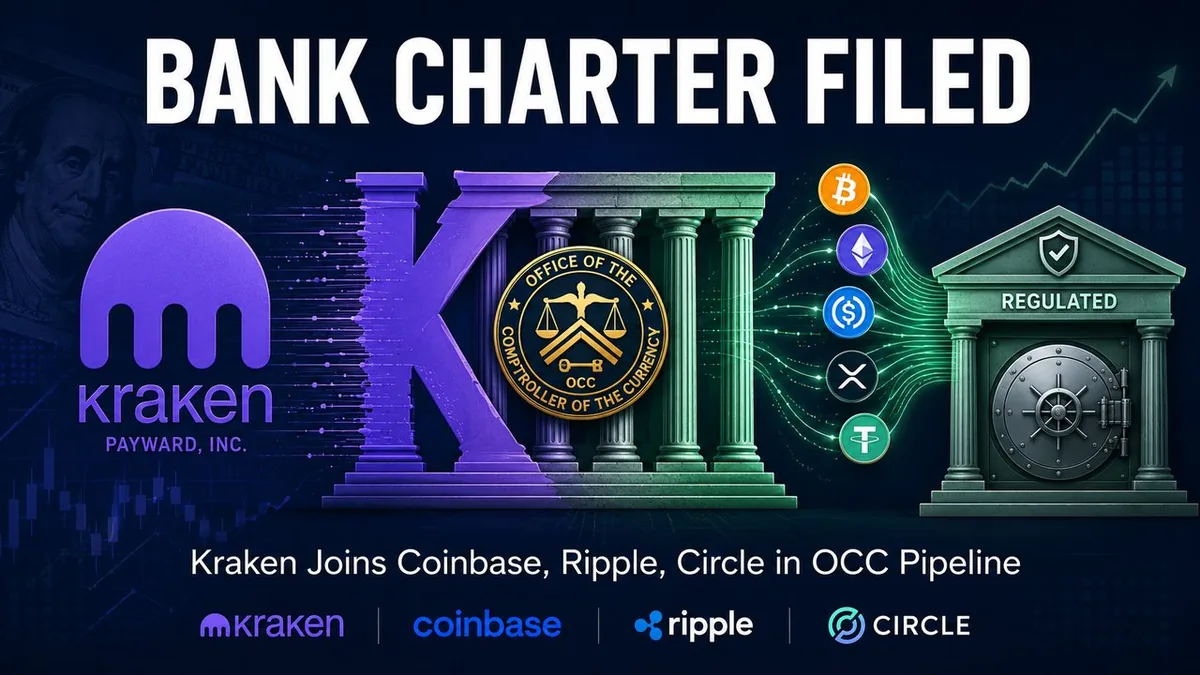
Payward, the parent company of crypto exchange Kraken, filed an application with the Office of the Comptroller of the Currency for a national trust company charter on Friday, May 8, 2026. Co-CEO Arjun Sethi framed the filing as “getting the framework right” rather than “being first,” which is a polite way of acknowledging that Coinbase, Ripple Labs, BitGo, Circle, Fidelity Digital Assets, and Paxos already received OCC approvals in December 2025. Kraken is the seventh major US crypto exchange to file. The pattern is now too consistent to call it anything other than what it is: a banking land grab.
This filing is not Kraken's first banking move. Payward already operates Kraken Financial, a Wyoming Special Purpose Depository Institution, and holds a Federal Reserve master account — both of which are meaningful regulatory positioning. The OCC national trust charter adds federal-level fiduciary custody authority, formalizes Payward's ability to hold customer crypto in regulated trust accounts, and is a precondition for the company's stated intent to IPO in 2027 (per Sethi, “about 80% ready”).
What the Charter Actually Authorizes
From Payward's announcement and the OCC's prior interpretive letters:
- Charter type: National trust company charter (not a full national bank charter)
- Services authorized: Fiduciary custody and other services primarily for digital assets
- Prior approvals: Coinbase, Ripple Labs, BitGo, Circle, Fidelity Digital Assets, and Paxos all received similar OCC approvals in December 2025
- Existing infrastructure: Kraken Financial (Wyoming SPDI), Federal Reserve master account, and the new charter would layer on top
- Recent acquisitions supporting bank ambitions: Bitnomial (closed), Reap (announced)
- Partnership expansion: MoneyGram for global crypto-to-cash withdrawals — leverages bank-rails for retail conversion
- IPO timeline: “About 80% ready” for a 2027 US public offering, per Sethi
- Regulatory context: OCC also weighing World Liberty Financial's application, which has drawn political scrutiny over Trump-family ties
The trust charter is narrower than a full national bank charter — Payward cannot make commercial loans, take FDIC-insured deposits, or use the Fed discount window with this license alone. It can hold customer crypto in regulated trust accounts and offer custody-as-a-service to institutional clients. That is the exact toehold Coinbase used to start migrating its institutional book onto regulated rails.
The 6-Month OCC Pipeline Pattern
The OCC approved six crypto firms for similar charters in December 2025: Coinbase, Ripple, BitGo, Circle, Fidelity Digital, and Paxos. Payward becomes the seventh major filer in mid-2026. The pattern across all seven is consistent:
- Apply for narrow trust charter (not full national bank) to limit regulatory friction
- Position the charter as “institutional custody only” publicly
- Quietly use the charter to migrate retail products onto regulated rails over 12-24 months
- File for full national bank charter once the institutional product proves out
Coinbase is roughly 6 months ahead on this curve. Anchorage Digital was the original template (chartered 2021). Custodia Bank's 2024 rejection (and ongoing court fight) is the cautionary story — apply too aggressively or with politically-fraught backers, and the OCC says no. Payward learned from that, which is why Sethi's “getting the framework right” framing carries strategic weight.
What This Means for Retail Crypto Users
Most retail Kraken users will see no immediate change. Custody pricing may decrease for institutional clients (deposit insurance equivalents, regulated trust protections) and Kraken's ability to integrate with traditional banking rails (ACH, wire) will expand. The longer-term effect: as more crypto exchanges become regulated trust banks, the “not your keys, not your coins” framing of self-custody becomes harder to maintain culturally. If your exchange is FDIC-equivalent regulated, why hold private keys in a hardware wallet?
The trade-off is real. Regulated trust custody = stronger consumer protections, easier tax compliance, audit-friendly statements. Self-custody = censorship resistance, no counterparty risk, no jurisdiction risk. The crypto industry has been arguing for a decade that these are different products for different users. Banking-charter pursuit by the major exchanges is now collapsing the distinction in practice — most retail users will simply use the regulated option and the self-custody share of the market will compress to ideologically-motivated holders.
My Take
Payward's OCC filing is rational, expected, and arguably overdue. The interesting question is not whether Kraken should pursue this charter (yes) or whether it will be approved (probably, after 6-12 months). The interesting question is whether the regulated-banking pivot defeats the original premise of crypto exchanges. Kraken's brand identity has been “crypto-native, security-first, customer-controlled.” The OCC charter trades part of that brand for institutional credibility and IPO-readiness.
The Coinbase template suggests this trade is net-positive for the company in the short term and culturally complicated long term. Coinbase's institutional book has grown faster than its retail book since the December 2025 approval. Kraken probably gets the same outcome. But Coinbase has also lost some of its identity as the “outsider” crypto company — its brand now sits closer to a crypto-flavored Schwab than to a hardware-wallet-first conviction product. Kraken will face the same drift. Sethi's “framework right” framing is intended to cushion that brand transition, but the structural pull toward becoming a normal bank is hard to resist once the charter is granted.
The other thing worth flagging: World Liberty Financial's pending OCC application is a political wildcard. If the OCC approves WLF (Trump-family-linked) on similar terms to Coinbase/Kraken, the trust-charter pipeline becomes politically toxic in ways that complicate every major exchange's approval. If the OCC denies WLF, the precedent constrains all future approvals. Payward's filing this week is timed before that outcome, which is shrewd. Watch for the WLF decision as the inflection point that determines how aggressive the next year of OCC charter approvals can be.
Frequently Asked Questions
What is a national trust charter?
An OCC-issued charter authorizing a company to hold assets in fiduciary custody for clients under federal banking regulation. It is narrower than a full national bank charter — trust companies cannot make commercial loans or take FDIC-insured deposits — but they can offer regulated custody services and operate across all 50 states under federal oversight.
Which other crypto firms have OCC trust approvals?
As of late 2025, six firms received similar OCC approvals: Coinbase, Ripple Labs, BitGo, Circle, Fidelity Digital Assets, and Paxos. Anchorage Digital was the earliest crypto firm chartered (2021). Custodia Bank's 2024 application was rejected and is still in litigation.
Does this mean Kraken can offer FDIC-insured accounts?
No. A trust charter does not authorize FDIC-insured deposits — that requires a full national bank charter (which Kraken has not applied for). Trust customers benefit from federal banking regulatory oversight and bankruptcy-remote custody, but funds are not FDIC-insured.
How long does OCC approval typically take?
Initial application review usually takes 6-12 months for crypto firms. Final approval can take longer if the OCC requests additional capital adequacy assessments or operational reviews. Coinbase's December 2025 approval came roughly 9 months after filing.
What happens to Kraken Financial (the Wyoming SPDI)?
Kraken Financial will likely continue operating in parallel. The Wyoming SPDI charter and the federal OCC trust charter authorize different services in different jurisdictions; Payward can run both as complementary regulated entities to serve different customer segments and use cases.
The Bottom Line
Payward becomes the seventh major US crypto exchange to apply for an OCC national trust charter. The application is rational, follows the Coinbase template, and is timed before the politically-fraught World Liberty Financial decision could constrain future approvals. For retail Kraken users, immediate impact is small; for the broader crypto industry, the regulated-banking pivot is the dominant strategic narrative of 2026 and the “exchanges as banks” transition is now too established to reverse.
Related Reading
- After Kelp DAO's $293M Blowup, DeFi Migrates Oracles to Chainlink
- 1inch Fusion Resolver TrustedVolumes Hit by $6.7M Exploit
- SAP's €1B Bet on Prior Labs