Travis Kalanick's Atoms: The Uber Founder Spent 8 Years Secretly Building a Robot Army
Eight Years in Stealth — Because of Course He Was Hiding
Travis Kalanick, the co-founder and former CEO of Uber who was forced out in 2017 amid allegations of fostering a toxic workplace culture, has finally revealed what he has been doing since. The answer: secretly building a robotics company called Atoms for the past eight years. The company, which operated under the names City Storage Systems and CloudKitchens, has now rebranded and come out of stealth with thousands of employees, an acquisition of Anthony Levandowski’s autonomous vehicle startup Pronto, and ambitions spanning food service, mining, and transportation.
The secrecy was so extreme that employees were reportedly not allowed to put the company name on their LinkedIn profiles. For eight years, thousands of people worked at a company they could not publicly acknowledge. If that sounds familiar, it should — Kalanick ran Uber with a similar philosophy of operating in legal and ethical gray zones and asking for forgiveness later. The difference is that at Uber, the secrecy eventually imploded. At Atoms, we are only now finding out what was being built behind closed doors.
Robots for Food and Mining — Not Humanoids
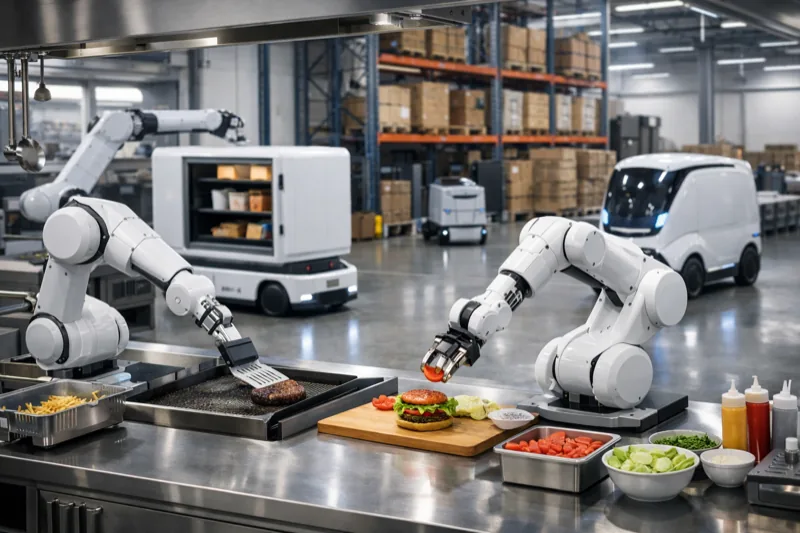
Atoms is deliberately avoiding the humanoid robot trend that has consumed companies like Tesla, Figure, and a dozen well-funded startups. Instead, Kalanick is focused on purpose-built robots for specific industries: food preparation and delivery, mining operations, and transportation logistics. The company has been testing robotic food preparation systems through its CloudKitchens ghost kitchen network, giving it real-world deployment data that most robotics startups can only dream of.
The acquisition of Pronto is particularly interesting. Anthony Levandowski is the engineer at the center of the infamous Uber-Waymo trade secrets lawsuit — he was convicted of stealing self-driving car technology from Google before joining Uber. After receiving a presidential pardon from Donald Trump, Levandowski started Pronto, which focused on autonomous trucking. Now his technology is being folded into Kalanick’s robot empire. The Uber autonomous driving saga has come full circle, except this time the people involved have criminal convictions and pardons on their resumes.
The Kalanick Problem: Culture and Accountability
The fundamental question with Atoms is not whether the technology works. It is whether Travis Kalanick has changed. His tenure at Uber ended with a board revolt driven by a company culture that included systemic sexual harassment, executive retaliation against whistleblowers, the use of secret software to evade regulators, and a CEO who was caught on camera berating a driver. Kalanick did not resign voluntarily — he was pushed out by his own investors.
Now he is running a company where employees cannot even say where they work. The stealth mode that lasted eight years was not just about competitive advantage — it was about control. Kalanick has always preferred to operate without oversight, without scrutiny, and without the kind of public accountability that comes with being a known entity. The fact that Atoms is emerging from stealth now, with thousands of employees and significant acquisitions, suggests the company has reached a scale where hiding is no longer possible — not that Kalanick chose transparency.
The Bottom Line
Travis Kalanick spending eight years secretly building a robot army is exactly the kind of move you would expect from the man who turned Uber into a verb and a cautionary tale simultaneously. The technology pivot away from humanoids and toward practical industrial robots is smart. The acquisition of Levandowski’s Pronto gives Atoms autonomous vehicle expertise with a complicated history attached. But the real question is not about robots — it is about the person building them. Kalanick was fired from his last company for creating a culture so toxic it became a Harvard Business School case study. He spent the next eight years building in secret, forbidding employees from even naming their employer. That is not stealth mode. That is a pattern. The robots might work perfectly. The culture around them is what you should watch.