Instructure (Canvas) Confirms Data Breach: ~9K Institutions Affected, 3.65TB Stolen
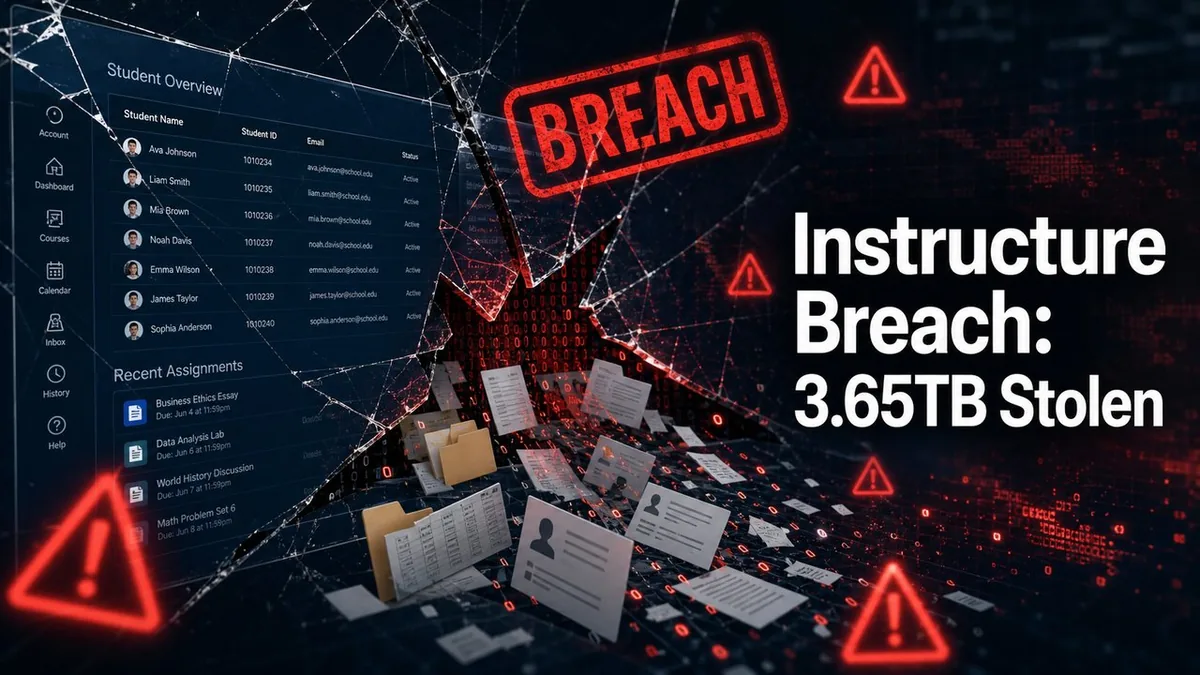
Instructure, the EdTech company behind the Canvas Learning Management System, has confirmed a data breach affecting approximately 9,000 educational institutions globally, with hackers claiming to have exfiltrated 3.65 terabytes of data including student identification records, course content, and direct messages. The breach disclosure — published via SEC Form 8-K and a customer notification email yesterday afternoon — represents one of the largest EdTech security incidents on record and immediately puts pressure on Canvas's market position as the dominant LMS for U.S. higher education.
The exposure is significant. Canvas serves roughly 8 million students at K-12 and 22 million at higher education institutions, making it one of the most widely-deployed educational platforms globally. The 9,000 affected institutions represent the bulk of Canvas's customer base; the 3.65TB of allegedly-stolen data, if confirmed, encompasses years of operational records across student demographics, enrollment patterns, course content, grades, and instructor-student communication.
What was actually stolen (per attacker claims)
The threat actor's leaked sample includes three categories of data. First, student identification records — names, dates of birth, institution affiliations, and in some cases government-issued ID numbers (varying by jurisdiction and what the institution chose to store). Second, course content and gradebooks — full course curricula, assignments, submitted student work, and historical gradebook data. Third, direct messages — instructor-to-student and student-to-student communications via Canvas's built-in messaging system.
The student-ID exposure is the most consequential category for affected individuals. Federal Student Aid (FAFSA) data — which some institutions store within Canvas integration — could enable identity theft and financial fraud against students. Course content and grades have lower individual-harm risk but represent meaningful intellectual property loss for institutions and instructors. Direct messages are mixed — most are routine, but specific cases (counseling contexts, accommodations requests, sensitive personal disclosures) could be highly damaging.
What Instructure has disclosed
Instructure's official statement confirms the breach but disputes the attacker's quantitative claims. The company says forensic investigation is ongoing and that the actual data exposure may be smaller than the 3.65TB claim. Instructure has engaged Mandiant and CrowdStrike for incident response and notified the FBI and state regulators. The initial breach vector has not been publicly disclosed but appears to involve compromised privileged-access credentials rather than a direct exploitation of Canvas's product surface.
Customer institutions have been notified and provided with recommended response actions including password resets, MFA enforcement, and student communication templates. Most institutions are still in the early-response phase; full notification of affected individual students will likely take 30-60 days under standard breach-notification timelines.
My Take
This breach matters for three reasons beyond its immediate scale. First, EdTech security has been under-invested for years, and Canvas's incident is going to force a category-wide reckoning. Schoology, Blackboard, D2L, and other LMS platforms are likely facing accelerated security audits and customer pressure. The competitive landscape may shift toward platforms with stronger security postures.
Second, the regulatory response will be substantial. The U.S. Department of Education, FERPA enforcement, and state-level attorneys general all have jurisdiction over student-data breaches. Expect material penalties for Instructure if forensic evidence supports the 3.65TB claim, plus extended consent-decree obligations that will reshape Canvas's security and operational requirements.
Third, the breach demonstrates that PE-owned EdTech is now a prime ransomware target. Canvas was acquired by Thoma Bravo in 2020 and operates with the cost-management discipline typical of PE portfolio companies — which often means under-investment in security infrastructure. The attacker pattern (privileged-access compromise rather than product exploitation) suggests insider-or-IT-vendor compromise; that vector is consistent across multiple recent EdTech and SaaS breaches and points to industry-wide hygiene failures.
For affected students and institutions, the practical recommendation is to treat Canvas-stored personal data as compromised and act accordingly: monitor financial accounts for fraud, enable MFA on all educational platforms, and request institutional confirmation of what specific data was exposed. Do not assume the institution will handle this proactively; affected individuals should drive their own response.
What this means for the EdTech sector
Three implications. First, expect EdTech security to become a procurement criterion for K-12 and higher-ed contracts, with security audits and incident-response track records weighted alongside pricing and feature competitiveness. Second, expect cyber insurance premiums for EdTech to rise materially through 2026, with some insurers exiting the segment entirely. Third, expect renewed regulatory attention to FERPA and student-data privacy, with possible new federal legislation extending HIPAA-like protections to educational records.
For Instructure specifically, the immediate cost is reputational and litigation-driven; the longer-term cost depends on whether Canvas can retain its market dominance through the recovery phase. Loss of even 10-15% of customer base to competitors would meaningfully impair Canvas's commercial trajectory, and that's a realistic risk.
Frequently Asked Questions
How big is the breach?
Approximately 9,000 educational institutions affected based on Instructure's notification. Hackers claim 3.65 terabytes of data exfiltrated; Instructure disputes the quantitative claim and forensic investigation is ongoing.
What student data was exposed?
Per the attacker's disclosed sample: identification records (names, DOB, institution affiliations), course content and gradebooks, and Canvas direct messages. Some institutions store additional sensitive data in Canvas integrations.
What should affected students do?
Monitor financial accounts for fraud activity, enable multi-factor authentication on educational and financial accounts, request specific exposure confirmation from your institution, and review your credit reports for unusual activity over the next 12 months.
Will Canvas continue operating?
Yes. Instructure remains operational and Canvas continues to serve customer institutions. The recovery phase includes ongoing forensic investigation, customer notification, and security infrastructure improvements. Loss of customer market share is a meaningful risk over 12-18 months.
The Bottom Line
The Instructure / Canvas data breach is one of the largest EdTech security incidents ever disclosed, with significant implications for student data privacy, EdTech industry security investment, and the broader PE-owned-SaaS security posture. Affected students should treat their Canvas-stored data as compromised and respond accordingly. Expect material regulatory action and competitive market repositioning over the next 12-18 months.
Related Articles
- Critical cPanel Bug Actively Exploited
- Ubuntu Services Hit by 850 Gbps DDoS Attack
- OpenAI Staff Flag Violence-Reporting Gaps