India Built a $300B Outsourcing Empire — Now AI Is Coming for Those Jobs
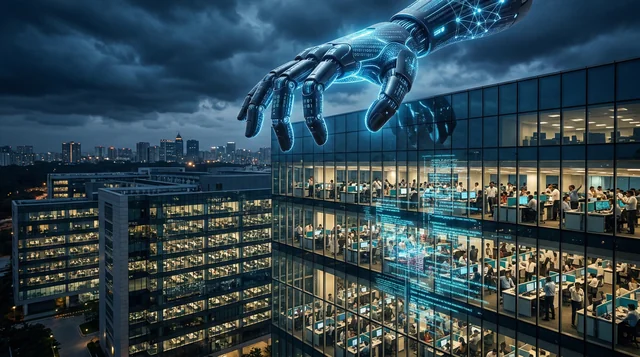
India's $300 billion outsourcing industry — the backbone of its economic transformation over the past 25 years — is staring down an existential threat. And the irony is almost too perfect: artificial intelligence is doing to India what India's cheap labor model did to Western workers.
The Disruptor Gets Disrupted
For a quarter century, India positioned itself as the world's back office, providing an educated, English-speaking workforce to perform tasks more cheaply than in the United States or Europe. The industry today employs more than six million people and accounts for over 7% of India's GDP.
But AI-powered tools are now capable of automating the very white-collar work that made India a tech powerhouse. Startups like Hunar.AI in Gurugram are building chatbots that handle entire hiring processes — from resume screening to onboarding — without a single human involved.
The Numbers Tell the Story
Tata Consultancy Services, one of India's largest employers, has already shrunk its workforce to 580,000, a decline of more than 20,000 from its 2022 peak when it hired 100,000 new workers in a single year. Rival Infosys has also slowed hiring, while dozens of smaller startups laid off workers across the country in 2025.
A research report by Citrini Research sent Indian tech stocks spiraling on February 22, painting a doomsday scenario about AI's impact. The report's key insight was brutally simple: "The entire model was built on one value proposition: Indian developers cost a fraction of their American counterparts. But the marginal cost of an AI coding agent had collapsed to, essentially, the cost of electricity."
India's AI Pivot — Too Little, Too Late?
Prime Minister Narendra Modi has pledged to make India an AI power, urging the country's software engineers to develop and export new technologies. But there's a fundamental problem: India lacks the infrastructure and natural resources needed to power AI products at scale.
While Indian graduates scramble to "upskill" — learning AI technology that's reshaping their industry — the uncomfortable truth remains. The investment firm Menlo Ventures puts it bluntly: "Markets are pretty efficient. If a tool exists that does a job cheaper, it will be adopted."
The Bottom Line
India built its economic miracle on being the cheaper option. Now something even cheaper has arrived. The question isn't whether AI will disrupt Indian outsourcing — it's whether India can reinvent itself fast enough to survive the disruption it once inflicted on others.
Source: The New York Times