India Banned China's Consumer Apps — Now It's Partnering With Alibaba to Sell Globally
In 2020, India made one of the most dramatic tech policy decisions of the decade: it banned TikTok, AliExpress, and dozens of other Chinese apps, citing national security concerns. The message was clear — Chinese consumer technology was not welcome in India.
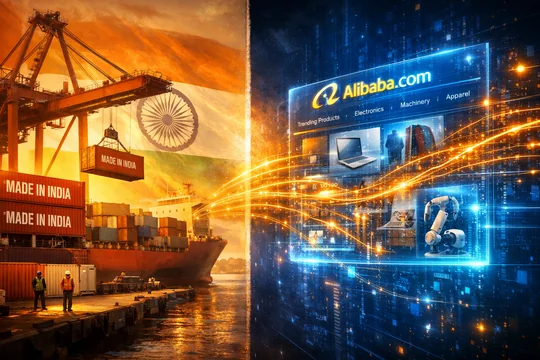
Fast forward to 2026, and India is partnering with Alibaba.com — yes, Alibaba — to help small and medium Indian businesses export their goods to the world. The government is working with the Chinese B2B giant as part of its ambitious plan to boost merchandise exports to $2 trillion by 2030.
The Deal That Nobody Saw Coming
India's Commerce Ministry, through the Directorate General of Foreign Trade (DGFT), is collaborating with Alibaba.com to onboard Indian SMEs onto the platform. The goal: help Indian exporters tap into global demand by leveraging Alibaba's massive international B2B marketplace, which connects suppliers with buyers across 190+ countries.
Alibaba.com already lists over 600,000 Indian suppliers, making India one of its top three sourcing countries. The partnership aims to grow this number significantly, with special focus on sectors like textiles, handicrafts, auto parts, and pharmaceuticals — sectors where India already has a competitive advantage.
The Obvious Contradiction
The optics are jarring. India banned Chinese consumer apps because they allegedly siphoned user data back to Beijing. The geopolitical tensions following the 2020 Galwan Valley border clash made the bans feel not just reasonable but necessary.
But here's the nuance the government is betting on: consumer apps that collect personal data from hundreds of millions of Indians are fundamentally different from a B2B platform that helps Indian businesses sell "Made in India" goods abroad. One is a perceived security threat. The other is a trade enabler.
Why This Makes Strategic Sense
India's export ambitions are massive. The country wants to double its merchandise exports from roughly $780 billion to $2 trillion by 2030. To get there, it needs every tool available — including Chinese ones.
Alibaba.com is the world's largest B2B cross-border trade platform. No Indian or Western alternative comes close in terms of global buyer reach. Amazon Business, Udaan, and IndiaMART serve different markets. For an Indian textile exporter in Surat trying to reach a buyer in Brazil, Alibaba.com is often the most efficient path.
The government's calculation is pragmatic: use Chinese infrastructure to boost Indian exports, while keeping Chinese consumer apps out of Indian phones. It's compartmentalized geopolitics — friendly where it helps the economy, hostile where it threatens sovereignty.
The Bigger Picture
This partnership is part of a broader pattern in India's foreign policy: strategic ambiguity. India bans Chinese apps but increases trade with China (bilateral trade hit $136 billion in 2024). It joins the Quad with the US but buys Russian oil. It champions "Make in India" but relies on Chinese components for its electronics manufacturing.
The India-Alibaba partnership is just the latest example of this approach. And honestly? It might be the most rational one. In a world where every country needs China for something, pretending otherwise is either naive or performative.
The question isn't whether this is hypocritical. It's whether India can navigate these contradictions without compromising its long-term strategic interests. So far, the bet seems to be: sell globally through Chinese platforms, but never let Chinese platforms sell to Indian consumers.
Geopolitics, it turns out, is just vibes.