India AI Impact Summit 2026: PM Modi Says Intelligence and Rationality Key to AI for Public Good
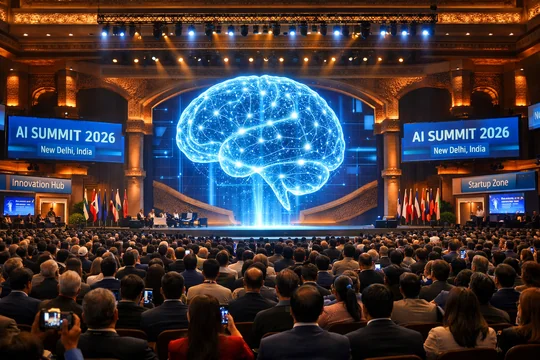
Prime Minister Narendra Modi inaugurated the India AI Impact Summit 2026 at Bharat Mandapam in New Delhi, marking a historic moment as the first major global AI gathering to be hosted in the Global South. In his remarks, PM Modi emphasized that intelligence, rationality, and sound decision-making are essential to ensuring artificial intelligence serves the public interest — not just corporate bottom lines.
India Positions Itself as the AI Bridge Between Silicon Valley and the Developing World
The India AI Impact Summit 2026 is not just another tech conference. With participation from over 20 Heads of State, 60 Ministers, and 500 global AI leaders, it signals India's ambition to become the central hub for AI governance and innovation in the developing world. Policymakers, technology companies, academia, and industry representatives have gathered to translate AI discussions into tangible development outcomes under the IndiaAI Mission and the Digital India initiative.
In a post on X, PM Modi said: "Intelligence, rationality and decision-making make science and technology useful to the masses. The India AI Impact Summit also aims to see how AI can be used in the public interest." He also highlighted the role of Indian talent and innovation, stating that the summit offers a glimpse into the extraordinary potential of AI combined with India's deep pool of researchers and developers.
The Numbers Behind the Summit
The scale of the event is staggering. The India AI Impact Expo spans 10 arenas across more than 70,000 square metres, featuring over 300 exhibition pavilions. More than 600 startups are participating, showcasing AI applications across healthcare, agriculture, education, finance, and governance. The event is expected to attract over 2.5 lakh visitors, including international delegates from across the globe.
After inaugurating the Expo, PM Modi interacted with exhibitors including startups and research institutions. He was accompanied by Union Minister Ashwini Vaishnaw and Minister of State Jitin Prasada, underscoring the government's direct involvement in pushing AI adoption at scale.
India's Digital Infrastructure Gives It a Unique AI Advantage
Mukesh Aghi, President and CEO of the US-India Strategic Partnership Forum, highlighted India's leadership in the democratization and diffusion of AI. "India has taken a very strong lead in trying to make AI more affordable, scalable, and accessible to its citizens," he told ANI, pointing to India's massive structured database — built on the back of Aadhaar, UPI, and DigiLocker — as a key differentiator.
This is a crucial point. While the US and China dominate AI research and model development, India's real advantage lies in its digital public infrastructure. No other country has a billion-plus population connected through a unified digital identity, payments, and data layer. This makes India uniquely positioned to deploy AI solutions at population scale — something even advanced economies struggle with.
The Real Test: Can AI Reach the People Who Need It Most?
The summit's goals are ambitious, but the real challenge lies in execution. India has 600+ AI startups showcasing solutions at the expo, but the question remains: will these innovations actually reach the 800 million people in rural and semi-urban India who stand to benefit the most? AI-powered crop advisory, telemedicine, financial inclusion, and education tools exist in prototype — the gap is always in last-mile delivery.
PM Modi's emphasis on "intelligence and rationality" is well-placed. The hype around AI is real, but so are the risks of deploying it without adequate safeguards. India's approach — focusing on public interest, affordable access, and leveraging existing digital infrastructure — offers a template that other developing nations are watching closely.
The Bottom Line
The India AI Impact Summit 2026 is a bold statement of intent. India is not content being a consumer of AI built elsewhere — it wants to shape the rules, build the tools, and ensure the benefits reach everyone, not just the tech elite. Whether this vision translates into reality will depend on execution, investment, and political will. But for now, India has the world's attention, and the Global South has a champion at the table.