Immersive Sports Viewing: How Volumetric Video Changes Fans
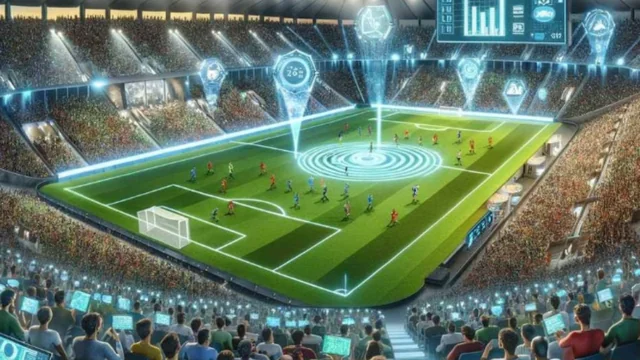
Immersive Sports Viewing Is No Longer a Gimmick—It’s a Strategy
As reported by TechCrunch [LINK TO SOURCE], sports leagues are facing a quiet but serious problem: younger fans are tuning out. Traditional broadcasts—one angle, fixed commentary, passive viewing—don’t compete well with interactive digital experiences. The response? A new wave of immersive sports viewing powered by AI, 3D reconstruction, and technology borrowed from self-driving cars.
One startup, Peripheral Labs, is betting that the future of sports isn’t just watched—it’s explored.
Key Facts at a Glance
Peripheral Labs is a Canada-based startup founded in 2024 by Kelvin Cui and Mustafa Khan, both alumni of the University of Toronto’s autonomous driving team. The company builds volumetric video systems that reconstruct live sports in photorealistic 3D.
Unlike traditional volumetric capture setups that require over 100 cameras, Peripheral Labs reduces that number to roughly 32 using AI-driven perception models. The platform enables viewers to rotate plays, freeze moments, follow specific players, and analyze movement in ways that resemble a video game rather than a TV broadcast.
The company recently raised $3.6 million in seed funding led by Khosla Ventures.
Why Immersive Sports Viewing Matters Right Now
The bigger story isn’t just about better camera tech—it’s about changing consumer behavior.
Gen Z and younger millennials expect control, interactivity, and personalization. They don’t just want to watch a game; they want to manipulate it, analyze it, and share moments from their own perspective. Immersive sports viewing directly addresses this shift.
This also reflects a broader trend: industries outside automotive are repurposing self-driving car technology. The same perception systems designed to understand roads and objects can interpret athletes, joints, and movement in real time. Sports just happen to be a highly visual, emotionally charged proving ground.
From a business standpoint, volumetric video also opens new revenue models. Teams can sell premium viewing modes, advanced analytics, or interactive replays without changing the sport itself.
How Volumetric Video Changes the Fan Experience
Volumetric video sports platforms reconstruct an entire play in 3D space. That unlocks experiences traditional broadcasts simply can’t deliver:
-
View a play from any angle, not just the director’s cut
-
Freeze critical moments to examine fouls or goals
-
Follow a single player throughout a sequence
-
Overlay biomechanical data like joint flexion and body positioning
Peripheral Labs’ system can even track fine movements such as knees, ankles, and fingers. For fans, that means deeper insight. For coaches and analysts, it means data-driven feedback that was previously impossible without wearables.
Implications for Broadcasters, Teams, and Leagues
For broadcasters, immersive sports viewing represents both a threat and an opportunity. Linear TV formats risk becoming outdated, but interactive feeds create differentiation and new sponsorship inventory.
For teams and leagues, lower hardware costs are critical. Peripheral Labs’ approach—fewer cameras, modular deployment, multi-year platform contracts—suggests volumetric video could finally scale beyond elite venues.
The likely next step is hybrid broadcasts: traditional live feeds enhanced with optional 3D replays and interactive layers. Over time, fans may expect this level of control by default, not as a premium add-on.
A Contrarian Take: This Isn’t Just for Hardcore Fans
The assumption is that advanced 3D sports replay only appeals to analysts and die-hard fans. But history suggests otherwise. Features like instant replay, slow motion, and on-screen graphics were once considered niche. Today, they’re standard.
Immersive sports viewing may follow the same path—starting as a novelty, then quietly becoming essential. The real challenge won’t be technology adoption, but designing interfaces that feel intuitive rather than overwhelming.
Looking Ahead: The Future of Immersive Sports Viewing
Peripheral Labs is still early, with partnerships yet to be publicly announced. But the direction is clear. As AI sports broadcasting matures, the line between watching and playing will blur.
The winners won’t just deliver better visuals—they’ll redefine how fans participate in live sports. In that future, immersive sports viewing won’t be a feature. It’ll be the baseline.
Q: What is immersive sports viewing?
A: Immersive sports viewing lets fans explore games interactively using 3D reconstruction, multiple angles, and AI-driven controls instead of a single fixed broadcast view.
Q: How does volumetric video work in sports?
A: Volumetric video sports systems use multiple cameras and AI models to reconstruct live action in 3D, allowing viewers to rotate, pause, and analyze plays from any angle.
Q: Can immersive sports viewing replace traditional broadcasts?
A: Not immediately. It’s more likely to complement traditional broadcasts at first, offering enhanced replays and interactive options alongside standard live feeds.