Humanoid Robots Beat Humans at Beijing Half-Marathon — One Breaks World Record
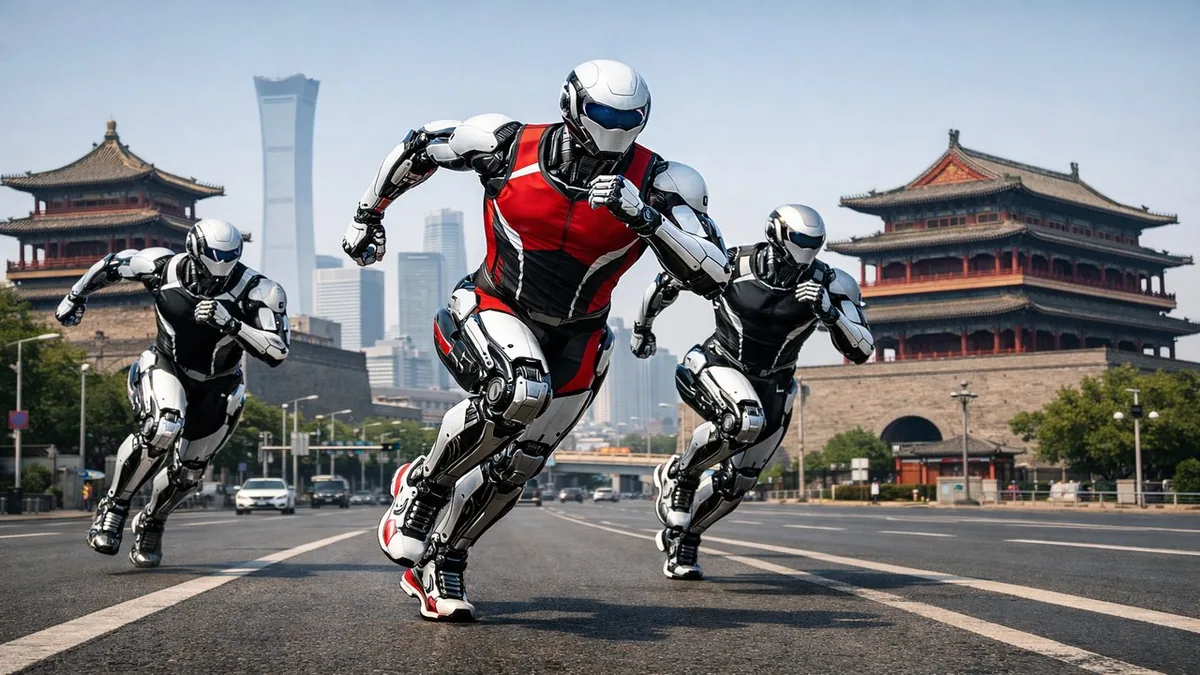
In a landmark moment for robotics, several humanoid robots completed the Beijing Half-Marathon faster than all human participants, with a robot made by Honor shattering the human world half-marathon record previously held by Jacob Kiplimo. The robots beat human winners by more than 10 minutes, marking one of the most dramatic public demonstrations of how rapidly humanoid robotics has advanced.
What Happened at the Beijing Race
The Beijing Half-Marathon included a dedicated humanoid robot category, with machines from multiple Chinese robotics companies participating alongside human runners. Honor's robot — leveraging advanced actuators, real-time gait optimization, and high-endurance power systems — completed the 21.1 km course at a pace that exceeded the standing human world record.
The result was greeted with both awe and unease on social media. Some observers noted the symbolic weight of a machine not merely matching human physical performance but surpassing it under real-world race conditions, with unpredictable terrain, weather, and crowd variables.
Why This Matters for Robotics
Half-marathon performance is a meaningful benchmark because it combines sustained power output, balance, thermal management, and adaptive locomotion over an extended period. These are exactly the challenges that have historically limited humanoid robots to short demonstrations in controlled lab settings.
Honor's achievement signals that Chinese robotics companies — backed by substantial state investment and access to domestic hardware manufacturing — are reaching performance levels that were considered years away by most analysts.
The Competitive Landscape
China has been investing heavily in humanoid robotics as a strategic national priority, with companies like Unitree, UBTECH, and now Honor emerging as credible rivals to Boston Dynamics and Figure AI in the US. The Beijing marathon result is likely to intensify both domestic investment and geopolitical scrutiny of Chinese humanoid robot capabilities.
Tesla's Optimus robot program and Figure AI's recent deployments in industrial settings suggest that the race to build practical humanoid robots is heating up globally — but the Beijing results show China may be ahead in raw physical performance benchmarks.
The Bottom Line
A humanoid robot breaking the human half-marathon world record is a milestone that would have seemed like science fiction a decade ago. It is now a market signal: the gap between human and machine physical performance is closing faster than expected, with major implications for manufacturing, logistics, and beyond.
Related Articles
- Tesla Robotaxi Expands to Dallas and Houston
- Google Forms AI Coding Strike Team