Explaining Power Play in Cricket: What It Means and How It Affects the Match
What is Power Play in Cricket? A Complete 2025 Guide
Power Play remains one of cricket's most strategic and exciting elements, fundamentally changing how limited-overs matches unfold. As we enter 2025, recent ICC rule modifications have refined these regulations, particularly affecting shortened T20 matches and creating subtle differences between men's and women's cricket formats. Understanding these fielding restrictions is crucial for players, spectators, and anyone looking to grasp cricket's tactical nuances.
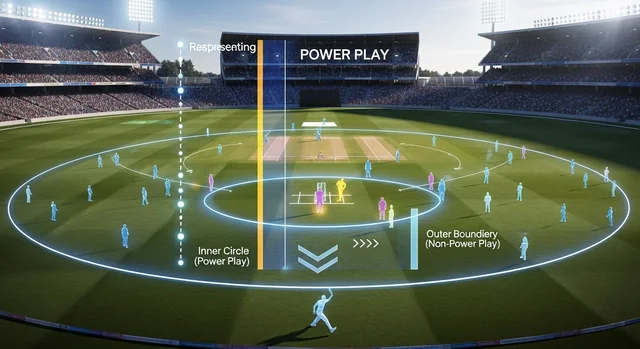
At its core, Power Play refers to designated periods during limited-overs cricket where strict fielding restrictions apply. These rules limit how many fielders can be positioned outside specific boundary circles, encouraging aggressive batting and higher scoring rates. The concept transforms cricket from a potentially defensive affair into an attacking spectacle that captivates audiences worldwide.
The Evolution and 2025 Updates to Power Play Rules
Cricket's Power Play system has undergone significant evolution since its introduction in the 1970s World Series Cricket. The International Cricket Council (ICC) formalized these restrictions in 2005, creating the structured system we recognize today. However, July 2025 brought important updates that reflect the game's continued adaptation to modern cricket demands.
For more details, check out our guide on Top 7 Best Video Player for Windows PC.
The most significant 2025 change affects shortened T20 matches, where Power Play overs are now rounded to the nearest ball rather than the nearest over. This modification ensures more precise calculations when weather or other factors reduce match duration, maintaining competitive balance even in abbreviated contests.
Key Historical Milestones
- 1970s: World Series Cricket introduces basic fielding restrictions
- 1992: Fielding restrictions officially adopted in ODI cricket
- 2005: ICC creates formal "Power Play" terminology and structure
- 2012: T20 Power Play rules standardized globally
- 2025: Shortened match calculations refined for precision
T20 Power Play Rules: 2025 Format
Twenty20 cricket employs a straightforward Power Play system designed to maximize entertainment value within the format's compressed timeframe. Understanding these rules is essential for appreciating T20's fast-paced nature and strategic depth.
T20 Power Play Structure
In T20 matches, the Power Play consists of the first six overs of each innings. During this period, only two fielders are permitted outside the 30-yard circle (25-yard circle in women's cricket). This restriction forces captains to position most fielders in catching positions near the batsman, creating opportunities for boundaries while simultaneously increasing dismissal chances.
The 2025 rule modification particularly affects rain-shortened T20 matches. Previously, Power Play overs were rounded to the nearest over, but the new system rounds to the nearest ball, providing more accurate calculations. For example, in a match reduced to 17.3 overs, the Power Play would now last 5.3 overs rather than being rounded to either 5 or 6 complete overs.
Strategic Implications for T20
Teams typically target 50-60 runs during the T20 Power Play, establishing a foundation for competitive totals. Successful Power Play batting often determines match outcomes, as teams struggle to recover from poor starts in cricket's shortest format. Conversely, bowling teams focus on taking early wickets while containing scoring, knowing that breakthrough moments during these overs can shift momentum decisively.
ODI Power Play: The Three-Phase System
One Day International cricket employs a more complex Power Play structure divided into three distinct phases, each presenting unique strategic challenges and opportunities.
Phase 1: Mandatory Power Play (Overs 1-10)
The opening phase mirrors T20 restrictions, limiting fielding teams to two players outside the 30-yard circle. This mandatory period encourages aggressive batting from the outset while providing bowlers with close catching positions. Teams typically target 40-50 runs during this phase, balancing aggression with wicket preservation for the longer innings ahead.
Phase 2: Middle Overs (Overs 11-40)
During the middle phase, up to five fielders can be positioned outside the circle, allowing defensive field settings. This period often features the most tactical cricket, as batsmen work to maintain scoring rates against spread fields while bowlers attempt to control run flow and create pressure through dot balls.
Phase 3: Final Power Play (Overs 41-50)
The final phase returns to Power Play restrictions, permitting only four fielders outside the circle. This compromise between the earlier phases creates exciting climaxes as batsmen launch final assaults while bowlers defend totals with slightly more flexibility than the opening Power Play.
| ODI Phase | Overs | Fielders Outside Circle | Strategic Focus | Target Runs |
|---|---|---|---|---|
| Phase 1 | 1-10 | Maximum 2 | Foundation building | 40-50 |
| Phase 2 | 11-40 | Maximum 5 | Consolidation | 120-150 |
| Phase 3 | 41-50 | Maximum 4 | Acceleration | 60-80 |
Men's vs Women's Cricket: Understanding the Circle Differences
One crucial distinction often overlooked involves the different circle sizes used in men's and women's cricket. While the fundamental Power Play principles remain consistent, the fielding circle dimensions create subtly different strategic considerations.
Men's cricket utilizes a 30-yard circle, providing a larger area for close fielders and requiring greater precision for boundary shots. Women's cricket employs a 25-yard circle, creating a more compact field that can lead to different tactical approaches. These variations reflect the different physical dimensions and playing styles between the formats while maintaining competitive balance.
Impact on Strategy
The smaller circle in women's cricket means fielders are positioned closer to the batsman, potentially creating more catching opportunities but also making it easier to clear the inner ring. Teams must adjust their Power Play strategies accordingly, with batsmen potentially adopting different shot selections and bowlers modifying their line and length approaches.
See also: How to Play Free Fire on PC with Keyboard and Mouse Controls.
Power Play Violations and Penalties
Cricket's Power Play rules carry strict enforcement mechanisms designed to maintain competitive integrity and ensure compliance with fielding restrictions.
No-Ball Penalties
When fielding teams violate Power Play restrictions by positioning too many players outside the designated circle, umpires signal a no-ball. This penalty provides the batting team with several advantages: an extra run added to the total, the ball doesn't count toward the over, and most significantly, the next delivery becomes a free hit.
Free Hit Rule
The free hit rule, triggered by Power Play violations, allows batsmen to attempt aggressive shots without dismissal risk (except run-outs). This penalty significantly favors batting teams and can prove costly for fielding sides, making precise field positioning crucial during Power Play periods.
Captains and coaches spend considerable time ensuring players understand exact circle boundaries and positioning requirements, as violations can swing match momentum dramatically. Modern technology assists umpires in monitoring compliance, with boundary markers and electronic systems helping identify infractions quickly and accurately.
Statistical Impact: Power Play Performance and Match Outcomes
Cricket statistics reveal Power Play performance as a crucial predictor of match success, with specific benchmarks indicating winning probabilities across different formats.
2019 World Cup Analysis
Data from the 2019 Cricket World Cup demonstrated that teams scoring 60 or more runs during the opening Power Play achieved a remarkable 70% win rate. This statistic underscores the correlation between early aggression and match success, influencing how teams approach these crucial opening overs.
The analysis revealed that successful Power Play batting creates psychological advantages beyond mere runs scored. Teams establishing early dominance often maintain momentum throughout innings, while those struggling early face mounting pressure that can compound throughout the match.
Learn more in our article about The Ultimate Guide to the Best Android Emulators in 2025: Gaming and Apps Without Limits.
Format-Specific Benchmarks
Different formats require adjusted expectations for Power Play performance:
- T20 Cricket: 50-60 runs represents excellent Power Play batting
- ODI Cricket: 40-50 runs provides a solid foundation
- T10 Cricket: 30-40 runs maximizes the abbreviated format
These benchmarks help teams evaluate performance and adjust strategies accordingly. Consistent achievement of these targets typically correlates with improved overall team performance and higher win percentages across seasons.
Modern Power Play Strategies and Tactics
Contemporary cricket has witnessed sophisticated tactical evolution in Power Play approaches, with teams developing specialized strategies for different match situations and opposition types.
Batting Strategies
Modern batting approaches during Power Play periods emphasize calculated aggression rather than reckless hitting. Teams often designate specific players as Power Play specialists, individuals skilled at exploiting fielding restrictions while minimizing dismissal risk. These players combine technical proficiency with aggressive intent, capable of finding boundaries consistently during restriction periods.
Successful teams also develop contingency plans for different scenarios. When early wickets fall, middle-order batsmen must adapt their approaches, potentially sacrificing some aggression for stability. Conversely, when Power Play batting succeeds, teams can establish platforms for massive totals that put significant pressure on opposition run chases.
Bowling and Fielding Tactics
Bowling during Power Play periods requires balancing attack and defense, seeking wickets while preventing excessive boundary scoring. Many teams employ specialist Power Play bowlers who excel at taking early wickets, often sacrificing some economy rate for breakthrough potential.
Field placement becomes an art form during Power Play overs, with captains positioning fielders to create catching opportunities while covering the most likely scoring areas. The restriction on fielders outside the circle forces creative positioning within the inner ring, leading to innovative field settings that maximize dismissal chances.
Learn more in our article about Hamachi Alternatives For Virtual LAN Gaming.
Technology and Power Play Enforcement
Modern cricket increasingly relies on technology to ensure accurate Power Play rule enforcement, reducing human error and maintaining competitive fairness.
Electronic boundary systems help umpires monitor fielder positions precisely, while broadcast technology provides instant verification of potential violations. These technological advances have made Power Play enforcement more consistent and accurate, reducing controversial decisions that could affect match outcomes.
Player tracking systems also provide detailed analytics about Power Play performance, helping teams identify strengths and weaknesses in their approaches. This data-driven analysis enables more sophisticated tactical planning and performance evaluation.
Frequently Asked Questions About Power Play in Cricket
What happens if a fielding team violates Power Play rules?
When a fielding team positions too many players outside the designated circle during Power Play, the umpire signals a no-ball. This results in an extra run for the batting team, the ball doesn't count toward the over, and the next delivery becomes a free hit where the batsman cannot be dismissed except by run-out.
How many overs is Power Play in T20 cricket?
T20 Power Play lasts for the first six overs of each innings, during which only two fielders can be positioned outside the 30-yard circle (25-yard circle in women's cricket). The 2025 ICC rule change affects shortened matches, where Power Play duration is now calculated to the nearest ball rather than the nearest over.
What's the difference between ODI and T20 Power Play rules?
T20 cricket has a single Power Play lasting six overs with maximum two fielders outside the circle. ODI cricket uses a three-phase system: Phase 1 (overs 1-10) allows maximum two fielders outside, Phase 2 (overs 11-40) allows maximum five fielders outside, and Phase 3 (overs 41-50) allows maximum four fielders outside the circle.
Why are there different circle sizes for men's and women's cricket?
Men's cricket uses a 30-yard circle while women's cricket uses a 25-yard circle. This difference reflects the different physical dimensions and playing styles between the formats while maintaining competitive balance and ensuring appropriate strategic challenges for each format.
What constitutes a good Power Play score in different formats?
In T20 cricket, teams typically target 50-60 runs during the six-over Power Play. For ODI cricket, 40-50 runs during the first ten overs represents solid foundation building. Teams achieving these benchmarks significantly improve their chances of posting competitive totals and winning matches.
Can fielding restrictions be changed during Power Play overs?
No, Power Play fielding restrictions are mandatory and cannot be modified during the designated overs. In ODI cricket, only the batting team previously had some control over when to take their discretionary Power Play, but current rules have standardized the three-phase system with fixed timing for all phases.
How do weather interruptions affect Power Play calculations?
The 2025 ICC rule change refined calculations for shortened matches, particularly in T20 cricket. Power Play overs are now rounded to the nearest ball rather than the nearest over, providing more precise calculations when weather or other factors reduce match duration while maintaining competitive balance.
What role does Power Play performance play in match outcomes?
Power Play performance significantly influences match results. Analysis from the 2019 World Cup showed that teams scoring 60+ runs during the opening Power Play achieved a 70% win rate. Strong Power Play batting creates psychological advantages and momentum that often persist throughout the entire innings.
Are there any exceptions to Power Play fielding restrictions?
Power Play restrictions are strictly enforced with no exceptions during the designated overs. All fielding teams must comply with the maximum number of players allowed outside the circle, regardless of match situation or tactical preferences. Violations result in immediate no-ball penalties and free hits for the batting team.
Learn more in our article about 15 Best VLC Media Player Keyboard Shortcuts.
How has Power Play strategy evolved in modern cricket?
Modern Power Play strategy emphasizes calculated aggression over reckless hitting. Teams now designate Power Play specialists, develop format-specific approaches, and use data analytics to optimize performance. Bowling strategies have also evolved to balance wicket-taking with run containment, while field placements have become more sophisticated within the restriction parameters.