Hong Kong Fire: 128 Dead in Deadliest Blaze in Decades at Wang Fuk Court
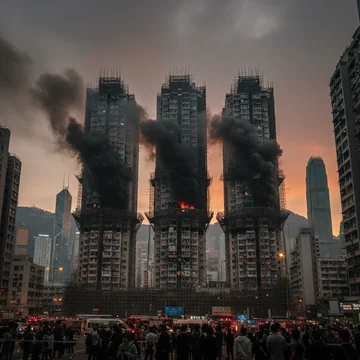
A devastating fire at the Wang Fuk Court housing complex in Hong Kong's Tai Po district has claimed at least 128 lives, making it the deadliest fire in Hong Kong in over 60 years. The tragedy has sparked widespread grief, investigations into possible corruption, and questions about building safety standards.
What Happened at Wang Fuk Court?
On November 26, 2025, at approximately 2:51 PM local time, a fire broke out at Wang Fuk Court, a government-subsidized housing estate in Tai Po, New Territories. The flames quickly spread across multiple high-rise buildings, engulfing bamboo scaffolding and green safety netting that had been installed for ongoing renovation work.
The fire was initially classified as a No. 1 alarm but was rapidly escalated to the highest level, No. 5, by 6:22 PM as the blaze spread uncontrollably. Firefighters battled the flames for nearly two days before bringing it under control on November 28.
Death Toll and Casualties
As of November 28, 2025, authorities have confirmed:
- 128 deaths including one firefighter, 37-year-old Ho Wai-ho
- 79 people injured
- Over 200 people still missing
Officials have warned that the death toll may continue to rise as search and rescue operations continue. Nearly 40% of Wang Fuk Court's 4,600 residents were aged 65 or older, according to the 2021 census, which may have contributed to the high casualty count.
What Caused the Fire to Spread So Quickly?
Several factors contributed to the rapid spread of the fire:
1. Bamboo Scaffolding and Green Netting
The eight buildings were undergoing major renovations that began in July 2024. All towers were wrapped in traditional bamboo scaffolding and flammable green safety netting. Once ignited, these materials allowed flames to shoot up the exterior of buildings and spread to adjacent blocks within minutes.
2. Sealed Windows with Polystyrene
Windows throughout the complex had been sealed with highly flammable polystyrene (styrofoam) material for more than a year as part of the renovation work. This material accelerated the fire's spread and trapped residents inside.
3. Dry Weather Conditions
Hong Kong was experiencing dry weather with relative humidity between 40-50% at the time. A Red Fire Danger Warning had been issued by the Hong Kong Observatory on November 24 and remained in effect on the day of the fire.
4. Strong Northeast Monsoon Winds
Strong winds during the northeast monsoon season helped fan the flames and carry burning debris to nearby buildings.
Emergency Response
The Hong Kong Fire Services Department deployed a massive emergency response:
- 128 fire trucks
- 57 ambulances
- 767 firefighters
This was only the second five-alarm fire since Hong Kong's handover to China in 1997, and the first since the Cornwall Court fire in 2008.
Arrests and Investigations
Authorities have launched multiple investigations into the tragedy:
Criminal Investigation
Three individuals, aged between 52 and 68, were initially arrested on suspicion of manslaughter. The number of arrests has since risen to eight people.
Corruption Probe
Hong Kong's Independent Commission Against Corruption (ICAC) has established a dedicated task force to investigate potential corruption linked to the HK$330 million (US$42.5 million) renovation project. Those arrested include:
- Two directors of the consulting firm overseeing the project
- Two project managers
- Three scaffolding subcontractors
- One additional individual
Government Response
Both Chinese and Hong Kong governments have responded to the disaster:
Chinese President Xi Jinping
President Xi extended condolences and allocated 2 million yuan (approximately US$282,470) through the Red Cross for emergency rescue and humanitarian assistance.
Hong Kong Government
Hong Kong Chief Executive John Lee Ka-chiu has:
- Ordered inspections of all public housing estates undergoing major renovations
- Established the "Support Fund for Wang Fuk Court in Tai Po" with HK$300 million (US$38.61 million) in initial funding
- Provided emergency subsidies of HK$10,000 (US$1,287) to each affected household
- Arranged temporary shelter for approximately 1,000 displaced residents in community facilities
The Bamboo Scaffolding Controversy
This tragedy has brought renewed scrutiny to Hong Kong's continued use of bamboo scaffolding in construction. While mainland China mandated metal scaffolding since the late 1990s, approximately 90% of scaffolding in Hong Kong remained bamboo-based as of 2003.
Notably, on March 17, 2025—just eight months before this fire—Hong Kong authorities announced plans to phase out bamboo scaffolding in favor of metal alternatives. Officials cited that bamboo deteriorates over time, has contributed to 23 scaffolding-related deaths since 2018, and is highly combustible.
Historical Context
The Wang Fuk Court fire is:
- The fourth deadliest fire in Hong Kong's history
- The deadliest since the Wing On warehouse fire in Shek Tong Tsui in 1948, which killed 176 people
- The deadliest fire in Hong Kong in over 60 years
FAQ: Hong Kong Fire
Where did the Hong Kong fire happen?
The fire occurred at Wang Fuk Court, a subsidized government housing estate located in Tai Po, New Territories, Hong Kong. The complex consists of eight high-rise residential towers built in 1983.
How many people died in the Hong Kong fire?
As of November 28, 2025, at least 128 people have died, including one firefighter. Over 200 people remain missing, and the death toll is expected to rise.
What caused the Hong Kong fire?
The exact cause is still under investigation. However, the fire spread rapidly due to flammable bamboo scaffolding, green safety netting, and polystyrene window seals that were part of ongoing renovation work. Dry weather and strong winds also contributed to the rapid spread.
Is the fire still burning?
No. The fire was declared under control at 10:18 AM on Friday, November 28, 2025, after burning for nearly two days.
Has anyone been arrested?
Yes. Eight people have been arrested, including directors and project managers from the consulting firm overseeing renovations, as well as scaffolding subcontractors. Investigations into potential corruption and manslaughter are ongoing.
How can I help the victims?
The Hong Kong government has established the "Support Fund for Wang Fuk Court in Tai Po" which accepts public donations to assist victims and affected families.
Will bamboo scaffolding be banned in Hong Kong?
Hong Kong authorities announced in March 2025 that they would begin phasing out bamboo scaffolding in favor of metal alternatives. This tragedy is likely to accelerate these efforts.
Conclusion
The Wang Fuk Court fire is a devastating tragedy that has exposed potential gaps in Hong Kong's building safety regulations and renovation oversight. As investigations continue, authorities and the public are calling for stricter safety standards and faster implementation of reforms to prevent such disasters in the future. Our thoughts are with the victims, survivors, and their families during this difficult time.