Google Finally Brings Desktop Mode to Pixel Phones — Years After Samsung Did It
Android Desktop Mode Finally Arrives on Pixel
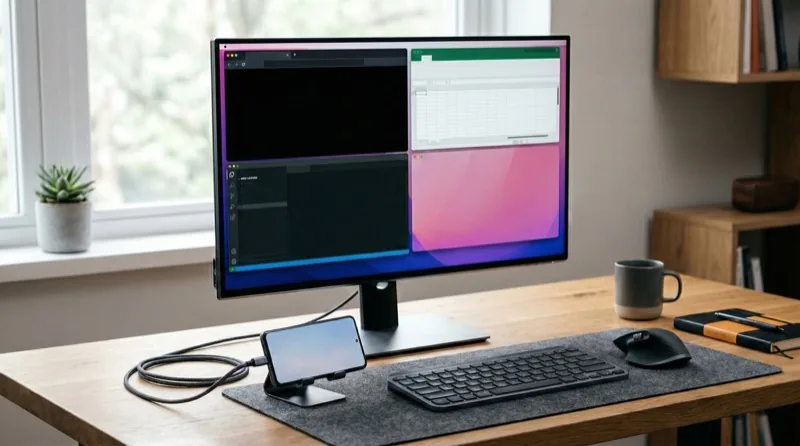
Google is rolling out a native desktop mode to Pixel phones as part of the March Pixel drop. The feature allows users with a Pixel 8 or newer to connect their phone to an external monitor via USB-C and get a "desktop-like multi-window experience" — complete with mouse and keyboard support.
The feature also works with the Pixel 9 Pro Fold, Pixel 10 Pro Fold, and the Pixel Tablet, which gets a separate "desktop windowing" feature for resizing and arranging overlapping windows.
Samsung Has Had This for Seven Years
If this sounds familiar, that is because Samsung launched Samsung DeX back in 2017 with the Galaxy S8. DeX turns Samsung phones into desktop-like computers when connected to an external display, offering resizable windows, a taskbar, and full keyboard and mouse support. It has been refined over seven generations of Galaxy flagships.
Google even acknowledged Samsung's head start. Last May, the company said it was working with Samsung to build on DeX, and started letting Pixel 8 users test desktop features in June 2025. The fact that it took Google nearly a year of testing — and seven years after Samsung shipped the feature — to bring this to Pixel says a lot about where Android desktop computing has been on Google's priority list.
What the Desktop Mode Actually Does
Google's announcement is notably light on details. There are no screenshots or images of the new desktop interface. What we know: you plug your Pixel into a monitor via USB-C, and you get a multi-window experience. You can use a mouse and keyboard. The Pixel Tablet version offers a "familiar interface to arrange and resize overlapping windows."
What we do not know: Does it support a taskbar? Can you resize windows freely? Does it work with all apps or just optimized ones? How does it handle phone notifications and calls while in desktop mode? Samsung answered all of these questions years ago with DeX.
Why It Matters (and Why It Might Not)
Desktop mode on phones has always been a compelling idea — carry one device that is both your phone and your computer. Samsung proved it works with DeX, but adoption has been limited. Most people who need a desktop computer just use a laptop. The phones powerful enough to run desktop mode well are flagships that cost $1,000+, at which point you could just buy both a mid-range phone and a Chromebook.
Still, for developers and power users who want a single-device setup, native Android desktop mode from Google means better app compatibility and broader ecosystem support than Samsung's proprietary implementation.
The Bottom Line
Google bringing desktop mode to Pixel is a welcome addition, but calling it innovative would be generous. Samsung shipped DeX in 2017. Google is shipping a less detailed version in 2026. The real question is not whether Android can run on a desktop — Samsung proved that years ago. It is whether Google can convince developers to optimize their apps for larger screens when Samsung, with its much larger user base, has struggled to do the same. Welcome to the party, Google. You are about seven years late.