Google Launches Deep Research and Deep Research Max on Gemini API for Paid Tiers
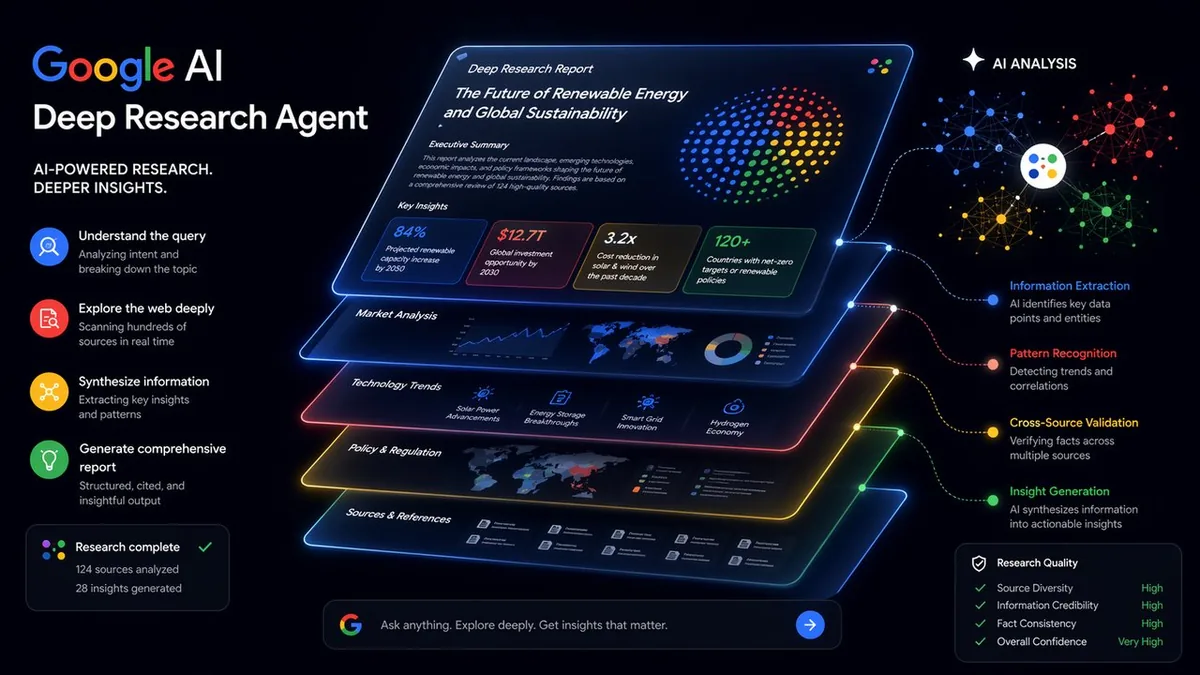
Google has launched two AI research agents — Deep Research and the more powerful Deep Research Max — through the Gemini API for paid tier subscribers. The dual-agent rollout replaces the December 2024 preview release of Deep Research and marks Google's formal commitment to AI-powered research as a commercial product category competing directly with OpenAI's research agents and Perplexity's Pro Search.
What Deep Research and Deep Research Max Can Do
Deep Research is designed to conduct multi-step research tasks autonomously — querying multiple sources, synthesizing information, and producing comprehensive reports with citations. The standard version handles moderately complex research tasks and is available on the base Gemini API paid tier. Deep Research Max, available on higher-tier API plans, handles significantly longer, more complex research workflows, processes larger document sets, and produces more detailed outputs with deeper cross-referencing.
Google says both agents are built on the Gemini 2.0 model family and use a "plan, execute, verify" architecture: the agent first outlines a research plan, executes web and document searches step by step, then verifies and reconciles conflicting information before producing a final synthesis. This differs from single-shot search summaries by explicitly modeling uncertainty and iterating on initial findings.
How It Competes With OpenAI and Perplexity
OpenAI offers its own Deep Research feature within ChatGPT Pro, which Google's product directly mirrors in naming and capability positioning. Google has been expanding its AI research tools across multiple products over the past year, but the Gemini API launch is the first time Deep Research has been made available to developers building third-party applications — a significant move that could embed Google's research AI in enterprise tools that currently use OpenAI's research agents.
Perplexity, which has built its entire product around AI-powered research and search, faces a more direct competitive threat. Google's combination of search infrastructure, Gemini model quality, and developer API distribution gives it structural advantages that pure-play AI search companies cannot easily replicate.
Pricing and Availability
Google has not published precise pricing for Deep Research Max, but Gemini API paid tiers start at $7 per million input tokens for Gemini 2.0 Flash. Deep Research tasks are billed on a per-query basis with costs varying by depth and length of the research task. Google confirmed that both agents are available globally from launch date for all API customers on paid plans, with no waitlist.
Frequently Asked Questions
What is Google Deep Research?
Google Deep Research is an AI agent that conducts multi-step research autonomously, querying sources, synthesizing information, and producing detailed reports with citations. It is available via the Gemini API on paid tiers.
What is the difference between Deep Research and Deep Research Max?
Deep Research handles standard research tasks, while Deep Research Max handles longer and more complex workflows, processes larger document sets, and produces more detailed cross-referenced outputs. Max is available on higher Gemini API pricing tiers.
Is Google Deep Research available to developers?
Yes. Both Deep Research and Deep Research Max are available via the Gemini API to all paid tier customers globally, with no waitlist, allowing developers to integrate Google's research AI into third-party applications.
The Bottom Line
Google's dual Deep Research launch is a serious escalation in the AI research agent market. By making these tools available via API — not just as a consumer feature — Google is positioning Gemini as the infrastructure layer for enterprise research automation. For OpenAI and Perplexity, the message is clear: Google is done ceding the AI search and research market without a fight, and its search data advantage makes it a formidable long-term competitor in this category.