Google Gemini AI Hits Millions of Vehicles via 12+ OEM Partnerships
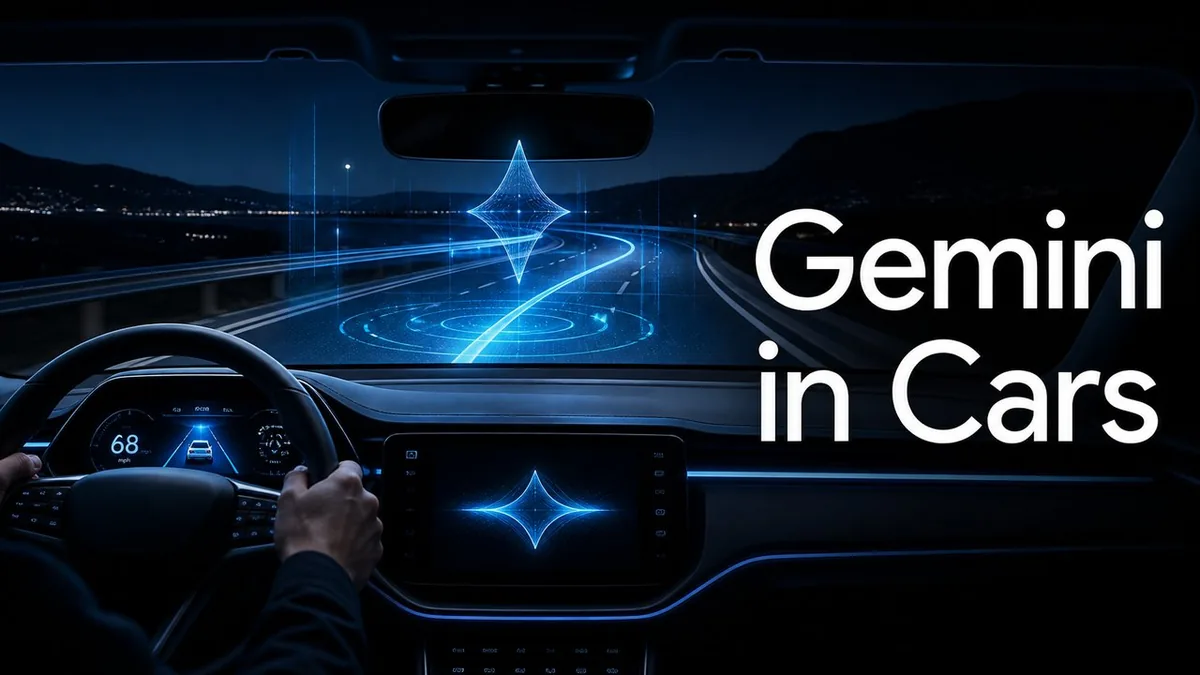
Google's Gemini AI assistant is shipping in millions of vehicles starting Q3 2026, replacing or supplementing Google Assistant in connected-car platforms across more than a dozen automakers. Confirmed launch partners include Mercedes-Benz, Volvo, Polestar, Renault, Honda, Acura, Ford, Nissan, Hyundai, Kia, Mahindra, and Tata Motors — covering both luxury and mass-market segments.
The integration is deeper than typical voice-assistant integrations: Gemini will run as the in-car AI layer for navigation context, vehicle controls, and a new category Google calls "drive assistant" — where Gemini understands the actual driving context (route, traffic, schedule, vehicle state) and proactively offers help.
What "Gemini in cars" actually does
Three product layers, per Google's launch materials:
Voice replacement. Gemini takes over from Google Assistant for voice commands — playback control, navigation requests, climate adjustments, calling, messaging. The conversational quality is meaningfully better than legacy voice assistants; multi-turn questions actually work.
Context-aware proactive assistance. Gemini reads the vehicle state and surroundings via the car's sensor data + the connected services. It can say things like "you're 20 minutes from your dinner reservation but traffic is heavy — should I call ahead?" — without being asked. The tier of intelligence here is genuinely new.
Multi-modal interaction. Where the vehicle has interior cameras (most luxury OEMs), Gemini can see and respond to gestures, gaze direction, and visual context. "Find me a charging station" with a glance at the dashboard battery gauge becomes a one-step interaction.
The competitive landscape
Apple's parallel strategy — CarPlay Ultra with Apple Intelligence — has been delayed and seems unlikely to ship before 2027. Tesla's voice assistant remains internally developed and isn't a Gemini competitor. Amazon Alexa Auto exists but adoption has been thin outside Amazon's own Ring/Echo ecosystem cars (Rivian, BMW limited).
Gemini's broad OEM partner list gives Google effective de facto dominance in the in-car AI assistant category, at least until Apple ships. The strategic implication: Google's data moat in maps, voice queries, and search behavior extends to a new domain (driving context) where it previously had limited presence.
The data and privacy dynamics
Gemini in cars accesses vehicle telemetry, location data, conversations, and (where cameras exist) interior visual data. The privacy framework Google published explicitly says: voice conversations are processed in encrypted cloud sessions, vehicle telemetry stays on-vehicle except for diagnostic events, and visual data from interior cameras is processed locally by default with cloud opt-in for specific features.
Whether OEMs and consumers actually verify these promises is the open question. The recent regulatory pressure on automotive data brokering — the FTC has been investigating six OEMs for selling driver data — gives Google an incentive to be visibly clean. Whether they actually are, only time and regulatory inspection will reveal.
My Take
Google quietly winning the in-car AI category is one of the more important strategic events of 2026 because it's a 10-year platform play. Cars are 10-15 year purchases; whoever owns the AI layer in cars sold in 2026-2028 owns those passengers' AI mindshare through 2035-2040. Apple's delay is going to look strategically catastrophic in retrospect — they had the brand and the integration story; they shipped it slow. The interesting second-order effect is on Tesla. Tesla's internally-developed voice assistant is significantly worse than Gemini, and Tesla doesn't have an Android Auto / CarPlay equivalent that Gemini-in-other-cars makes appealing. As consumers experience Gemini in their friend's Hyundai, Tesla starts to feel like the one car that doesn't have the AI feature you want. That's a slow-burn brand erosion that probably accelerates through 2027. Watch whether Tesla licenses Gemini directly — would be a major strategic concession but the alternative is increasingly worse.
FAQ
When does Gemini ship in my car? Q3 2026 for new model-year vehicles from confirmed partners. Existing vehicles with Android Automotive may get OTA updates earlier; legacy CarPlay/Android Auto integrations don't get the full Gemini experience.
Does this require a Google subscription? Standard Gemini in-car features are free; advanced features (multi-modal, deeper proactive assistance) require Google One AI Premium or equivalent OEM-bundled subscription.
What about non-partnered automakers? Gemini is available as a standalone app on Android Auto / CarPlay, but with the limited integration of any third-party app. Full vehicle integration requires the OEM partnership.
The Bottom Line
Google ships Gemini AI assistant across millions of vehicles via deep partnerships with 12+ automakers. Apple's CarPlay Ultra delay means Google has an effective monopoly in deep in-car AI integration through at least 2027. Watch the competitive responses from Tesla and Apple.