Google Earth AI Is Now Predicting Disease Outbreaks Before They Happen
From Satellites to Stethoscopes
Google has quietly built one of the most ambitious public health tools in existence. Google Earth AI — the company’s planetary intelligence platform — is now being used to predict disease outbreaks, map vaccination gaps, and forecast clinic utilization across multiple continents. The system combines satellite imagery, population dynamics models, weather data, and local health records to anticipate health crises weeks or months before they happen.
This is not a research paper or a concept demo. Earth AI is already operational with partners including the WHO Regional Office for Africa, Mount Sinai, Boston Children’s Hospital/Harvard, the University of Oxford, and the Victor Chang Cardiac Research Institute in Australia.
What Earth AI Actually Does
Earth AI is powered by two core technologies: the Population Dynamics Foundation Model (PDFM) and Mobility AI. These models analyze how populations interact with environmental factors — weather, air quality, flooding, geography — using decades of research that models the physical world.
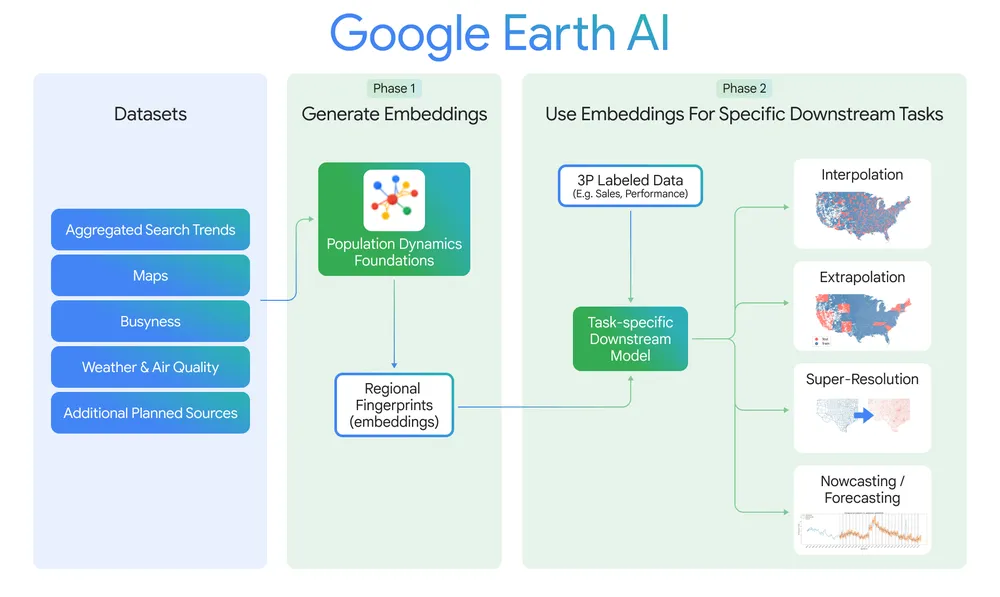
When combined with local health data, the system can:
- Predict cholera outbreaks — by combining weather forecasting with population dynamics, Earth AI improved cholera case prediction accuracy by over 35% compared to standard models, working with the WHO
- Forecast dengue fever — University of Oxford researchers used Earth AI to significantly improve six-month dengue forecasts in Brazil, giving local authorities more time to implement preventive measures
- Map vaccination gaps — researchers at Mount Sinai and Boston Children’s Hospital used PDFM to produce “superresolution” vaccination coverage estimates, mapping rates down to the ZIP-code level to identify undervaccination clusters
- Predict clinic utilization — in Malawi, Google.org grantee Cooper/Smith combined Earth AI with local data to predict health service demand at local clinics
The Skeptical Take
Let’s be clear about what this is: Google is building a global health surveillance infrastructure powered by satellite imagery and population tracking. The public health benefits are real — predicting cholera outbreaks before they happen could save thousands of lives. But this is also Google extending its data collection apparatus into healthcare under the banner of humanitarian good.
The privacy implications are significant. Even though Google emphasizes “privacy-preserving, aggregated data,” the underlying capability — tracking population movements and health patterns at sub-ZIP-code granularity — is exactly the kind of infrastructure that could be repurposed for less noble ends. Today it maps vaccination gaps. Tomorrow it could map anything else about populations that someone with access to the data wants to know.
Why It Matters
The traditional approach to public health is reactive — wait for an outbreak, then respond. Earth AI’s approach is predictive: use environmental and population data to forecast where health crises will emerge and allocate resources before they are needed. If the 35% improvement in cholera prediction accuracy holds across other diseases and regions, this could fundamentally change how global health organizations operate.
The question is whether we are comfortable with Google being the entity that holds the keys to this capability — and whether the public health benefits outweigh the surveillance infrastructure it requires.