Global AI Arms Race Accelerates as Nations Race to Build Autonomous Weapons Systems
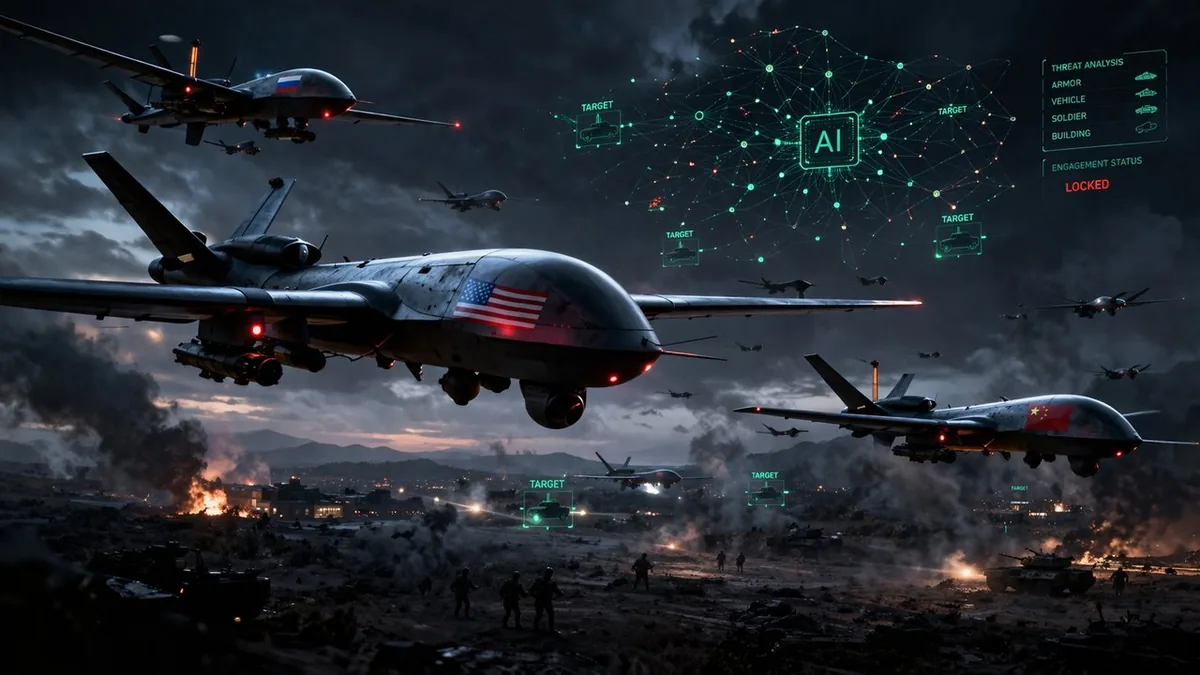
The United States, China, and Russia are accelerating the development of AI-backed autonomous weapons systems, with each nation pursuing a different strategic vision for how artificial intelligence should be integrated into military decision-making, the New York Times reported. The arms race is not theoretical — military drones with AI-assisted targeting are already deployed in active conflict zones, and major powers are investing billions in systems that can identify, track, and engage targets with reduced or no human authorization. The convergence of large language models, computer vision, and autonomous hardware is creating a new category of weapon that challenges existing international law and military ethics frameworks.
The Three-Power AI Weapons Race
The United States military's approach to AI weapons prioritizes keeping humans "in the loop" for lethal decisions, at least officially. The Department of Defense's AI principles require meaningful human control before any autonomous weapon is authorized to engage. In practice, the speed advantage of AI-enabled systems is creating pressure to relax these constraints — a drone swarm responding to incoming threats in milliseconds cannot wait for human authorization. The Pentagon is investing heavily in AI-assisted logistics, targeting intelligence, and command-and-control systems, with the Joint Artificial Intelligence Center serving as the coordinating body across services.
China's military AI program is more centralized and less constrained by the public accountability pressures that shape US policy. The People's Liberation Army has integrated AI into its surveillance infrastructure, drone programs, and command systems, with particular emphasis on compute-intensive sensor fusion and battlefield awareness applications. Russia, despite its more limited semiconductor access following export controls, has deployed AI-assisted targeting in Ukraine through its Lancet loitering munitions program, demonstrating that military AI advantage does not require frontier hardware — optimized algorithms on existing hardware can deliver operational capability.
Why This Matters Now
The AI weapons race is reaching a point of irreversibility. Once autonomous targeting systems prove their military effectiveness in combat — as they already have in limited forms — the incentive for any nation to constrain its own programs without reciprocal international agreement is negative. The UN has been discussing a treaty on lethal autonomous weapons systems (LAWS) for over a decade without agreement, largely because the major military powers are unwilling to constrain capabilities they are simultaneously racing to develop. The International Committee of the Red Cross has warned that AI weapons that cannot distinguish combatants from civilians violate existing international humanitarian law — a concern that becomes acute as systems are deployed in urban conflict environments.
Frequently Asked Questions
What are AI autonomous weapons?
AI autonomous weapons are military systems that use artificial intelligence to identify, track, and engage targets with reduced or no human authorization. They include AI-assisted drones, autonomous loitering munitions, and AI-enabled targeting systems integrated into existing weapon platforms.
Are AI weapons being used in real conflicts?
Yes. AI-assisted drone systems have been deployed in active conflicts, including Russia's Lancet loitering munitions in Ukraine and various drone programs in the Middle East. Fully autonomous engagement without human authorization remains more limited but is technically feasible.
Is there international law governing AI weapons?
Existing international humanitarian law requires that weapons be capable of distinguishing between combatants and civilians. The UN has discussed a specific treaty on lethal autonomous weapons for over a decade without agreement, as major military powers have been unwilling to constrain their programs.
The Bottom Line
The global AI arms race is the most consequential and least publicly discussed application of the technology that is simultaneously reshaping commerce, medicine, and culture. The decisions being made now — about how much human control to require, what targeting constraints to impose, and whether international agreements are achievable — will determine whether AI weapons become a stabilizing force through deterrence or a destabilizing one through lowered thresholds for conflict. The history of arms control suggests that constraints are easiest to negotiate before capabilities are proven; the window for meaningful international agreement on AI weapons may be closing.