German Chancellor Merz Pushes EU to Deregulate AI Amid Global Race
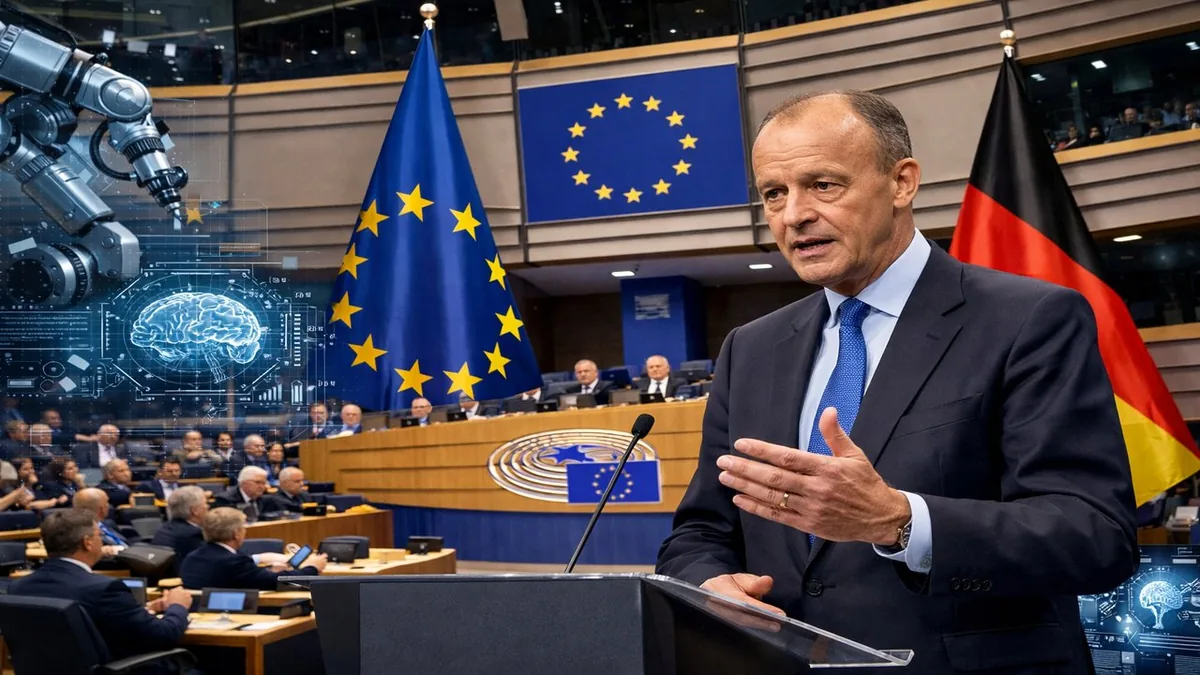
German Chancellor Friedrich Merz has called on European Union leaders to substantially deregulate AI development, arguing that the bloc's existing AI Act framework risks making Europe structurally uncompetitive with the United States and China in the race for AI leadership. Speaking at an industry summit, Merz described the current regulatory posture as "existentially dangerous" for European tech ambitions.
Merz's Core Argument
The Chancellor's position centers on the compliance burden imposed by the EU AI Act on general-purpose AI systems — requirements around transparency, risk assessment, and training data documentation that Merz argues are disproportionately costly for European startups compared to their American and Chinese counterparts. He specifically called for a two-year regulatory freeze on enforcement for AI systems below a certain capability threshold, giving European companies time to scale before facing full compliance requirements.
Europe's AI Competitiveness Problem
Merz's intervention comes as data consistently shows Europe falling further behind in AI model development, compute investment, and AI startup formation. Despite strong research talent and a large enterprise customer base, European AI companies have struggled to attract the capital concentrations needed to train frontier models. The continent's top AI companies — Mistral (France), Aleph Alpha (Germany) — operate at a fraction of the scale of OpenAI, Anthropic, or Google DeepMind.
Reactions from Other EU Members
Merz's proposal received a cautious reception from other EU member states. France and the Nordic countries signaled openness to targeted adjustments, while advocacy groups in Germany itself pushed back on the idea of weakening AI safeguards that they argue protect citizens from discriminatory and opaque automated systems. The European Commission is expected to respond with a formal review of AI Act implementation timelines in the coming months.
The Bottom Line
Merz's AI deregulation push reflects a real and growing tension at the heart of European AI policy: the desire to protect citizens from AI harms versus the competitive urgency to participate meaningfully in the global AI race. How the EU resolves this tension in the next 18 months will likely determine whether Europe can build any sovereign AI capability at scale.
Related Articles
- AI Chip Export Controls: Understanding the BIS Bottleneck
- AI Researchers Returning to China from the US