GameStop Preparing Takeover Bid for eBay — At 4x Its Own Market Cap
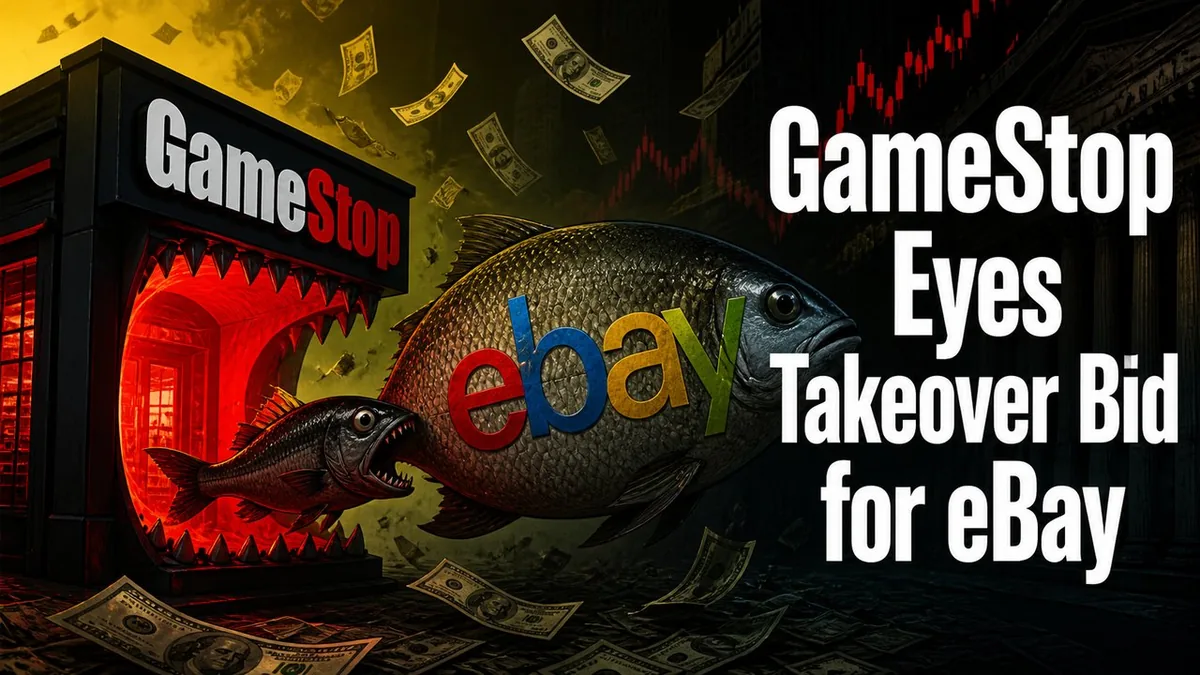
GameStop is preparing a takeover offer for eBay, despite the e-commerce marketplace having a market capitalization roughly four times larger than GameStop's own. The Wall Street Journal first reported the story yesterday, citing people familiar with GameStop's deliberations. The deal — if pursued — would be one of the most audacious M&A attempts of the decade and a strategic stretch that bears the unmistakable fingerprints of Ryan Cohen, GameStop's chairman and largest individual shareholder.
The numerical gap alone makes the proposed transaction extraordinary. GameStop's market cap stands at roughly $9.2 billion as of yesterday's close. eBay's market cap is approximately $36 billion. For a smaller-cap acquirer to buy a larger-cap target requires a meaningful capital raise, premium financing, or a carefully-structured stock-and-cash arrangement — none of which has been disclosed. The WSJ reporting describes the deal as "early stage" and "non-public," with GameStop's board and financial advisors evaluating multiple structures.
The strategic rationale GameStop is thinking about
The pitch — to the extent it can be reverse-engineered from GameStop's recent strategic communications — has three legs. First, eBay's secondary collectibles marketplace overlaps significantly with GameStop's specialty in trading cards, retro games, and physical collectibles. eBay is the dominant platform for high-value collectibles transactions; GameStop has been building its own collectibles infrastructure but has hit ceiling effects without a true marketplace product. Second, eBay's payment infrastructure (Adyen-powered, with $25B+ in processed volume per quarter) gives any acquirer a meaningful financial-services optionality that GameStop has been pursuing with limited success on its own. Third, combining the two retail bases — GameStop's gamer-collector audience and eBay's broader marketplace audience — creates cross-sell economics that justify some premium.
The argument against the deal is roughly that it doesn't actually solve GameStop's core problem. GameStop's original business — physical retail of new video games — is in structural decline, and acquiring eBay doesn't reverse that. eBay would deliver scale, but it would also deliver a complex marketplace business with its own structural challenges (Etsy and Amazon competition, persistent margin pressure, declining buyer cohort engagement). GameStop would be doubling down on physical commerce in an era when physical commerce is shrinking — a strategically questionable move regardless of the price.
The Ryan Cohen factor
Any analysis of this story has to account for Ryan Cohen's personal investment thesis and board influence. Cohen — the Chewy founder turned activist investor turned GameStop chairman — has spent four years building GameStop into a kind of operational holding company, with $4B+ in cash on the balance sheet, minimal capex commitments, and a willingness to deploy capital into ambitious M&A. His public statements over the past 18 months have hinted at "transformational" deals, and several smaller acquisitions have been folded into the GameStop platform.
An eBay bid fits the Cohen pattern — large, audacious, structurally surprising, with a coherent (if ambitious) operational thesis. Cohen has executed similar trades before, most notably the BBBY bond bet that, despite ending in chapter 11, demonstrated his willingness to make high-conviction directional plays. Whether this translates into a successful eBay acquisition is a separate question, but the strategic posture is consistent with Cohen's broader investment philosophy.
My Take
The honest read on this story is that the bid is more likely to fail than to succeed, but the analytical question is what GameStop gets from the attempt regardless of outcome. Three plausible scenarios. First, the bid succeeds at a premium — unlikely given the size mismatch and eBay's likely shareholder pushback. Second, the bid fails but generates strategic activist pressure on eBay's board to undertake operational changes — possible and probably the highest-EV outcome for GameStop's shareholders. Third, the bid is preliminarily explored but never formally launched — most likely if the financing structure proves harder than anticipated.
The deeper signal here is that the legacy retail M&A landscape is becoming more chaotic, not less. Activist-driven, founder-led, hedge-fund-aligned bids are increasingly being made for strategically-stretched targets in declining categories. GameStop bidding for eBay is one example; we're likely to see more such attempts as legacy retail capital structures look for transformative options that pure-play strategic acquirers won't pursue.
For eBay shareholders, the practical takeaway is that the takeover speculation alone provides upward pressure on the stock — premium speculation typically adds 5–15% to a target's price during the deliberation phase. Holders should watch the next 30–60 days for either formal offer disclosure or a clean rejection from GameStop, both of which would clarify the trade.
What this means for retail M&A
Three implications. First, expect more cross-tier retail M&A attempts as the category continues to consolidate under structural pressure — Macy's, Kohl's, and Bed Bath & Beyond's successor companies are all candidate acquirers or targets in scenarios with similar tier-mismatched dynamics. Second, expect activist pressure on eBay specifically regardless of GameStop's eventual move — the speculation will catalyze parallel campaigns from other activists. Third, expect GameStop's stock to face heightened volatility as the eBay narrative plays out — both upside (deal succeeds, transformative scale) and downside (capital raise dilution, governance complexity) tail outcomes are real.
Frequently Asked Questions
How big is the size mismatch?
GameStop's market cap is roughly $9.2 billion. eBay's is approximately $36 billion. GameStop's bid would need to overcome a roughly 4x size gap, requiring meaningful capital raise, premium financing, or a carefully-structured stock-and-cash arrangement.
Has GameStop officially announced anything?
No. The Wall Street Journal reported the deliberations based on people familiar with the matter. GameStop has not publicly confirmed or denied the reporting.
What's Ryan Cohen's role?
Cohen is GameStop's chairman and largest individual shareholder. He is the most visible architect of the company's M&A strategy and has consistently signaled willingness to pursue large, audacious transactions.
Could the bid actually succeed?
Most analysts view it as low probability. The size mismatch, financing complexity, and likely eBay shareholder resistance create significant execution risk. The more likely outcome is that the bid catalyzes operational changes at eBay rather than completing a full takeover.
The Bottom Line
GameStop's reported eBay takeover bid is the boldest M&A speculation of 2026 so far. The size mismatch makes successful execution unlikely, but the strategic implications — for both companies and the broader retail M&A landscape — are real regardless of outcome. Watch the next 30–60 days for formal disclosure or rejection, and expect heightened volatility in both stocks during the deliberation phase.