Framework Is Building a MacBook Pro for Linux Users and the Timing Is Perfect
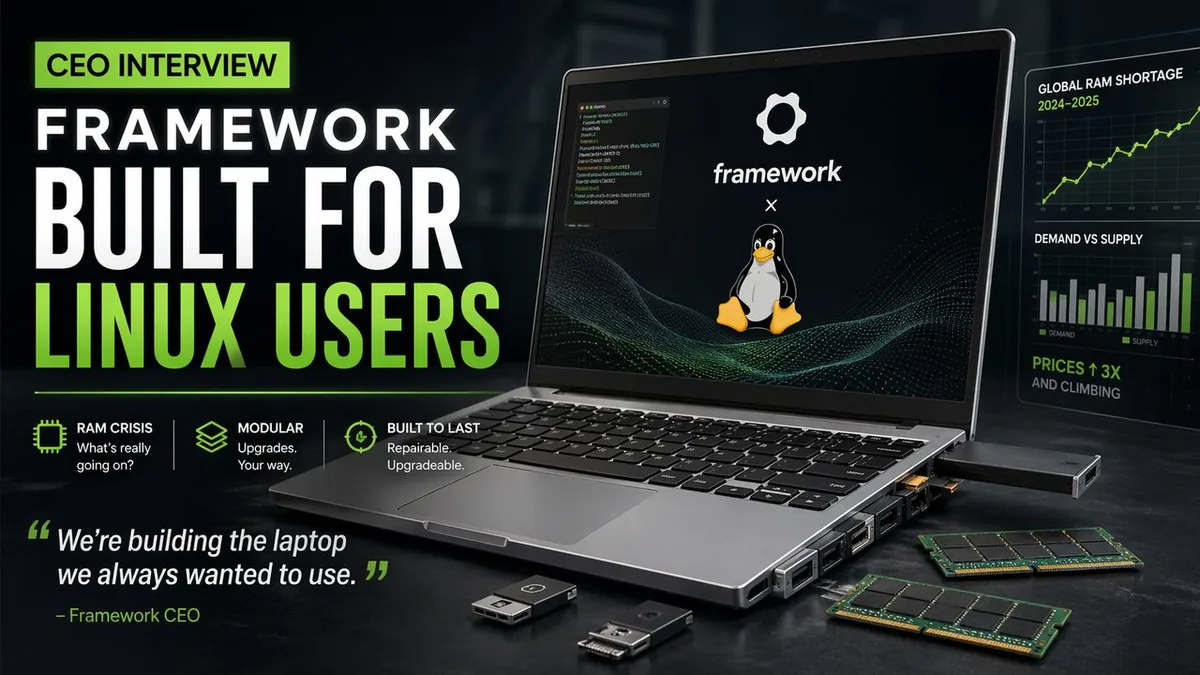
Framework has announced the Laptop 13 Pro — its most ambitious product yet and the company's first officially Ubuntu Certified laptop. Built around Intel's Core Ultra Series 3 processor, priced from $1,199 (DIY) to $1,699 (pre-built), and designed explicitly for the developer who wants a premium Linux machine that matches MacBook Pro build quality without MacBook Pro platform lock-in. According to Framework's own internal surveys, Linux users already outnumber Windows users on Framework laptops — 55% to 45%.
What Makes It Different
Ubuntu Certification is the headline feature that distinguishes the Laptop 13 Pro from Framework's existing lineup. Ubuntu Certified means Canonical has validated that Ubuntu runs fully and correctly on this hardware — no workarounds for sleep, no broken Wi-Fi drivers, no kernel parameter hacks required at install. For enterprise Linux deployments, Ubuntu Certification is often a procurement requirement. For individual developers, it means the OS works the way it should from day one.
The Laptop 13 Pro uses LPCAMM2 memory modules — a user-upgradeable format that Framework has been pushing as a replacement for soldered RAM. CEO Nirav Patel noted that Framework expects to have ample LPCAMM2 supply during the current shortage because the modules are harder to source elsewhere, meaning Framework's supply chain for this specific component is less contested than commodity LPDDR5.
The Market Framework Is Targeting
Framework's survey data is striking: more than half of their users are already running Linux. That is not an accident — Framework's modular, repairable design philosophy aligns with the values of the Linux community in ways that other hardware makers have not matched. The Laptop 13 Pro formalizes that relationship by making Linux the primary, officially supported operating system rather than a tolerated alternative.
The RAM Shortage Context
The announcement comes as Apple's Mac mini — the other popular Linux-adjacent developer machine — is going out of stock due to the global LPDDR5 shortage driven by AI infrastructure demand. Framework's decision to use LPCAMM2 rather than LPDDR5 gives it a supply advantage at exactly the moment when its natural competitor is unavailable.
My Take
Framework is doing something no major hardware maker has done: treating Linux users as primary customers rather than edge cases. The Ubuntu Certification, the repairability, the LPCAMM2 modularity — these are all signals that Framework is building for developers who have specific requirements, not consumers who want the path of least resistance. At $1,199, it is not cheap. But compared to a MacBook Pro that runs macOS and nothing else, it is a compelling alternative for the developer who wants premium hardware without the platform tax.
Related Articles
- Apple's Mac Mini Is Becoming Impossible to Buy and the Reason Is AI
- Ubuntu 26.04 LTS Is Out: What Is New in Resolute Raccoon