Epstein Files Expose EV Startup Funding Blind Spots
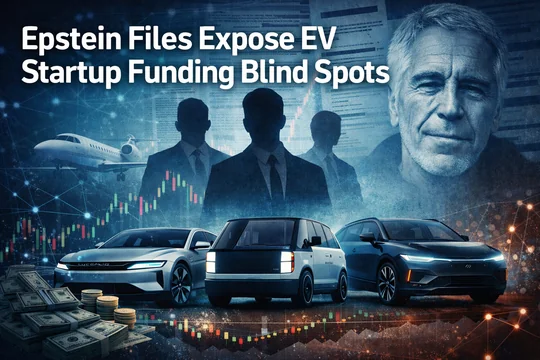
Epstein Files Reveal EV Startup Funding Blind Spots
Epstein files are giving journalists a rare look at how certain Silicon Valley relationships and deal pipelines operated behind the scenes.
The headlines are easy to guess: a notorious name, famous connections, and money moving around the edges of the tech world.
But the bigger story isn’t just “who knew who.”
It’s what these documents reveal about how EV startup funding really worked during the industry’s most chaotic, hype-driven years—and what today’s founders, investors, and operators should learn from it.
Key Facts (The Short Version)
The Justice Department released new documents connected to Jeffrey Epstein, and reporters found more links to Silicon Valley than many expected.
According to TechCrunch reporting and discussion on the Equity podcast, a businessman named David Stern developed a long-running relationship with Epstein and pitched him investments tied to multiple electric vehicle startups.
Those startups included:
-
Faraday Future
-
Lucid Motors
-
Canoo
The documents suggest Stern and Epstein discussed opportunities to invest during moments of fundraising pressure—when companies were vulnerable, valuations were unstable, and insiders were looking for fast capital.
Even more notable: Epstein ultimately did not invest in these companies. But the emails show the kinds of conversations happening in the background of major EV funding eras—after Epstein had already pleaded guilty in 2008.
Why This Matters (Even If You Don’t Care About the Drama)
If you work in tech, startups, or venture capital, the Epstein files aren’t just gossip.
They highlight three uncomfortable truths about how Silicon Valley has often worked:
1) “Reputation risk” is often treated like a PR problem
One of the most unsettling details is that many of these interactions happened after Epstein’s 2008 guilty plea.
That matters because it undercuts the convenient excuse of “people didn’t know.” They may not have known everything, but they knew enough to ask harder questions—and many didn’t.
For founders, this is a warning: when you accept money or access from questionable figures, you’re not just taking capital. You’re taking their baggage, too.
2) EV startup funding was a perfect playground for opaque dealmaking
EV startups (especially between 2014–2021) had a unique mix of:
-
massive capital needs
-
unclear timelines
-
extreme hype cycles
-
complex technology claims
-
limited public transparency
That creates an environment where “mysterious investors” can thrive.
Canoo is a good example from the reporting: early on, its backers were unclear until legal disputes surfaced later. That’s not just a Canoo problem. That’s a system problem.
3) The real product wasn’t always the vehicle—it was the exit
One quote from the discussion captures the vibe: it wasn’t about building companies, it was about making “the most money the fastest.”
That mindset is common in bubbles. But in EVs, it’s especially dangerous because these companies aren’t apps. They’re factories, supply chains, and safety-critical machines.
When the primary goal becomes flipping a stake instead of building a durable business, the entire industry gets weaker:
-
employees get burned
-
public trust drops
-
real innovation slows down
-
regulators step in later with a hammer
The Bigger Trend: The “Mobility Gold Rush” Had a Shadow Economy
Back then, “mobility” was treated the way people talk about AI today: as an inevitable future that everyone needed a piece of.
Automakers wanted partnerships. Investors wanted the next Tesla. Startups wanted billion-dollar valuations.
And when everyone is chasing the same narrative, the market becomes vulnerable to a shadow economy of dealmakers—people who operate through connections, secrecy, and leverage.
The Epstein files are one more proof point that Silicon Valley has long had two worlds:
-
The official world: press releases, pitch decks, and demo days
-
The unofficial world: introductions, backchannels, and “quiet capital”
The problem is that the unofficial world is often where the biggest ethical failures live.
What Happens Next: Likely Implications for Silicon Valley
This story probably won’t cause a single dramatic “collapse.” Silicon Valley is too decentralized for that.
But it may accelerate a few trends that are already underway.
More scrutiny on investor networks
Even if Epstein didn’t invest, the fact that his name appears in EV startup discussions will make people re-check:
-
who introduced whom
-
which intermediaries facilitated deals
-
how certain investors got access
This is especially true for funds and founders trying to raise institutional money today. Limited partners don’t want surprises.
Stronger pressure for startup due diligence
The phrase “startup due diligence” usually means checking the company.
But this story reinforces something else: investors and founders must also do due diligence on each other.
If you’re building a company meant to last 10+ years, the wrong money can become a long-term liability.
EV funding will continue shifting away from hype
The era of “raise first, figure it out later” is already fading.
EVs are moving toward a more grounded funding environment:
-
fewer mega-rounds
-
more manufacturing proof required
-
more attention to unit economics
-
more emphasis on credible operators
This is a good thing.
Practical Takeaways for Founders and Investors
If you want something useful from this story, it’s this: the EV bubble wasn’t only about technology. It was also about trust.
Here are a few grounded lessons:
-
Treat reputational risk like operational risk
If an investor can blow up your credibility, they can blow up your hiring, partnerships, and next round. -
Be suspicious of “mystery backers” and silent partners
If someone insists on secrecy, ask why. Then ask again. -
Watch for the “fast money” mindset
Anyone optimizing only for speed and return is likely to abandon the company the moment conditions change. -
Build a paper trail you’re not ashamed of
In a world of leaks, lawsuits, and FOIA releases, “private” rarely stays private forever.
Conclusion: The Epstein Files Aren’t Just a Scandal—They’re a Mirror
The Epstein files are disturbing for obvious reasons. But for the tech world, they’re also revealing in a different way.
They show how easily Silicon Valley’s funding machine can normalize proximity to unethical power—as long as it comes wrapped in money, access, and connections.
If there’s a forward-looking takeaway, it’s this:
The next era of EV startup funding won’t be won by the best hype artists. It’ll be won by the teams who build trust as deliberately as they build technology.
And yes, the Epstein files will likely keep surfacing uncomfortable names. But the bigger question is whether Silicon Valley will finally stop pretending it’s shocked.