Citadel Tells AI Doomers to Calm Down — But Who's Really Doing the Coping?
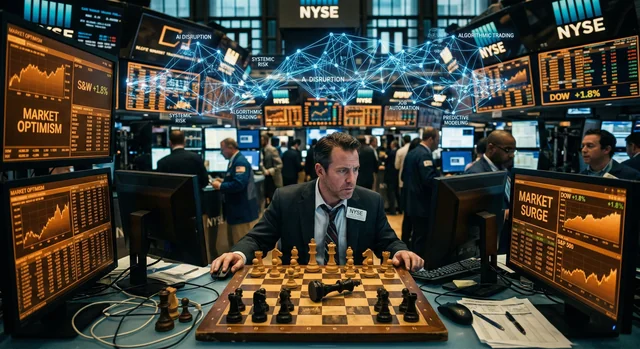
When a viral Substack essay warns that AI will obliterate the white-collar workforce by 2028, you'd expect the rebuttal to come from a tech optimist or an AI company. Instead, it came from Citadel Securities — one of the most powerful trading firms on Wall Street — and their argument is as much about economics as it is about ego.
The Viral Claim They're Fighting
Citrini Research published "The 2028 Global Intelligence Crisis" on Substack, painting a picture of AI-driven mass unemployment and economic collapse. It went massively viral. The thesis: AI's recursive self-improvement will compound so fast that white-collar jobs will evaporate, aggregate demand will collapse, and we'll face an unprecedented economic crisis.
Citadel's Frank Flight calls this out directly, noting the irony that "the forward path of labor destruction can apparently be inferred with significant certainty from a hypothetical scenario posted on Substack" — while the macroeconomic community can't even forecast payroll growth two months ahead.
Citadel's Counter-Argument: The Data Doesn't Support the Panic
Citadel lays out several data-driven rebuttals:
Software engineer jobs are rising, not falling. Indeed job postings for software engineers are up 11% year-over-year. If AI were about to replace coders, you'd expect the opposite.
AI adoption is stable, not exponential. St. Louis Fed data on AI usage at work shows "unexpectedly stable" trends. Daily AI use for work hasn't inflected upward — there's "little evidence of any imminent displacement risk."
Recursive tech ≠ recursive adoption. Technology diffusion follows an S-curve, not an exponential one. Early adoption is slow, growth accelerates, then plateaus as organizational costs, regulation, and diminishing returns kick in.
The compute cost ceiling. Here's the critical insight: if AI deployment expands rapidly, demand for compute rises, pushing up its marginal cost. If the marginal cost of compute rises above the marginal cost of human labor, substitution simply won't occur. This creates a natural economic boundary that the doomsayers ignore.
The Keynes Parallel
Citadel invokes Keynes' famous 1930 prediction that productivity growth would shrink the workweek to 15 hours. He was right about productivity but completely wrong about the outcome. Instead of working less, societies consumed dramatically more. "Keynes underestimated the elasticity of human wants," Citadel writes — and the same miscalculation may be happening with AI doom predictions.
The Skeptic's Take
Let's be honest about who's talking here. Citadel Securities is a market-making giant with every incentive to keep markets bullish and capital flowing. Their argument that AI won't disrupt much is also an argument that the current economic order — which makes Citadel very, very rich — will persist.
Their data points are legitimate, but cherry-picked. Software engineer postings rising 11% doesn't mean AI isn't reshaping work — it might mean companies are hiring engineers specifically to build the AI that will later displace other roles. And pointing to stable AI adoption curves ignores that we're still in the early innings. The S-curve argument works both ways: if we're at the bottom of the S, the acceleration phase hasn't even started.
The compute cost argument is the strongest point in the paper — but even that assumes energy and chip constraints won't be solved. Given the hundreds of billions pouring into data centers and energy infrastructure, that assumption deserves scrutiny.
The Bottom Line
Both sides are arguing from self-interest. Citrini's viral doom piece drives newsletter subscriptions. Citadel's rebuttal protects market confidence. The truth is probably somewhere in the middle: AI will reshape work profoundly, but the timeline and severity remain genuinely uncertain. What's notable is that the debate has escalated to the point where Wall Street's biggest firms feel compelled to respond to Substack essays. That alone tells you something about the anxiety in the system.