China's Humanoid Robots Are Outpacing the US — Shipping 36x More Units Than American Rivals
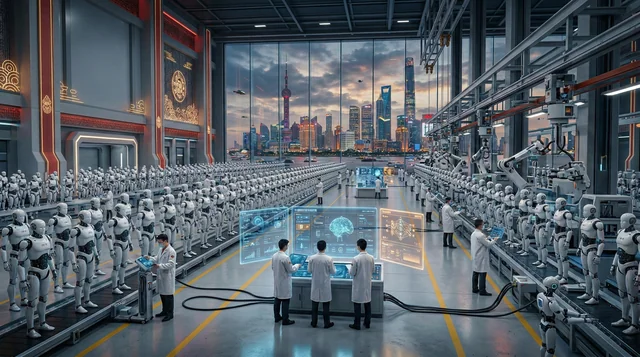
While American robotics companies are still polishing demos, China is shipping humanoid robots at scale. Chinese companies shipped roughly 36 times more humanoid robot units last year than U.S. rivals like Figure and Tesla combined — and the gap is only widening.
At this year's Spring Festival Gala, China's most-watched television event, humanoid robots performed kung fu flips for hundreds of millions of viewers. It wasn't just entertainment — it was a statement of industrial capability.
The Numbers Tell the Story
Global humanoid robot shipments totaled just 13,317 units in 2025, according to a Forbes report. That's a tiny base for an industry expected to nearly double annually and reach 2.6 million units by 2035. But the leaderboard is already clear: the top six humanoid robot makers by shipments are all Chinese — Agibot, Unitree, UBTech, Leju Robotics, Engine AI, and Fourier Intelligence.
China's Unitree alone was valued at around $3 billion after closing its Series C, with IPO ambitions that could push it to $7 billion. Galbot has raised more than $300 million, reportedly reaching a $3 billion valuation — one of the largest financings in China's humanoid robotics sector.
Why China Is Winning
"China has a more robust hardware supply chain — much of it built up through the EV sector, from sensors to batteries — and the world's strongest manufacturing base, allowing companies to iterate far faster than Western competitors," said Selina Xu, a China and AI policy lead at the office of Eric Schmidt, speaking to TechCrunch.
The advantages are structural. China's electric vehicle boom created a massive supply chain of sensors, batteries, motors, and precision components that robotics companies can tap directly. This means Chinese robots are not only cheaper to build but can move from prototype to production in a fraction of the time it takes American competitors.
The biggest shift has been from "demo-driven excitement" to "operations-driven adoption," according to Yuli Zhao, chief strategy officer at Galbot. "More customers are asking: Can the robot run stably in real environments and actually take work off people's plates?" Zhao told TechCrunch.
Government Strategy Meets Market Demand
Robotics was flagged as a priority under China's "Made in China 2025" plan, originally focused on factory automation. Now, rapid advances in multimodal AI are accelerating embodied AI — autonomous machines operating in the real world. Officials say this push could help offset China's looming labor shortages and drive productivity gains across manufacturing, services, and healthcare.
China is already targeting a mix of affordable mass-market models and high-end applications, rapidly expanding humanoids across industrial, consumer, and rehabilitation sectors.
Where America Still Has an Edge
The picture isn't entirely one-sided. When it comes to AI software and integrated systems, it's still unclear where Chinese humanoid firms truly stand. The industry is betting on vision-language-action models and "world models," but both technologies remain in early stages.
Nvidia currently leads the space with its end-to-end humanoid software stack, and most humanoid startups in China are powered by Nvidia's Orin chips. U.S. startup Foundation plans to build 50,000 humanoid robots by the end of 2027, showing American companies are getting serious about volume too.
The Race Is Just Beginning
With only 13,000 units shipped globally last year and a projected 2.6 million by 2035, the humanoid robot market is still in its infancy. But the early advantage belongs to China — not through any single breakthrough, but through the relentless industrial machine that turned the country into the world's EV leader and is now doing the same for robots.
The question isn't whether humanoid robots will become commonplace. It's whether American companies can close the manufacturing gap before China's head start becomes insurmountable.