China's AI Ambitions Are on a Collision Course With Its Job Market
The AI Superpower Paradox
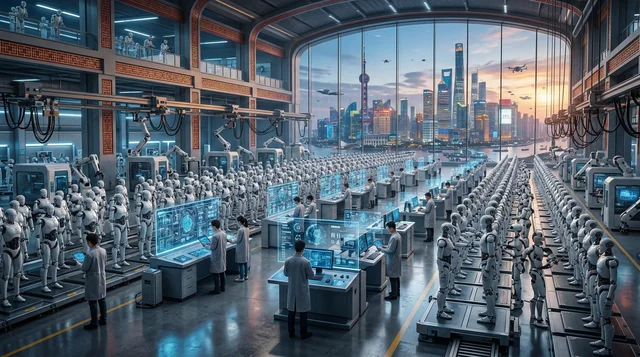
Days after back-flipping AI humanoids dazzled China during a New Year performance, a small research firm jolted US markets with a sobering warning: China's aggressive push into AI automation could trigger an economic spiral by displacing millions of workers in an already fragile employment market.
The numbers are staggering. Researchers from Peking University estimate that AI technology could displace up to 278 million Chinese workers by 2049 — roughly a third of the country's current workforce. A separate study puts 54% of all Chinese jobs at high risk of being substituted in the coming decades.
White-Collar Workers Are Not Safe Either
What makes this displacement wave different from previous automation cycles is that it is not just factory workers at risk. Generative AI's cognitive capabilities mean that white-collar professionals — accountants, analysts, customer service managers, even software developers — face displacement alongside manual laborers.
The regional inequality adds another layer of complexity. Well-educated urban workers in Beijing, Shanghai, and Shenzhen are more likely to access AI training and pivot to higher-end jobs. Workers in less-developed inland regions face much higher displacement risks, potentially widening the already significant income gaps between China's coastal cities and its interior.
Why This Matters Beyond China
China's consumer economy is already under strain. Youth unemployment has been a persistent problem, the property sector remains troubled, and domestic consumption has not recovered to pre-pandemic momentum. If AI automation accelerates job losses before new industries can absorb displaced workers, it could suppress consumer spending further — creating a deflationary spiral that would ripple through global markets.
This is the paradox Xi Jinping faces: China needs AI supremacy to compete with the United States, but achieving it too fast could undermine the domestic economic stability that sustains the Communist Party's social contract.
The Bottom Line
China's policymakers say they are acting to cushion AI's impact on employment while investing in human capital. But the pace of AI advancement is not waiting for policy to catch up. The country that figures out how to deploy AI automation without gutting its own consumer base will define the next economic era. China is not guaranteed to be that country — and the stakes of getting it wrong extend far beyond its borders.