Bithumb Wins Court Stay on South Korea 6-Month Suspension — Operations Continue Through Litigation
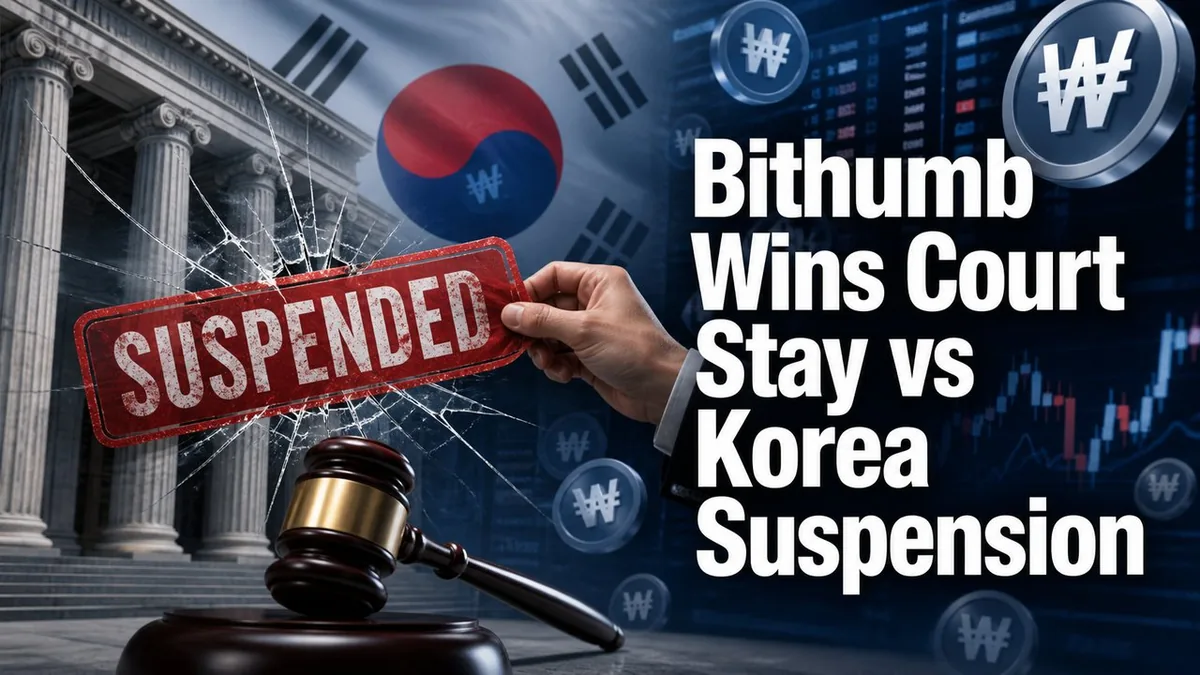
Bithumb has won an emergency court stay against a six-month operational suspension that South Korean regulators imposed last month, the country's largest crypto exchange announced this morning. The Seoul Administrative Court granted Bithumb's injunction in a ruling that effectively pauses the suspension while the underlying merits are litigated, a process expected to take 8–14 months.
The Financial Services Commission (FSC) had ordered Bithumb suspended in early April over alleged failures in its money-laundering and customer-verification controls, citing approximately 47,000 accounts with insufficient KYC documentation. The exchange disputed the FSC's specific findings and the proportionality of the six-month penalty, arguing that a full operational shutdown would impose disproportionate harm on more than 11 million Korean users versus the alternative of corrective measures during continued operation.
What the court actually ruled
The injunction is narrow in legal terms but commercially decisive. The Seoul Administrative Court held that Bithumb established a credible case that the FSC's penalty was likely disproportionate to the underlying violations, and that the operational and consumer harm from a six-month suspension would be irreversible if the underlying litigation eventually went in Bithumb's favor. This is a stay of enforcement, not a ruling on merits — the FSC's case proceeds, and Bithumb could still lose the underlying litigation and face the suspension after the appeals process.
For now, Bithumb continues to operate. New customer registration resumed yesterday afternoon. Withdrawal flows that had been throttled during the regulatory uncertainty are normalizing. Most importantly for the company's competitive position, the existing user base — which had been migrating in meaningful numbers to Upbit and Coinone — has slowed its rotation, with some accounts already reactivating.
The competitive context
Korean crypto exchange market share has been a tightly-contested four-way race for years: Upbit (roughly 65% pre-suspension), Bithumb (28%), Coinone (5%), and Korbit (2%). The April suspension order, even before it took effect, had pushed Bithumb's share down toward 18% as users hedged exit risk by migrating. The court stay is unlikely to fully reverse those flows in the short term — once users have set up alternative accounts, switching costs go both ways. But it stops the bleeding and gives Bithumb a chance to defend its position over the litigation window.
Upbit, which had been the primary beneficiary of Bithumb's troubles, will see its share growth flatten. Coinone and Korbit, which had been picking up smaller flows, lose their margin tailwind. The Korean retail trader behavior pattern has historically been highly responsive to perceived regulatory risk on exchanges, so the next 90 days will be a test of how durable the user migration was.
My Take
The pattern here is interesting and not specific to Korea: regulators issuing aggressive penalties against major exchanges, courts intervening to stay them, and the underlying disputes dragging on for 12+ months while operations continue. We've seen versions of this in the U.S. (Coinbase's various SEC fights), the UK (Binance restrictions and pushback), and now Korea. The common thread is that operational shutdown penalties are disproportionate enough that courts are reluctant to enforce them at scale, especially when the alleged violations are administrative rather than fraudulent.
That has a structural implication for crypto regulation: aggressive penalty postures are hard to sustain because courts add friction. Regulators have to either shift to monetary fines and operational remedies (which do get enforced) or accept that big-stick enforcement will be litigated for years. The expected value of "we'll suspend you" as a regulatory tool is dropping, which probably makes regulators rely more on civil penalties and license conditions going forward.
What this means for Korean crypto policy
Three things will shift over the next quarter. First, expect the FSC to tighten its administrative process for issuing operational penalties to make them harder to enjoin — this typically means more thorough documentation, more graduated steps, and clearer correlation between violation severity and penalty severity. Second, expect renewed legislative pressure from the National Assembly to give regulators clearer pre-suspension authority, which would limit court intervention in future cases. Third, expect Korean exchanges generally to invest aggressively in KYC and AML systems over the next 6 months, given that Bithumb's underlying KYC issues are still on the table even with the stay.
For Bithumb specifically, the next 12–14 months of litigation will determine whether it retains its #2 market position or settles into a longer-term decline. The court stay is necessary but not sufficient — if the underlying merits ruling goes against the company in early 2027, the suspension could still take effect and the rotation to Upbit would accelerate dramatically.
Frequently Asked Questions
Can Bithumb users withdraw their funds?
Yes. With the court stay in place, Bithumb is operating normally. Withdrawals had been throttled during the regulatory uncertainty but are now normalizing. Korean account holders should not face elevated withdrawal risk while the stay is active.
What happens if Bithumb loses the underlying case?
The six-month suspension would take effect after the appeals process is exhausted, likely in early-to-mid 2027. Bithumb would then face an operational shutdown unless additional appeals or settlement modify the outcome.
Why did regulators want to suspend Bithumb?
The FSC alleged that approximately 47,000 Bithumb accounts had insufficient KYC and AML documentation, in violation of South Korean financial regulations. Bithumb disputes the specific findings and the proportionality of a full six-month suspension as a penalty.
How long will the litigation take?
Korean administrative court timelines suggest 8–14 months for the merits ruling, with potential additional appeals extending the process beyond two years. The stay remains in place during this window unless modified by a higher court.
The Bottom Line
Bithumb's court stay is a meaningful tactical win, but the underlying merits case still threatens the exchange's operations through 2027. The Korean crypto regulatory environment is becoming more litigated, not less, and exchanges should expect to defend operational penalties in court as a routine part of doing business. Bithumb keeps its #2 position for now — whether it holds it through the litigation window depends on user trust and the eventual merits ruling.
Related Articles
- Canada Proposes Nationwide Crypto ATM Ban
- Celsius Founder Mashinsky Settles FTC Case
- Galaxy Digital Reports $216M Q1 Loss