Beyond the Cloud: Why Are We Talking About Putting AI Data Centers in Space?
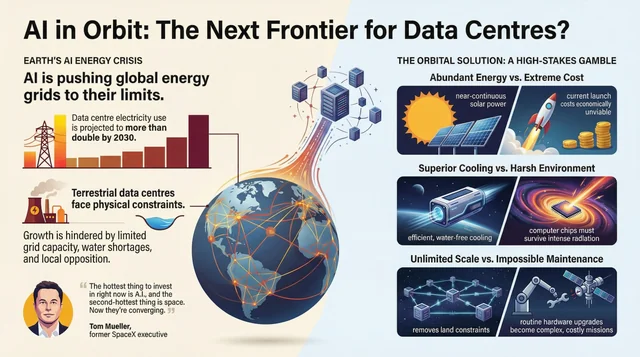
As artificial intelligence models approach planetary-scale energy consumption, their demands are skyrocketing, pushing our terrestrial infrastructure to its breaking point. This insatiable appetite is fueling a frenzy among tech leaders, creating an energy and resource crisis that the AI industry must confront. In response, a radical solution is gaining momentum, one that sounds pulled from the pages of science fiction: building the next generation of data centers in space. Companies like Google, in a partnership with Planet, are now seriously exploring running AI on vast constellations of satellites powered by the sun—constellations so large they could one day "be visible in the night sky like planets."
The Earthly Burden: Why Our Planet Is Pushing Back
The push toward orbit is a direct response to the severe and growing constraints of building and operating massive computing facilities on the ground. These terrestrial data centers are placing an unsustainable burden on our planet's resources.
An Insatiable Appetite for Power and Water
The scale of the problem is staggering, driven by the AI industry's need for ever-more computational power.
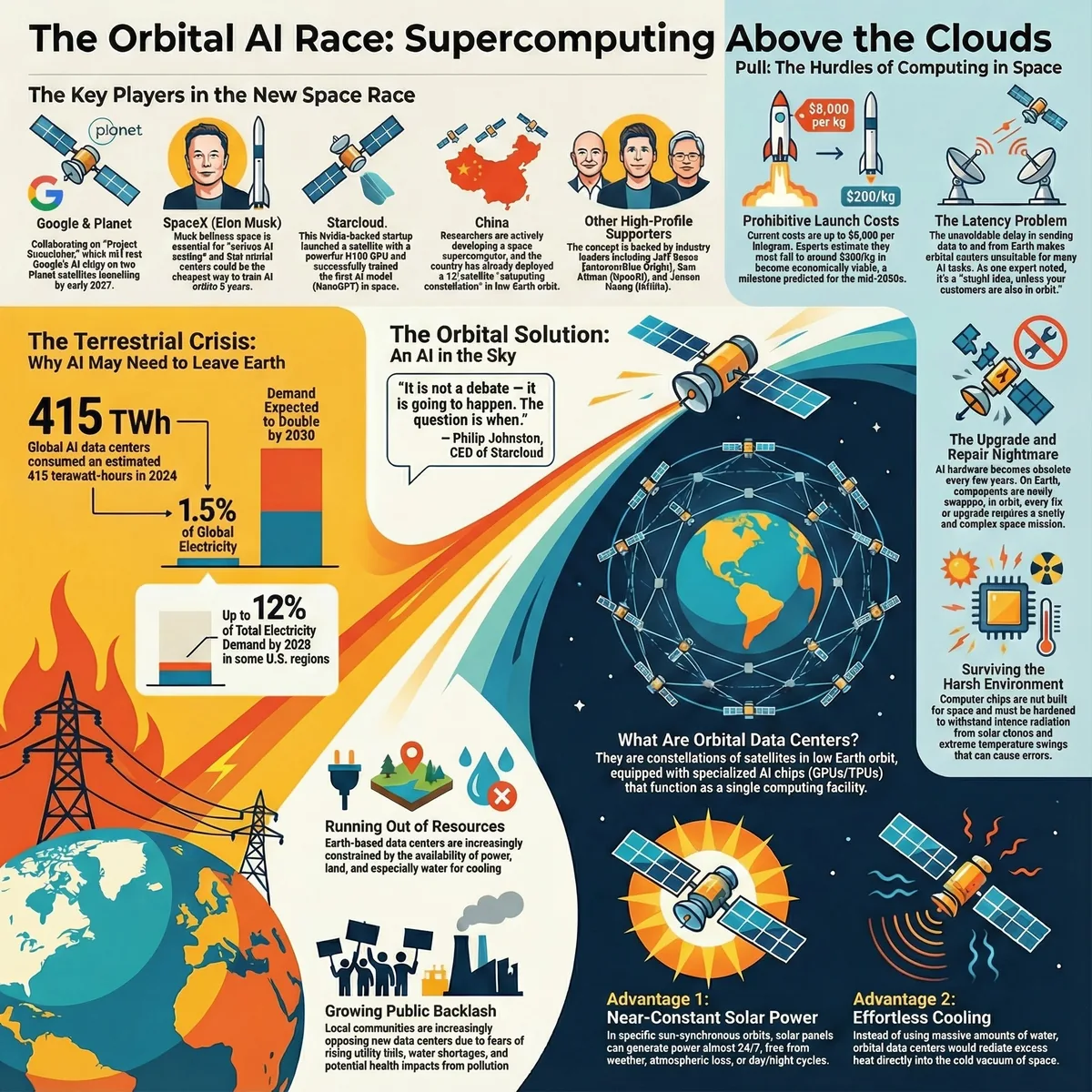
- Global Electricity Use: In 2024, data centers consumed an estimated 1.5% of total global electricity. Projections suggest this figure could more than double by 2030 as AI workloads surge.
- Grid Strain: The pressure on local power grids is immense. Utilities in some U.S. regions are already planning for AI-driven data centers to account for a staggering 6.7% to 12% of their total electricity demand by 2028.
- Cooling Demands: To prevent overheating, terrestrial data centers rely on water-intensive cooling systems. This is becoming a major constraint in a world facing increasing water shortages.
- Local Opposition: Communities are beginning to push back. Data center projects are facing fierce opposition, with residents near xAI’s massive facility in Memphis reporting "worsened symptoms and fear of pollution-linked illnesses since the facility began operating."
These earthly limits are forcing the technology industry to look skyward for an elegant, if ambitious, solution.
The Orbital Solution: Tapping the Sun and the Void
In theory, moving data centers into space neatly solves two of the biggest problems plaguing their terrestrial counterparts: power and cooling.
- Near-Constant Solar Power By placing satellite constellations in specific orbits, such as a sun-synchronous orbit, they can have nearly 24/7 access to solar energy. This avoids Earth's day/night cycles, atmospheric losses that reduce efficiency, and the limitations of aging terrestrial power grids.
- Effortless Cooling Instead of using precious water, the intense heat generated by computer chips would be rejected directly into the frigid vacuum of space through a process called radiative cooling. This solves a fundamental thermodynamic problem that constrains the density and power of data centers on Earth.
While the theoretical benefits are profound, engineers and scientists must first overcome a series of immense practical challenges.
Down to Earth: The Five Towering Challenges
Despite the elegant theory, experts are torn on the feasibility of orbital data centers. Critics argue that the concept flies in the face of physics and economics, presenting five critical challenges that must be solved.
- Astronomical Launch Costs The primary barrier is the sheer expense of lifting heavy equipment into orbit. Individual server racks can weigh over 1,000 kilograms. For the economics to become viable, experts estimate that launch costs need to fall dramatically, from the current range of ~2,000-8,000 per kilogram to around $200 per kilogram.
- The Tyranny of Latency The physical distance between an orbital data center and users on the ground creates an unavoidable communication delay, or latency. For most AI workloads that require near-instantaneous processing, this delay is a dealbreaker. As Joe Morgan, COO of data center infrastructure firm Patmos, bluntly puts it: "Putting the servers in orbit is a stupid idea, unless your customers are also in orbit."
- Impossible Repairs and Upgrades The AI industry is defined by "hardware churn," where powerful new chips make previous generations obsolete every few years. On Earth, swapping out a server rack is a routine task. In orbit, every repair or upgrade would require a costly and complex mission. This rapid obsolescence cycle means that the astronomical launch costs wouldn't be a one-time expense, but a recurring, multi-billion dollar operating cost just to keep the facility current. As Morgan asks, "Who wants to take a spaceship to update the orbital infrastructure every year or two?"
- The Harsh Environment of Space Electronics in orbit must be incredibly resilient. They need to survive the intense vibrations of a rocket launch and then operate reliably for years while being constantly exposed to radiation, solar storms, and extreme temperature swings.
- Cooling in a Vacuum There is a paradox to cooling in space. While space is a frigid minus 455 degrees Fahrenheit, it is also a vacuum. That means there is no air to transfer the heat from the A.I. chips. This requires orbital data centers to be equipped with large, complex radiator panels to disperse heat, adding to their weight and complexity.
Despite these hurdles, some of the most powerful organizations in the world are investing billions to turn this vision into reality.
The New Space Race: Who Is Building Our Future in Orbit?
As the AI race hits a fever pitch, a new competition is underway, but this time the finish line is in low-Earth orbit. This frenzy involves tech giants, ambitious startups, and entire nations, all vying to be the first to establish a computing foothold in space.
The competition is already producing historic milestones. The startup Starcloud, for instance, has achieved a remarkable first by launching a satellite carrying an Nvidia H100 GPU—a chip 100 times more powerful than any other that has ever been in outer space—and successfully training the first AI model ever in orbit. Meanwhile, China is pursuing a multi-pronged national strategy, with researchers at its Institute of Computing Technology (ICT) pushing for a 10,000-card orbital data center, even as another state-backed collaboration has already deployed the first computing constellation in space. The race is on.
|
Player/Entity |
Project/Initiative |
Key Detail |
|
|
Project Suncatcher |
Partnering with Planet to launch two demo satellites by 2027 to test their Tensor Processing Units (TPUs) in orbit. |
|
SpaceX (Elon Musk) |
Orbital Data Centers |
Believes this will be the cheapest way to train AI "not more than five years from now"; SpaceX’s CFO stated in a letter to shareholders the company would explore an IPO to fund these projects. |
|
Starcloud |
Starcloud-1 Satellite |
Has already launched its Starcloud-1 satellite with an Nvidia H100 GPU, which is 100 times more powerful than any prior chip in space, and successfully trained NanoGPT, the first AI model ever trained in space. |
|
China |
Space Supercomputers |
A collaboration between Guoxing Aerospace and Zhejiang Lab has already deployed a 12-satellite constellation, the first of its kind in space. |
|
Other Notables |
Various |
Jeff Bezos (Blue Origin) sees orbital data centers as potentially cheaper in "the next couple of decades." |
This intense competition raises a fundamental question: what is the ultimate purpose of this monumental effort?
The Ultimate Goal: An Escape Hatch for Earth or an Engine for Space?
There are two competing long-term visions for why we need data centers in space. These visions represent two distinct potential futures for humanity's relationship with technology and the cosmos.
Vision 1: Easing Earth's Burdens
This view argues that orbital facilities are primarily a release valve for our strained planet. By offloading "non-latency-sensitive" data processing workloads, we could directly address the terrestrial energy crisis. In this future, space could also serve as an ultra-secure, off-world vault for humanity's most critical "civilisational" data, protecting it from Earthly disasters.
Vision 2: Powering a Space Economy
The alternative perspective, championed by experts like Christophe Bosquillon, co-chair of the Moon Village Association’s working group for Disruptive Technology & Lunar Governance, is that space-based data centers are not for Earth at all—they are essential infrastructure for space itself. In this vision, orbital computing would form the backbone for a "data-driven lunar industry and the cis-lunar economy," handling everything from processing lunar sensor data to enabling autonomous navigation for a permanent human presence on the Moon.
A Sci-Fi Idea on the Launchpad
For now, space-based AI remains in the experimental, research-and-development phase. Yet it is an idea being driven forward by the very real and escalating pressures on Earth's energy, water, and land. The proposals from Google, SpaceX, and others are a direct symptom of an industry confronting the physical limits of our planet. Whether this sci-fi concept ever truly escapes Earth's gravity may ultimately depend less on technological breakthroughs and more on "how desperate the energy race becomes."