Baidu Robotaxi Outage Strands Passengers Across Wuhan in Mass Malfunction
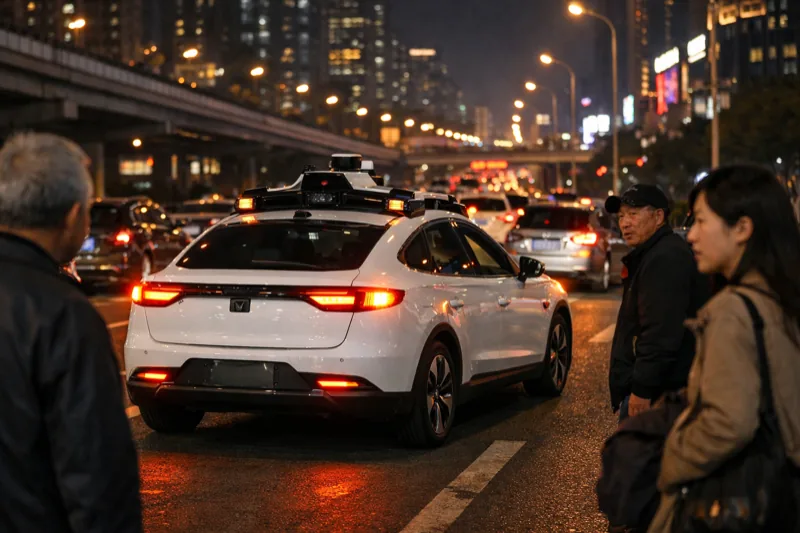
A mass system failure in Baidu's Apollo Go robotaxi fleet brought traffic in the Chinese city of Wuhan to a standstill on Tuesday, with at least a hundred self-driving cars freezing in the middle of roads and highways. Passengers were trapped inside vehicles for over an hour, and social media footage appeared to show the outage causing at least one highway collision.
What Happened in Wuhan
Local police confirmed that a "system malfunction" caused multiple Apollo Go vehicles to stop mid-traffic. Videos posted on Weibo showed rows of white robotaxis sitting motionless across intersections and highway lanes, hazard lights blinking while confused pedestrians and other drivers navigated around them. Police said no injuries were reported and all passengers eventually exited safely.
Baidu, which operates Apollo Go in dozens of cities across China, did not immediately respond to requests for comment. The cause remains under investigation.
A Pattern of Autonomous Vehicle Failures
This is not the first time self-driving fleets have experienced catastrophic technical failures. In December 2025, a major power outage in San Francisco caused Waymo taxis to shut down city-wide, creating massive traffic jams. Just months before that, an Apollo Go robotaxi carrying a passenger in Chongqing fell into a construction pit.
Jack Stilgoe, professor of science and technology policy at University College London, noted that while driverless tech "may be safer on average" than human drivers, this incident demonstrated it could "still go wrong in completely new ways." The simultaneous failure of an entire fleet is a risk category that simply does not exist with human-driven vehicles.
The Bigger Picture for Autonomous Vehicles
Baidu has been aggressively expanding Apollo Go, and in December 2025, both Uber and Lyft announced partnerships to test Apollo Go cars on UK roads. Those trials were expected to begin in 2026, pending regulatory approval — approval that incidents like this make significantly harder to obtain.
The Wuhan incident exposes a fundamental vulnerability in fleet-based autonomous driving: when the central system fails — much like how AI demand is disrupting other tech markets —, it does not just affect one car. It can disable an entire transportation network simultaneously, creating the kind of cascading urban chaos that regulators have long feared but rarely seen demonstrated at scale.
The Bottom Line
The promise of robotaxis has always been built on the argument that computers do not get tired, drunk, or distracted. But they can crash — not in the collision sense, but in the software sense — and when they do, the failure mode is fundamentally different. A hundred human drivers do not all freeze at the same moment. Until autonomous vehicle companies can guarantee fleet-level resilience, incidents like Wuhan will continue to erode public trust and slow regulatory progress worldwide.