Are Your Loading Zones Built for Speed, Safety, and Surprise Inspections?
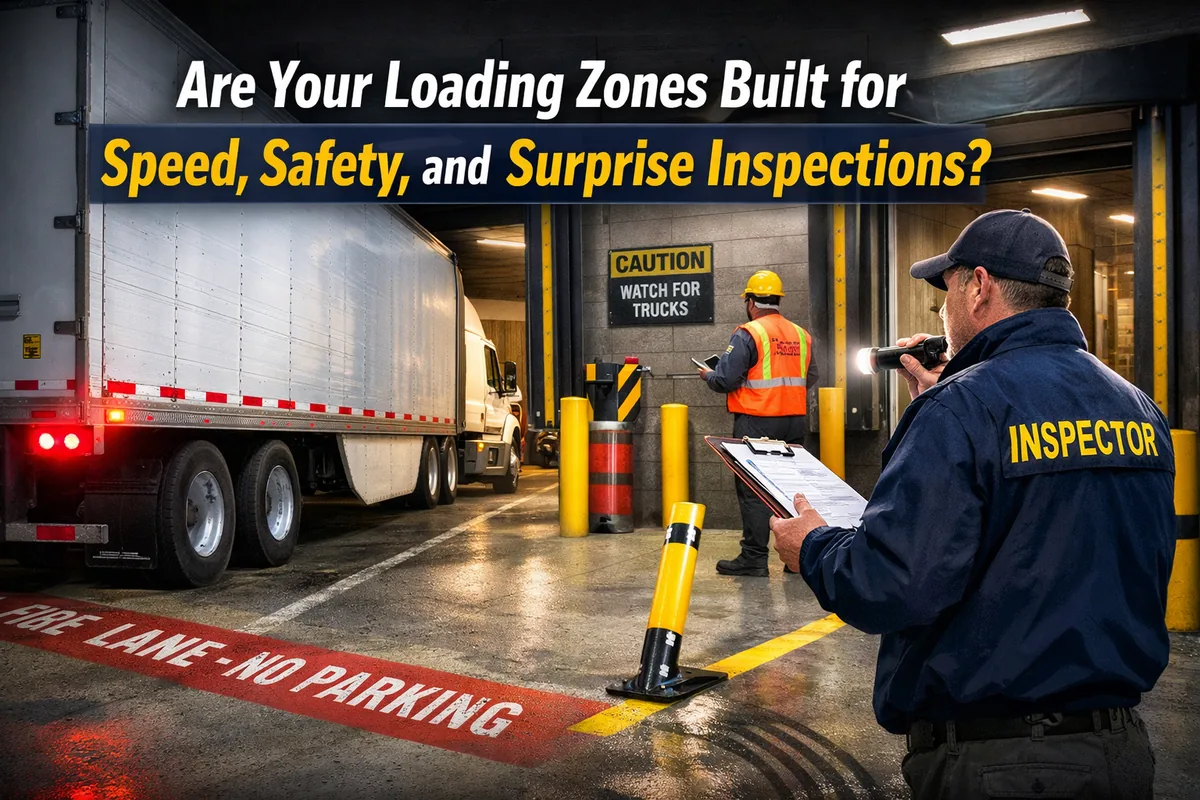
Every delivery shift depends on a loading zone that supports both speed and safety. When truck paths are unclear, barriers lack strength, or access points are bypassed during peak activity, delays and damage increase quickly. Facilities also face tighter appointment windows, higher trailer counts per day, and unannounced inspections focused on fire lanes and emergency clearance widths.
Facility and operations teams need freight to move steadily while doors, curbs, pedestrians, and required access routes stay protected. That requires barrier placement based on measured turning paths and queue depth, along with traffic-rated posts designed to handle contact without cracking the slab. Clear layouts and organized installation records make inspection reviews faster and reduce compliance risk.
High-Velocity Access Design
Trailer turning radii and dock approach angles define where fixed and movable barriers can be installed without disrupting flow. Before drilling into the slab, measure tire sweep, cab overhang, trailer off-tracking, and the straightening distance required on final approach. Queue stacking depth should reflect peak-hour volume, since short staging areas force abrupt braking and sharper steering inputs that reduce dock efficiency.
In high-traffic dock environments, a folding bollard is most effective near the apron when positioned outside the full tire swing envelope. If a single post sits too close to a turning path, it can trigger early braking, corrective backing, or low-speed contact with the base. Proper placement protects the overhead door track and adjacent pedestrian edge while maintaining a clear entry lane, allowing drivers to complete the final approach with fewer steering corrections and steadier cycle times.
Impact Resilience Standards
Traffic-rated steel bollards are designed to withstand repeated low-speed contact common at active dock faces. Trailers often creep, pivot, and crowd tight corners, placing sustained pressure on protective posts. Breakaway or controlled-flex designs limit force transfer into the slab, reducing the likelihood of cracked concrete, damaged door frames, and broken curb edges after minor impacts.
Mounting configuration carries equal importance. Base type, embedment depth, anchor diameter, and spacing must match slab thickness and reinforcement conditions. Inadequate embedment can lead to spalling, loose bases, and trip hazards following routine strikes. Hardware selected for predictable impact loads and matched to site conditions reduces structural damage and keeps dock positions operational with minimal repair disruption.
Inspection-Ready Layouts
Fire lane markings and required clearance widths must be visible from both the driver’s seat and pedestrian approaches. Reflective collapsible bollards help outline no-parking areas and door swing zones while allowing authorized access when lowered. Emergency paths should remain clear of pallets, carts, and staged freight, since obstructed routes draw immediate attention during compliance reviews.
Inspection readiness also depends on organized documentation. Product data sheets, load ratings, anchor specifications, and installation details should be accessible within minutes. Measured clearance dimensions and a simple dock layout plan prevent uncertainty when questions arise. Maintaining a dedicated file for each dock area supports faster walkthroughs and reduces the likelihood of follow-up corrections or citations.
Operational Downtime Control
Resettable and removable bollard systems reduce the time a dock position remains unusable after minor impacts or unauthorized access. A post that can be re-secured or replaced without cutting, welding, or slab repair allows the lane to return to service quickly. At high-volume doors, restoring a single blocked position prevents yard congestion and protects scheduled unloading windows from cascading delays.
Maintain a labeled spare-parts kit that includes lock cylinders, hinge pins, anchor hardware, and matching keys for each installed model. Verify that maintenance staff understand the reset procedure at every dock location. When small incidents can be handled internally, vendor calls are limited to structural damage, and receiving schedules remain stable during peak delivery cycles.
Smart Site Coordination
Camera placement and lighting should guide bollard positioning around dock doors and gate lines. Posts must remain visible within fixed camera angles so lowered or unlocked positions can be confirmed in recorded footage. Avoid blind spots near corners or stacked materials where barrier status becomes unclear. Clear alignment between hardware and surveillance supports reliable monitoring of access points.
Defined authority strengthens compliance across shifts. Assign responsibility for lowering or unlocking bollards and connect that authority to badge credentials or access logs. Keyed-alike cylinders reduce excess keys and discourage improvised entry. Video-supported access control keeps dock operations consistent as crews rotate.
High-performing dock areas depend on disciplined layout, durable hardware, and straightforward operating rules. Measured turning paths, adequate queue depth, and bollards positioned outside tire swing zones let trucks enter with fewer corrections and less idle time. Traffic-rated steel posts, slab-matched anchors, and controlled breakaway features limit concrete damage after low-speed contact. Marked fire lanes, documented clearance widths, and resettable systems support smooth inspections and faster recovery from minor impacts. Ongoing reviews of each dock position keep placements accurate, parts stocked, and access authority consistent across every shift throughout the entire operating week each year.